Answer: (D) (4) A is false but R is true.
Concept: In an Assertion–Reason item, first judge the Assertion (A) true or false, then the Reason (R), and only if both are true ask whether R tells why A is true.
Step 1 — Judge the Assertion.
A weak electrolyte is partly ionised, so it has some ions and allows a small current; a bulb in a circuit with acetic acid glows dimly. The statement 'weak electrolytes do not allow any electricity to flow' is therefore false.
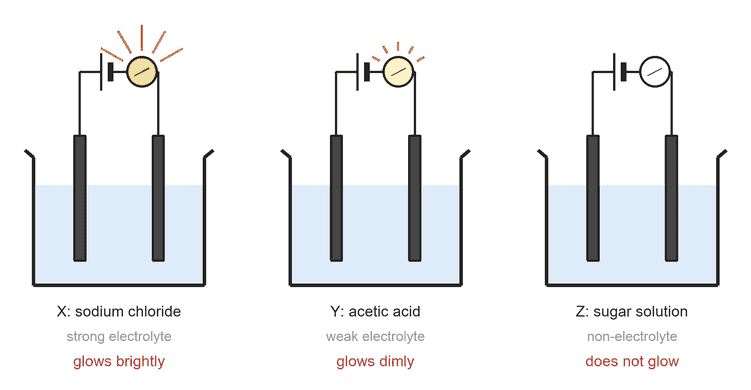
Step 2 — Judge the Reason.
Substances made only of molecules (non-electrolytes, such as sugar solution) do not allow current to flow. R is true.
Watch out: 'weak' means a small current, not no current.
Why the other options are wrong:
- (A) (1) Both A and R are true and R is the correct explanation of A: It treats A as true, but A is false.
- (B) (2) Both A and R are true but R is not the correct explanation of A: It treats A as true, but A is false.
- (C) (3) A is true but R is false: It treats A as true and R as false, the wrong way round.
Therefore, A is false but R is true, option (D).
