Answer: (A) (1) Both A and R are true and R is the correct explanation of A.
Concept: In an Assertion–Reason item, first judge the Assertion (A) true or false, then the Reason (R), and only if both are true ask whether R tells why A is true.
Step 1 — Judge the Assertion.
Sodium chloride is an electrolyte. A is true.
Step 2 — Judge the Reason.
Sodium chloride conducts when dissolved or melted, because its Na+ and Cl− ions are then free to move. R is true.
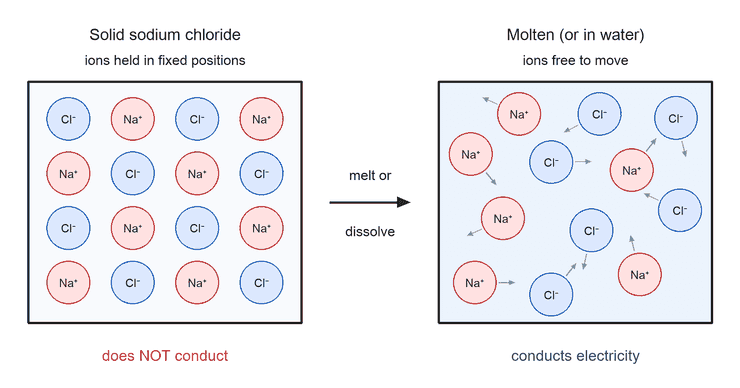
Step 3 — Check the link.
Conducting (and being decomposed) in these states is exactly what makes a compound an electrolyte, so R explains A.
Why the other options are wrong:
- (B) (2) Both A and R are true but R is not the correct explanation of A: R does explain A.
- (C) (3) A is true but R is false: R is true.
- (D) (4) A is false but R is true: A is true.
Therefore, both A and R are true and R is the correct explanation of A, option (A).
