
Question 25 marksEasy
Define the following terms :
(a) Electrolysis,
(b) Non-electrolyte,
(c) Cation and anion,
(d) Weak electrolytes.
Confirming your payment
Sign up now and get 250 free tokens.
Electrolysis · Question 2 of 76
Define the following terms :
(a) Electrolysis,
(b) Non-electrolyte,
(c) Cation and anion,
(d) Weak electrolytes.
Solution:
Concept: Every definition in this chapter turns on ions: whether a substance has free ions, and what happens to the ions at the electrodes when a current passes.
Step 1 — (a) Electrolysis.
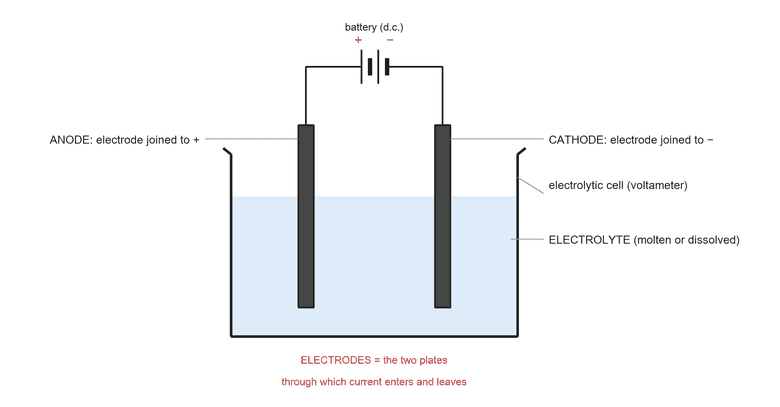
Electrolysis is the process of decomposition of a chemical compound in the aqueous or molten (fused) state by the passage of an electric current, with a chemical change at the electrodes.
For example, molten lead bromide is decomposed into lead at the cathode and bromine at the anode.
Step 2 — (b) Non-electrolyte.
A non-electrolyte is a compound which does not conduct electricity in the molten or aqueous state, because it contains only molecules and no ions.
Examples are sugar solution, alcohol and carbon tetrachloride.
Step 3 — (c) Cation and anion.
A cation is a positively charged ion, such as or . During electrolysis it moves to the cathode.
An anion is a negatively charged ion, such as or . During electrolysis it moves to the anode.
Step 4 — (d) Weak electrolytes.
Weak electrolytes are electrolytes which are only partially dissociated (ionised) in the fused or aqueous state. Their solutions contain ions as well as un-ionised molecules, so they conduct electricity only feebly.
Examples are acetic acid, ammonium hydroxide and carbonic acid.
Watch out: A cation goes to the cathode and an anion to the anode; the names match their first letters, which helps to remember them.
Therefore, electrolysis is decomposition of a molten or dissolved compound by an electric current; a non-electrolyte has no ions and does not conduct; cations are positive ions and anions negative ions; weak electrolytes are only partly ionised and conduct feebly.