Solution:
Concept: A substance conducts electricity only if it has charged particles that are free to move. Metals (and graphite) have free electrons; an electrolyte has free ions, but only when it is molten (fused) or dissolved in water. Electrolysis is the chemical change that the current then brings about at the electrodes.
Step 1 — (a) When does common salt conduct.
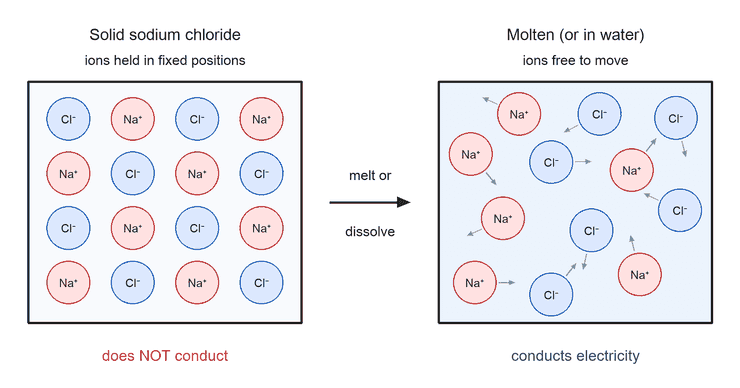
Solid sodium chloride does not conduct, because its Na+ and Cl− ions are held in fixed positions in the crystal. Melting it, or dissolving it in water, sets the ions free, and the moving ions carry the current.
So the blanks are: it conducts when dissolved in water or when melted (fused).
Step 2 — (b) Molten lead bromide.
Molten lead bromide conducts and is decomposed by the current, so it is an electrolyte. It is made of lead ions and bromide ions:
PbBr2⟶Pb2++2Br−
The lead ions are positively charged and are called cations. The bromide ions are negatively charged and are called anions.
Step 3 — (c) Conductors in the solid state.
Substances that conduct while solid must already have free charged particles. These are generally metals (and graphite), which conduct by free electrons, so they need not be melted or dissolved.
Step 4 — (d) Zinc and copper.
Zinc lies above copper in the electrochemical series, so a zinc atom gives up its electrons more easily:
Zn−2e−⟶Zn2+
The electron-releasing tendency of zinc is therefore greater than that of copper.
Step 5 — (e) HCl in water and in toluene.
Hydrogen chloride is a polar covalent compound. In water it ionises, so the solution has free ions:
HCl+H2O⟶H3O++Cl−
Toluene is a non-polar solvent, so in toluene HCl does not ionise and stays as molecules; there are no ions to carry the current.
Step 6 — (f) What pure water is made of.
Pure water is ionised only to a very tiny extent, so it consists almost entirely of molecules.
Step 7 — (g) Does pure water conduct.
With almost no ions, pure water is a very poor conductor, so it will not normally conduct electricity.
Step 8 — (h) Definition of electrolysis.
In electrolysis the current (a flow of electricity) passes through the liquid, and the liquid is decomposed at the electrodes, which is a chemical change.
Watch out: In (h) the answer is 'electricity', not 'electrons': inside the liquid the current is carried by ions, not by a stream of electrons.
Therefore, the blanks are: (a) dissolved in water, melted (fused); (b) electrolyte, ions, ions, positively, cations, ions, negatively, anions; (c) metals; (d) greater; (e) it ionises (forms free ions), it does not ionise (stays as molecules); (f) molecules; (g) will not; (h) electricity, chemical.
