Solution:
Concept: Ionic (electrovalent) compounds already contain ions and only set them free on melting or dissolving; polar covalent compounds form ions only when they react with water.
Step 1 — (a) Arrhenius and modern explanations.
Arrhenius said that an electrolyte, when dissolved in water, dissociates into free, mobile ions, which carry the current. He thought that water produces the ions.
The modern explanation says that an electrovalent compound is ionic even in the solid state. There the ions are held in fixed positions by strong electrostatic forces, so they cannot move. Water (or melting) only breaks these forces and makes the existing ions mobile; it does not create the ions.
Step 2 — (b) Electrolytic dissociation and ionisation.
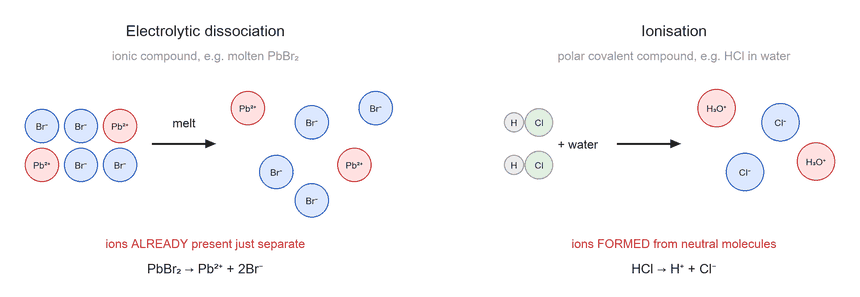
Electrolytic dissociation is the separation of ions already present in an electrovalent compound when it is melted or dissolved in water:
KCl⟶K++Cl−
Ionisation is the formation of ions from a polar covalent compound, which has no ions of its own, when it is dissolved in water:
HCl+H2O⟶H3O++Cl−
Step 3 — (c) Cation and anion.
A cation is positively charged and is formed by loss of electrons. It moves to the cathode and gains electrons there (reduction):
Pb2++2e−⟶Pb
An anion is negatively charged and is formed by gain of electrons. It moves to the anode and loses electrons there (oxidation):
Br−−e−⟶Br
Step 4 — (d) Electrolytic and thermal dissociation.
In electrolytic dissociation an electrolyte breaks up into ions when it is melted or dissolved in water; no heat is needed to make the ions.
In thermal dissociation a compound breaks up reversibly into simpler molecules on heating. The products are neutral molecules, not ions, and they recombine on cooling:
NH4Cl⇌NH3+HCl
Step 5 — (e) Strong and weak electrolytes.
A strong electrolyte is almost completely dissociated. Its solution contains (almost) only ions, so it is a good conductor, e.g. sodium chloride solution and dilute hydrochloric acid.
A weak electrolyte is only partially dissociated. Its solution contains ions and molecules, so it is a poor conductor, e.g. acetic acid and ammonium hydroxide.
Watch out: Ionisation and dissociation both give free ions, but only dissociation starts from a compound that is already made of ions.
Therefore, the modern theory says the ions already exist in the solid; dissociation separates existing ions while ionisation forms new ones; a cation is positive and goes to the cathode, an anion is negative and goes to the anode; electrolytic dissociation gives ions while thermal dissociation gives molecules on heating; a strong electrolyte is almost fully dissociated and a weak one only partly.
