Answer: (B) (2) Both A and R are true but R is not the correct explanation of A.
Concept: In an Assertion–Reason item, first judge the Assertion (A) true or false, then the Reason (R), and only if both are true ask whether R tells why A is true.
Step 1 — Judge the Assertion.
A polar covalent compound such as HCl forms ions in water:
HCl+H2O⟶H3O++Cl−
A is true.
Step 2 — Judge the Reason.
Electrovalent compounds such as KCl show dissociation:
KCl⟶K++Cl−
R is true.
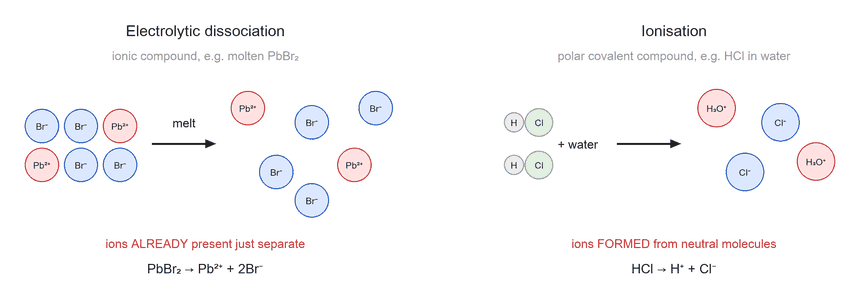
Step 3 — Check the link.
R is about a different class of compounds (ionic ones, which already have ions), so it cannot explain why covalent compounds form ions.
Watch out: Ionisation (covalent compounds) and dissociation (ionic compounds) are two different processes.
Why the other options are wrong:
- (A) (1) Both A and R are true and R is the correct explanation of A: R does not explain A.
- (C) (3) A is true but R is false: R is true.
- (D) (4) A is false but R is true: A is true.
Therefore, both A and R are true but R is not the correct explanation of A, option (B).
