
Question 642 marksEasy
Differentiate between electrical conductivity of – copper sulphate solution and of copper metal.
Confirming your payment
Sign up now and get 250 free tokens.
Electrolysis · Question 64 of 76
Differentiate between electrical conductivity of – copper sulphate solution and of copper metal.
Solution:
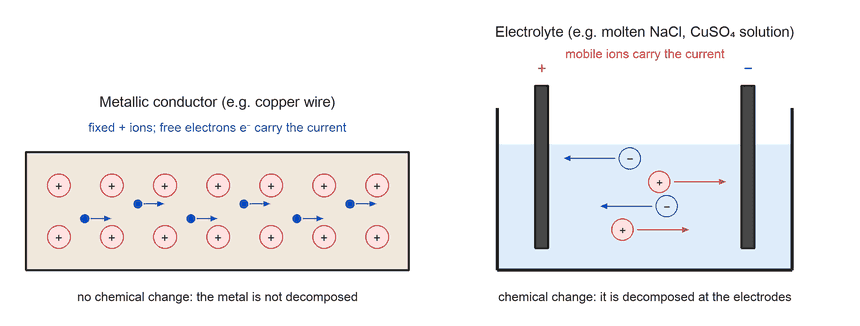
Concept: Electrolytic conduction is by ions with a chemical change; metallic conduction is by electrons without any chemical change.
Step 1 — Compare the two side by side.
The table sets out the three differences.
| Copper sulphate solution | Copper metal |
|---|---|
| Conducts by the movement of ions (, , , ). | Conducts by the movement of free electrons. |
| The solution is decomposed: a chemical change occurs at the electrodes. | No chemical change: the copper is unchanged. |
| It is an electrolyte. | It is a metallic conductor (non-electrolyte). |
Step 2 — Show the chemical change.
In copper sulphate solution, for example, copper ions are discharged at the cathode, so new copper appears, which never happens in a copper wire:
Therefore, copper sulphate solution conducts by ions and is decomposed, while copper metal conducts by free electrons and is not changed.