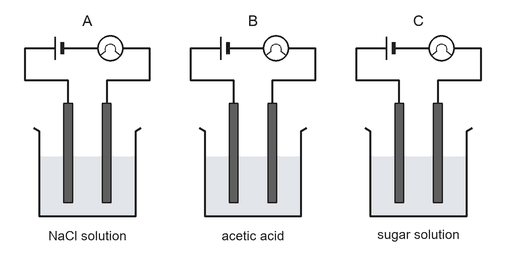
Solution:
Concept: The brightness of the bulb depends on how many free ions the solution contains.
Step 1 — Cell A: bulb glows brightly.
Sodium chloride is a strong electrolyte, completely dissociated into Na+ and Cl− ions. The large number of ions carries a large current.
Step 2 — Cell B: bulb glows dimly.
Acetic acid is a weak electrolyte, only partly ionised:
CH3COOH⇌CH3COO−+H+
Few ions are present, so only a small current flows.
Step 3 — Cell C: bulb does not glow.
Sugar is a non-electrolyte; its solution contains only molecules and no ions, so no current flows.
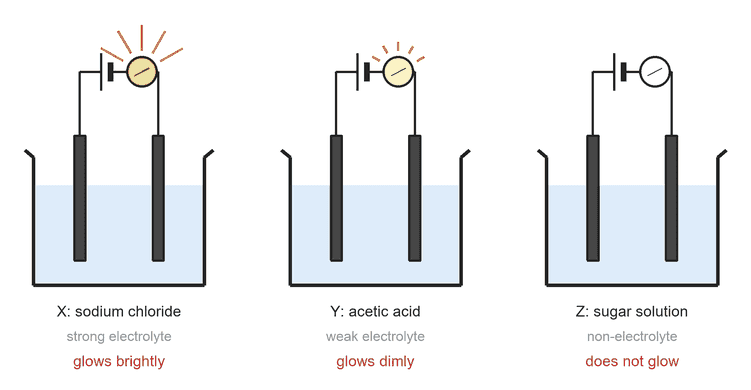
Therefore, A glows brightly (strong electrolyte, many ions), B glows dimly (weak electrolyte, few ions) and C does not glow (non-electrolyte, no ions).