
Question 212 marksEasy
To carry out the so-called "electrolysis of water", sulphuric acid is added to water. How does the addition of sulphuric acid produce a conducting solution ?
Confirming your payment
Sign up now and get 250 free tokens.
Electrolysis · Question 21 of 76
To carry out the so-called "electrolysis of water", sulphuric acid is added to water. How does the addition of sulphuric acid produce a conducting solution ?
Solution:
Concept: Pure water is almost entirely molecules; an acid supplies plenty of free ions.
Step 1 — Look at pure water.
Water is a polar covalent compound and is only very slightly ionised, so it is a very poor conductor.
Step 2 — Add dilute sulphuric acid.
Sulphuric acid is a strong electrolyte and dissociates almost completely:
It also increases the ionisation of the water itself:
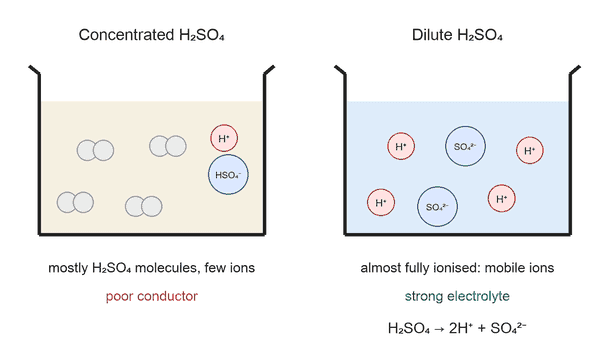
Step 3 — See the result.
These free, mobile ions carry the current, so the acidified water becomes a good conductor and the water can be electrolysed.
Watch out: The acid is not decomposed in the process; hydrogen and oxygen come from the water, and the acid is left behind.
Therefore, sulphuric acid dissociates into free H⁺ and SO₄²⁻ ions (and helps water to ionise), and these mobile ions make the solution conduct.