Solution:
Concept: In the cell symbol the long thin plate is the positive (+) terminal and the short thick plate is the negative (−) terminal. The anode is joined to + and the cathode to −. Oxidation (loss of electrons) takes place at the anode.
Step 1 — Trace the wires.
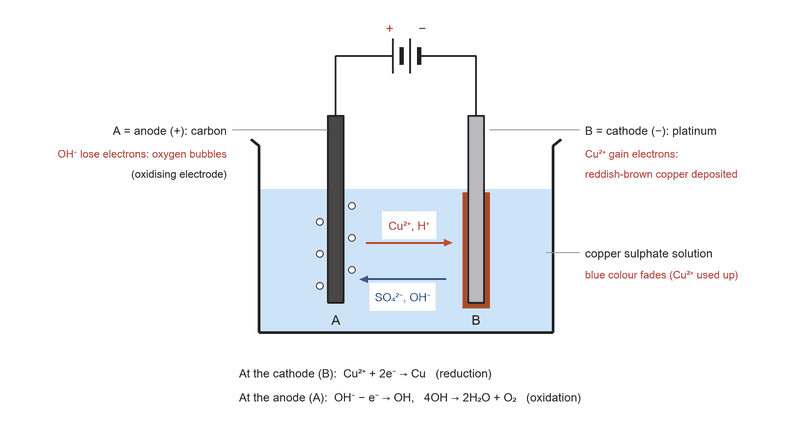
Electrode A is joined, through the key, to the long thin plate of the cell, the positive terminal. Electrode B is joined, through the rheostat, to the short thick plate, the negative terminal.
Step 2 — (a) Name the electrodes.
So A is the anode, and since the stem says the anode is carbon, A is the carbon electrode. B is the cathode, the platinum electrode.
Step 3 — (b) The oxidising electrode.
At the anode A, OH− ions are discharged in preference to SO42−. They lose electrons (are oxidised) and oxygen is given off:
4OH−−4e−⟶2H2O+O2
At B the copper ions gain electrons and copper is deposited:
Cu2++2e−⟶Cu
Watch out: The anode is decided by which terminal it is joined to, not by its position on the left or right.
Therefore, (a) A is the anode (carbon) and B is the cathode (platinum); (b) A, the anode, is the oxidising electrode.

