Solution:
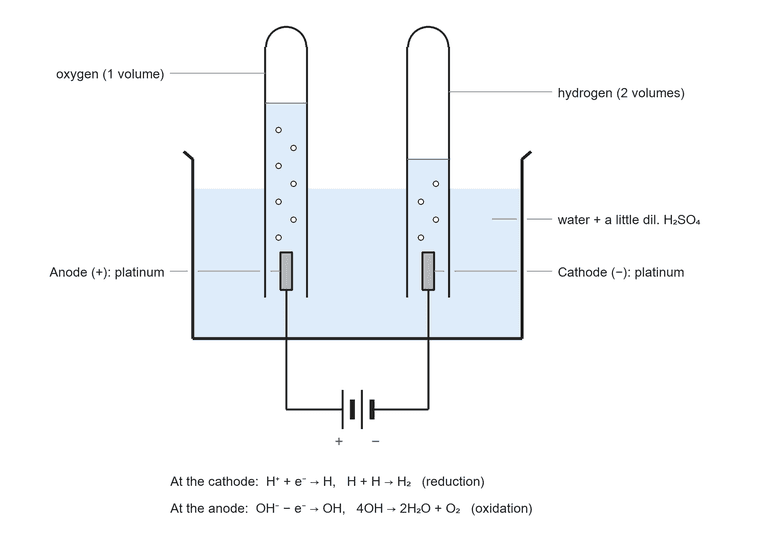
Concept: Acidified water contains H+, OH− and SO42− ions. At an inert platinum anode the anion lower in the series (OH−) is discharged; at the cathode H+ is discharged.
Step 1 — (a) Name the two anions.
The anions are sulphate ions, SO42−, from the acid, and hydroxyl ions, OH−, from water:
H2SO4⟶2H++SO42−
H2O⇌H++OH−
Step 2 — (b) Product at the anode.
The OH− ion lies below SO42− in the series, so it is discharged. Each hydroxyl ion loses an electron, and the OH groups then combine to give oxygen:
OH−−e−⟶OH
4OH⟶2H2O+O2
Step 3 — (c) Product at the cathode.
The H+ ions gain electrons and the atoms pair up to give hydrogen:
H++e−⟶H
H+H⟶H2
For every four electrons, two molecules of hydrogen form at the cathode but only one molecule of oxygen at the anode, so the gases form in the ratio 2 : 1 by volume.
Step 4 — (d) Any colour change.
There is no change in colour. All the ions present (H+, OH−, SO42−) are colourless, and the products, hydrogen and oxygen, are colourless gases.
Step 5 — (e) Why it is called catalysis.
Pure water contains very few ions, so it hardly conducts electricity. The dilute sulphuric acid supplies plenty of ions (H+ and SO42−), so the solution conducts and the water is decomposed into hydrogen and oxygen.
The acid itself is not used up: the same amount is left at the end. A substance that helps a reaction without being consumed acts as a catalyst, so this electrolysis is treated as an example of catalysis.
Note: The acid does not make the water itself ionise more; it only provides the ions that carry the current.
Watch out: The sulphate ion reaches the anode but is not discharged; the oxygen comes from the hydroxyl ions of water.
Therefore, (a) SO₄²⁻ and OH⁻; (b) oxygen, 4OH⁻ − 4e⁻ → 2H₂O + O₂; (c) hydrogen, 2H⁺ + 2e⁻ → H₂; (d) no colour change, as all ions and products are colourless; (e) the acid supplies the ions that carry the current but is not used up, like a catalyst.
