
Question 182 marksEasy
A solution of caustic soda (NaOH) in water or when fused, conducts an electric current. What is the similarity in these two cases ?
Confirming your payment
Sign up now and get 250 free tokens.
Electrolysis · Question 18 of 76
A solution of caustic soda (NaOH) in water or when fused, conducts an electric current. What is the similarity in these two cases ?
Solution:
Concept: An electrolyte conducts only through free, mobile ions.
Step 1 — Look at solid sodium hydroxide.
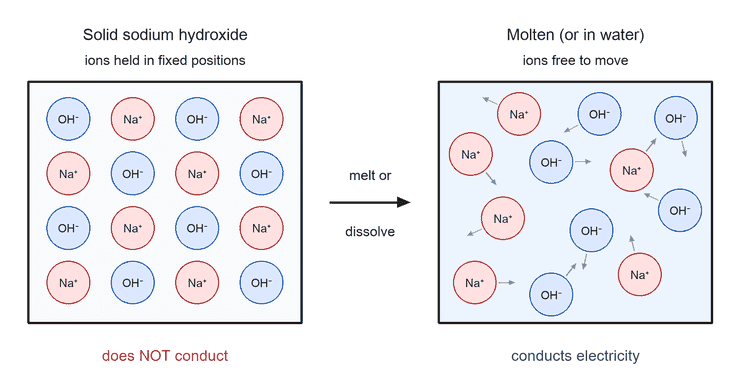
Sodium hydroxide is an ionic compound. In the solid its and ions are held in fixed positions and cannot move, so the solid does not conduct.
Step 2 — Melt it or dissolve it.
Melting or dissolving breaks the forces between the ions, so the same ions become free to move:
Step 3 — Compare the two cases.
In both the melt and the solution the current is carried by the same free ions, moving to the cathode and moving to the anode.
Watch out: Water does not create the ions here; they were already in the solid and are only set free.
Therefore, the similarity is that in both cases the current is carried by the same free, mobile Na⁺ and OH⁻ ions.