
Question 74 marksEasy
Explain why ;
(a) Cu, though a good conductor of electricity is a non electrolyte,
(b) Solid sodium chloride does not allow electricity to pass through ?
Confirming your payment
Sign up now and get 250 free tokens.
Electrolysis · Question 7 of 76
Explain why ;
(a) Cu, though a good conductor of electricity is a non electrolyte,
(b) Solid sodium chloride does not allow electricity to pass through ?
Solution:
Concept: An electrolyte conducts by ions and is decomposed by the current. A metal conducts by free electrons and is not decomposed.
Step 1 — (a) Why copper is a non-electrolyte.
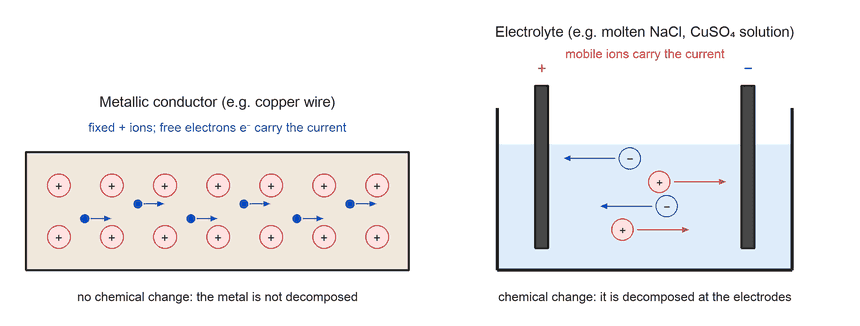
Copper conducts by the flow of its free (mobile) electrons. It has no moving ions, and it undergoes no chemical change when the current passes: after the current is switched off it is still the same copper.
An electrolyte must be decomposed by the current, so copper, though a good conductor, is a non-electrolyte (a metallic conductor).
Step 2 — (b) Why solid sodium chloride does not conduct.
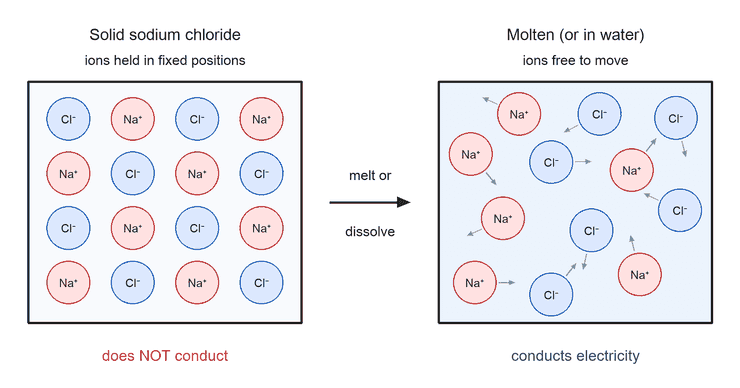
In solid sodium chloride the and ions are held firmly in fixed positions in the crystal lattice by strong electrostatic forces. They are not free to move, so they cannot carry the current.
When the salt is melted or dissolved in water these forces are broken, the ions become mobile, and sodium chloride conducts.
Watch out: Solid sodium chloride does contain ions; it fails to conduct because the ions cannot move, not because there are no ions.
Therefore, (a) copper conducts by electrons without being decomposed, so it is a non-electrolyte; (b) in solid sodium chloride the ions are fixed in the lattice and cannot move, so it does not conduct.