Solution:
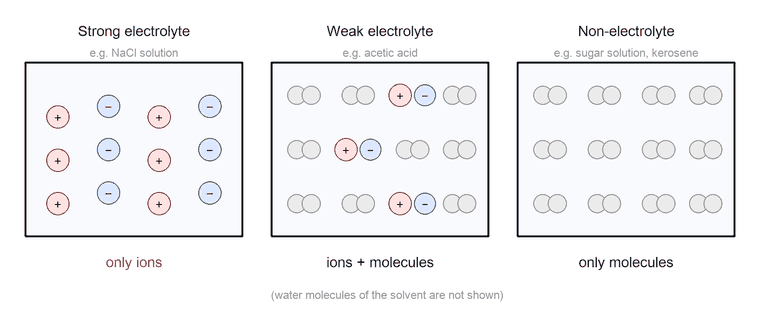
Concept: Ask how far each substance breaks into ions in water. Salts and mineral acids dissociate almost fully (strong); acetic acid and ammonium hydroxide only partly (weak); a covalent liquid such as CCl4 not at all (non-electrolyte).
Step 1 — Strong electrolytes.
Ammonium chloride, dilute hydrochloric acid, sodium acetate and dilute sulphuric acid are strong electrolytes. The two salts are ionic, and the two mineral acids ionise almost completely, for example:
H2SO4⟶2H++SO42−
Step 2 — Weak electrolytes.
Acetic acid and ammonium hydroxide are weak electrolytes. Their solutions hold ions and un-ionised molecules, for example:
CH3COOH⇌CH3COO−+H+
Step 3 — Non-electrolytes.
Carbon tetrachloride is a non-electrolyte. It is made only of molecules and forms no ions.
Watch out: Sodium acetate and ammonium chloride are salts of a weak acid or a weak base, but the salts themselves are ionic and therefore strong electrolytes.
Therefore, (a) strong: ammonium chloride, dilute hydrochloric acid, sodium acetate, dilute sulphuric acid; (b) weak: acetic acid, ammonium hydroxide; (c) non-electrolyte: carbon tetrachloride.
