
Question 715 marksMedium
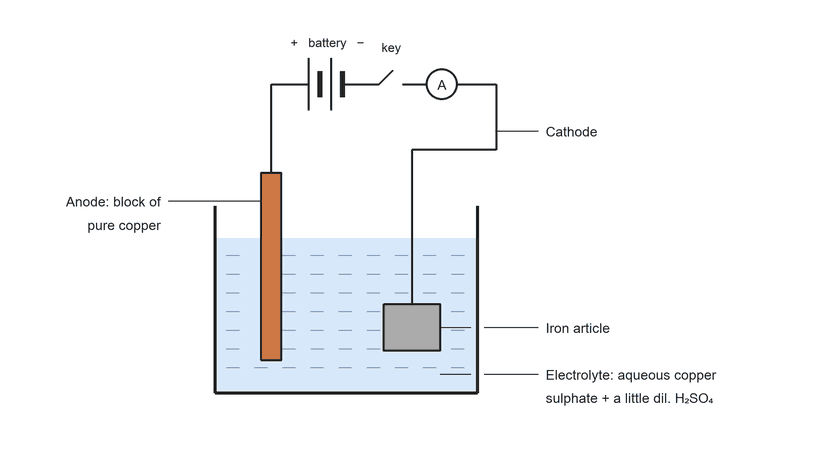
(a) Draw a labelled diagram to show how iron is electroplated with copper.
(b) Which solution is preferred as electrolyte, or ?
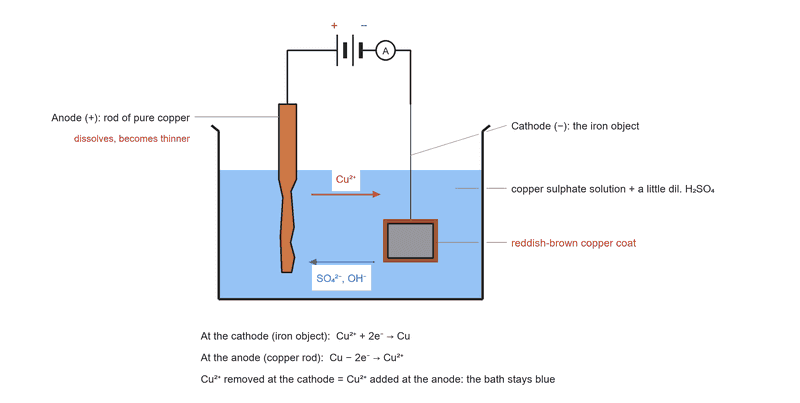
(c) Describe what happens to the iron object and the copper rod.
Confirming your payment
Sign up now and get 250 free tokens.
Electrolysis · Question 71 of 76
(a) Draw a labelled diagram to show how iron is electroplated with copper.
(b) Which solution is preferred as electrolyte, or ?
(c) Describe what happens to the iron object and the copper rod.
Solution:
Concept: In electroplating the article to be plated is the cathode, a block of the pure plating metal is the anode, and the electrolyte is a solution containing ions of the plating metal. Here the plating metal is copper, so the electrolyte must contain ions.
Step 1 — (a) Draw the set-up.
The block of pure copper is the anode (joined to the + terminal), the iron article is the cathode (joined to the − terminal), and the electrolyte is aqueous copper sulphate with a little dilute sulphuric acid. A low current is passed for a longer time.
Step 2 — (b) Choose the electrolyte.
is preferred. The electrolyte must contain ions of the metal to be deposited (copper); would supply only ions and could not give a copper coat.
Step 3 — (c) What happens to the iron object.
ions move to the iron object (cathode), gain electrons, and it gets coated with a reddish-brown layer of copper:
Step 4 — (c) What happens to the copper rod.
The copper atoms of the rod (anode) lose electrons and pass into the solution as ions, so the rod dissolves and becomes thinner. This keeps the copper-ion concentration, and the blue colour, constant:
Watch out: The object to be plated (iron) is the cathode, not the anode.
Therefore, (a) pure copper anode, iron article as cathode, copper sulphate electrolyte; (b) CuSO₄; (c) the iron object gets a copper coat and the copper rod dissolves and becomes thinner.