Solution:
Concept: The particles present depend on how far the substance ionises, and a plating bath must supply ions of the metal being deposited.
Step 1 — (a) A liquid non-electrolyte.
A non-electrolyte does not ionise at all, so it contains only molecules and has no ions to carry a current.
Step 2 — (b) A weak acid HX.
A weak acid ionises only partly, so its solution contains H+ ions, X− ions and un-ionised HX molecules:
HX⇌H++X−
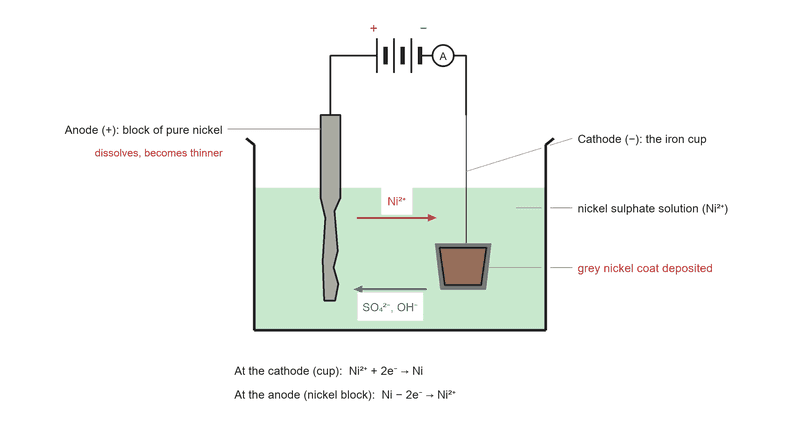
Step 3 — (c) A plating bath.
The solution must contain ions of the metal to be plated, for example Ni2+ ions for nickel plating or Ag+ ions for silver plating. These cations move to the article (the cathode) and are deposited on it:
Ni2++2e−⟶Ni
Therefore, (a) only molecules; (b) H⁺ ions, X⁻ ions and HX molecules; (c) ions of the metal to be plated.
