
Question 311 markMCQEasy
The observation seen when fused lead bromide is electrolysed is :
Confirming your payment
Sign up now and get 250 free tokens.
Electrolysis · Question 31 of 76
The observation seen when fused lead bromide is electrolysed is :
(A) A silver grey deposit at anode and a reddish brown deposit at cathode.
(B) A silver grey deposit at cathode and a reddish brown deposit at anode.
(C) A silver grey deposit at cathode and reddish brown fumes at anode.
(D) Silver grey fumes at anode and reddish brown fumes at cathode.
Answer: (C) A silver grey deposit at cathode and reddish brown fumes at anode.
Concept: Lead, a metal, is formed at the cathode; bromine, a non-metal, is formed at the anode.
Step 1 — Look at the cathode.
Lead ions gain electrons and a silvery grey metal (lead) collects:
Step 2 — Look at the anode.
Bromide ions lose electrons. Bromine is volatile at the temperature of the melt, so it escapes as dark reddish-brown fumes:
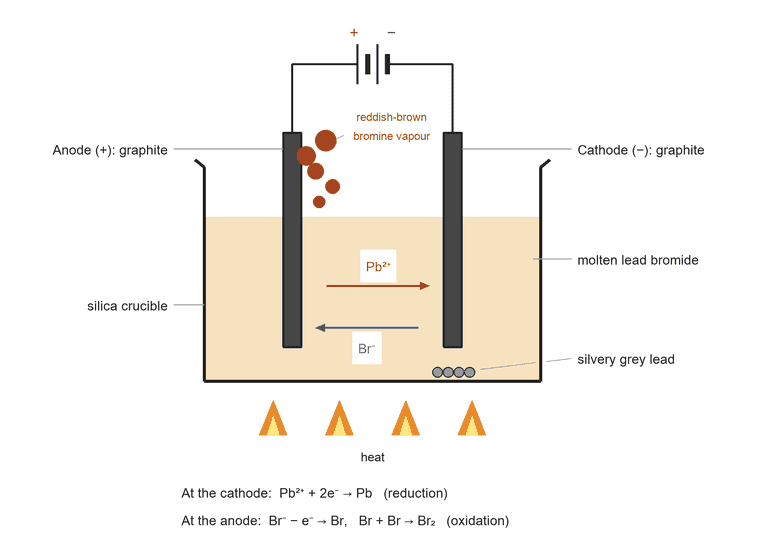
Watch out: Bromine is not a deposit; it leaves the anode as fumes.
Why the other options are wrong:
Therefore, a silver grey deposit forms at the cathode and reddish brown fumes at the anode, option (C).