
Opening your dashboard
Class 10 Chemistry Chapter 6 Electrolysis: Competency-Based Questions (CBQ)
40 questions on Chapter 6, each worked through on its own page with the AI tutor. Class 10 Chemistry, ICSE 2026-27.
40 questions
1–5 marks · Mixed difficulty
- 11 mark
Question 1
Cognitive domain: Recall & Understanding · CISCE Competency-Focused Practice Questions 2024, Q6
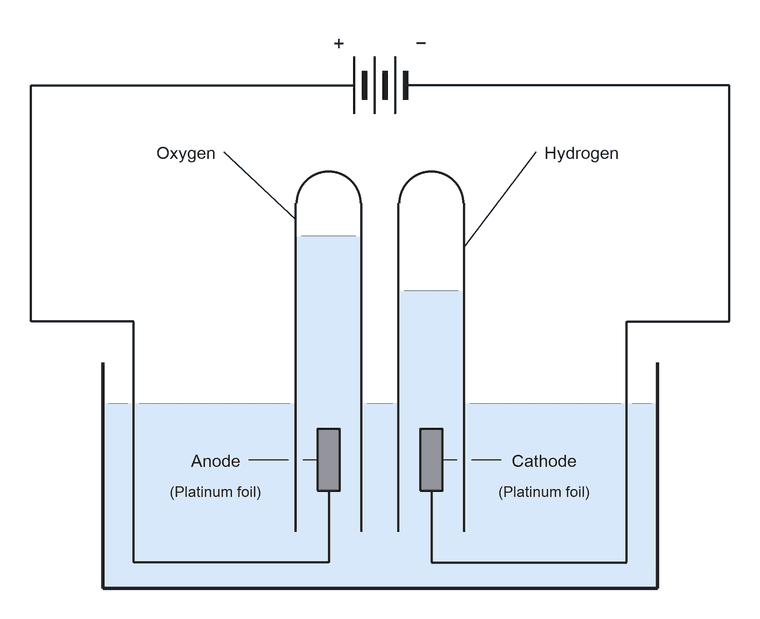
The above diagram represents the electrolysis of acidulated water. The reaction occurring at the anode is:
- 21 mark
Question 2
Cognitive domain: Analysis · CISCE Competency-Focused Practice Questions 2024, Q8
The picture given below shows an apparatus that a teacher used for demonstrating the properties of ionic substances. The teacher heats a sample of lead bromide in a crucible which contains two electrodes which are part of the circuit shown. The bulb does not light up. What is the best explanation for this?
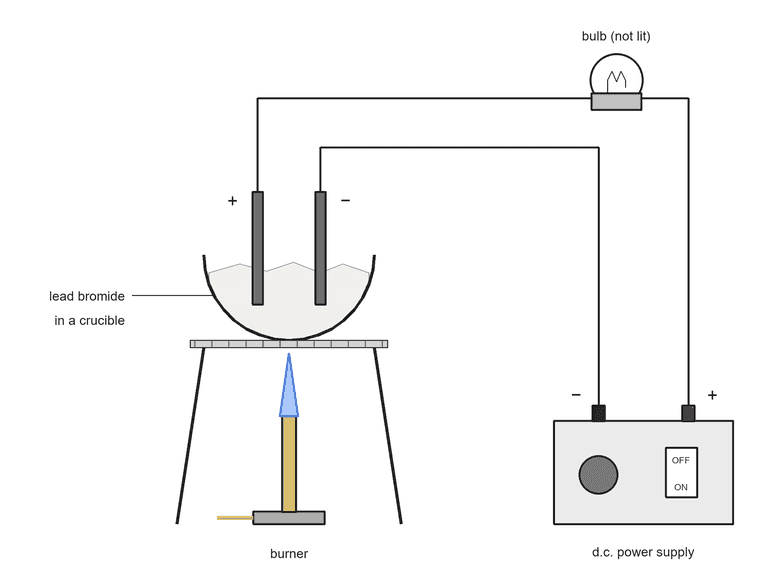
- 31 mark
Question 3
Cognitive domain: Understanding & Application · CISCE Competency-Focused Practice Questions 2024, Q10
The diagram below shows a circuit used to electrolyse aqueous sodium argentocyanide.
Which arrow indicates the movement of the silver ions in the electrolyte and of the electrons in the external circuit?

- 41 mark
Question 4
Cognitive domain: Application · CISCE Competency-Focused Practice Questions 2024, Q15
When a compound was electrolysed using inert electrodes, the gas released at the anode made a glowing splinter rekindle. The electrolyte that will not produce such gas observation at the anode is:
- 51 mark
Question 5
Cognitive domain: Understanding · CISCE Competency-Focused Practice Questions 2024, Q20
The electrolytic cell used for the electrolysis of molten lead bromide is made of silica. Which of the following is a property of silica that does not have much significance in the process of electrolysis?
- 61 mark
Question 6
Cognitive domain: Application · CISCE Competency-Focused Practice Questions 2024, Q25
The diagram shown is a wrong attempt to electroplate a pan with copper:
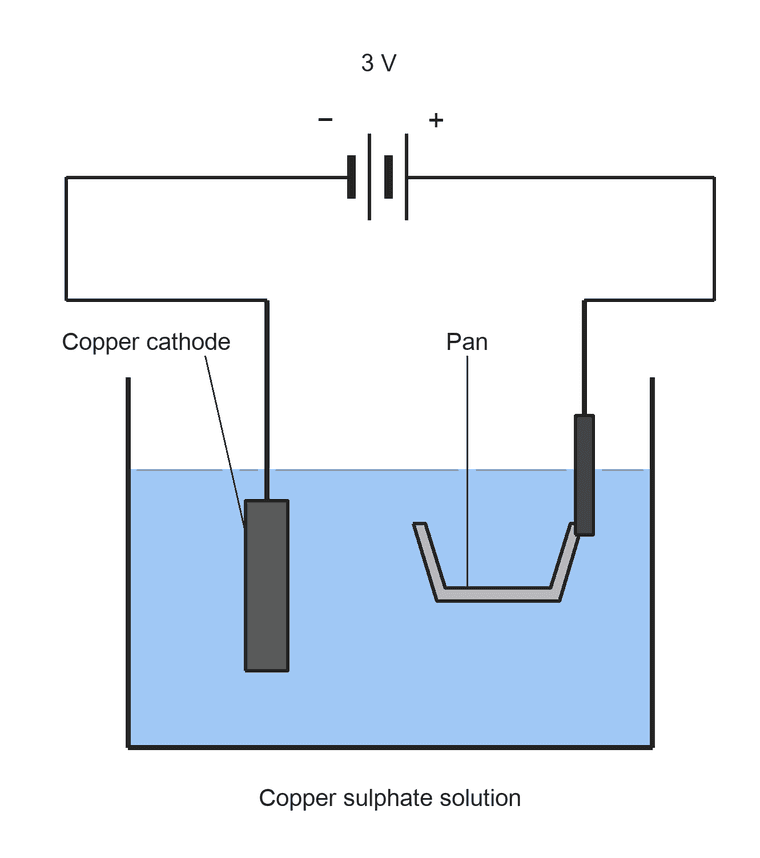
Which of the following could have been done to copper plate a pan?
- 71 mark
Question 7
Cognitive domain: Application · CISCE Competency-Focused Practice Questions 2024, Q28
When electrolysis of molten lead bromide is carried out, the products formed at the respective electrodes are:
- 81 mark
Question 8
Cognitive domain: Application · CISCE Competency-Focused Practice Questions 2024, Q33
The statements below show the results when three metal strips, P, Q, and R, are placed in blue copper sulphate solution.
- P: Solution turns green.
- Q: Solution becomes colourless.
- R: Solution remains blue.
Which of the following metals could be P, Q, and R?
- 91 mark
Question 9
Cognitive domain: Understanding · CISCE Competency-Focused Practice Questions 2024, Q47
The ________ (higher/lower) is the position of the cation in the electrochemical series, the greater the difficulty of it being discharged at the cathode.
- 102 marks
Question 10
Cognitive domain: Understanding & Application · CISCE Competency-Focused Practice Questions 2024, Q104
is a hard crystalline solid having high melting and boiling points. It is a good conductor of electricity in both molten and aqueous forms.
(a) The conductivity of is due to the presence of free ________ (ions, molecules, electrons).
(b) During electrolysis of aqueous , if thickening of the cathode and thinning of the anode is observed, the anode material will be ________ (graphite, metal P).
- 113 marks
Question 11
Cognitive domain: Understanding & Application · CISCE Competency-Focused Practice Questions 2024, Q111
Rohan wants to electroplate a spoon with nickel.
(a) To which electrode should he connect the article to be electroplated?
(b) Write the equation for the reaction that will occur at the cathode.
(c) What should the anode be made up of?
- 121 mark
Question 12
Cognitive domain: Understanding
A laboratory assistant dissolves calcium chloride in water to prepare a test solution.
Assertion (A): The solution contains twice as many chloride ions as calcium ions, and yet it is electrically neutral.
Reason (R): Each calcium ion carries two units of positive charge and each chloride ion carries one unit of negative charge, so the total positive charge in the solution is equal to the total negative charge.
- 131 mark
Question 13
Cognitive domain: Application
Molten lead bromide is electrolysed between graphite electrodes in a school laboratory.
Assertion (A): For every atom of lead set free at the cathode, one atom of bromine is set free at the anode.
Reason (R): The number of electrons taken up by the cations at the cathode is equal to the number of electrons given up by the anions at the anode.
- 144 marks
Question 14
Cognitive domain: Analysis
The technician who services the water purifier in Kabir's flat checks the water with a pen-shaped "TDS meter". He explains that the meter has two metal pins. It passes a tiny electric current through the water between the pins, and the more current the water carries, the bigger the number on the display. Kabir borrows the meter and tests five samples at home. For three of them he stirs one teaspoon of a kitchen substance into a glass of distilled water. (Vinegar is a dilute solution of acetic acid.)
Sample Meter reading Distilled water 1 Distilled water + sugar 1 Distilled water + vinegar 140 Distilled water + common salt above 2000 Tap water 310 (a) Why does distilled water give a reading of almost zero, while the salt solution gives a very high reading? Write an equation to show what happens to the salt in water.
(b) Name the kind of particles present in the sugar solution, in the vinegar solution and in the salt solution, and use this to explain the order of the three readings.
(c) Kabir concludes, "A reading close to zero proves that nothing is dissolved in the water." Use the table to judge his conclusion, and state what the reading for tap water really tells him.
- 155 marks
Question 15
Cognitive domain: Application
In the weeks before Diwali, a brassware workshop silver-plates brass pooja thalis. Each thali is scrubbed clean, hung in a bath of sodium argentocyanide solution and joined to the negative terminal of a d.c. supply. A plate dipping in the same bath is joined to the positive terminal.
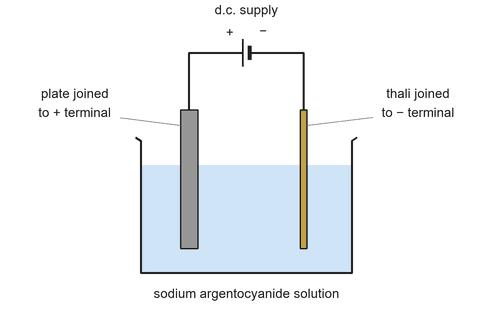
Farhan, a new apprentice, plates three identical thalis in three separate, freshly made baths and notes down what he finds.
Trial Plate joined to the positive terminal Current Time Result 1 Silver Large 4 minutes Dull, rough coating that rubs off; bath as strong as before 2 Silver Small 40 minutes Smooth, bright, firm coating; bath as strong as before 3 Graphite Small 40 minutes Smooth, bright coating; bath weaker than before (a) What do Trials 1 and 2 show about the current and the time that should be used for electroplating?
(b) Explain why the bath stays as strong as before in Trial 2 but becomes weaker in Trial 3. Write the equation for the reaction at the silver plate in Trial 2.
(c) In Trial 2 the silver plate became lighter by 2.16 g. Find the mass of silver deposited on the thali and the number of electrons taken up by the silver ions at the thali. (Ag = 108; Avogadro's number = )
- 164 marks
Question 16
Cognitive domain: Evaluation
For a science exhibition, Ananya's group writes this plan:
"We will make sodium metal from kitchen salt. We will dissolve plenty of salt in water, dip two graphite rods in the solution and join them to a 9 V battery. Sodium ions are positive, so shiny sodium will collect on the rod joined to the negative terminal."
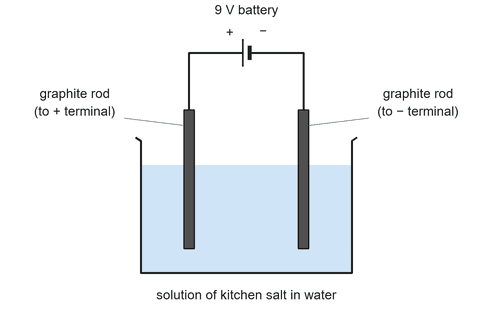
When they try it out, bubbles of a colourless gas come off at that rod and no metal appears. (Sodium chloride melts only at about 800 °C.)
(a) Name the colourless gas. Use the electrochemical series to explain why the plan does not give sodium.
(b) Describe a test by which the group can confirm what the gas is.
(c) What change in the electrolyte would make sodium form at the negative electrode? Write the reactions at the two electrodes for this case, and give one reason why it cannot be shown on an exhibition table.
- 171 mark
Question 17
Cognitive domain: Understanding
Neha's torch works on a dry cell. Her brother's workshop uses an electrolytic cell to nickel-plate steel bolts. Neha says that the two devices do opposite jobs: one gives out electricity, while the other needs electricity before anything happens.
Which option describes the two devices correctly?
- 181 mark
Question 18
Cognitive domain: Analysis
A student is given strips of four metals P, Q, R and S. She knows only that they are copper, iron, silver and zinc, in some order. She places a strip of each metal in a solution of the salt of each of the other three metals. A coating of a different metal on a strip shows that a reaction has taken place.
Strip of metal Solution of salt of P Solution of salt of Q Solution of salt of R Solution of salt of S P not tried no change coating forms no change Q coating forms not tried coating forms coating forms R no change no change not tried no change S coating forms no change coating forms not tried Which option identifies the four metals correctly?
- 191 mark
Question 19
Cognitive domain: Application
A technician tests two solutions of the same concentration in the same circuit: sodium hydroxide solution, and ammonium hydroxide solution (ammonia gas dissolved in water).
Assertion (A): The ammonium hydroxide solution conducts electricity, but much less than the sodium hydroxide solution does.
Reason (R): Ammonium hydroxide is only partly ionised, so its solution contains molecules as well as ions.
- 201 mark
Question 20
Cognitive domain: Analysis
In a metal plant, fused (molten) sodium chloride is electrolysed between inert electrodes.
Assertion (A): Sodium is set free at the cathode and chlorine at the anode.
Reason (R): In the fused salt the current is carried by electrons that travel from the cathode to the anode through the melt.
- 211 mark
Question 21
Cognitive domain: Analysis
In a copper-refining tank, thin sheets of pure copper and slabs of impure copper hang in a solution of copper sulphate and dilute sulphuric acid. Direct current is passed for 10 hours. The impure copper contains zinc, iron, silver and gold. (Hypothetical data.) The graph shows how the mass of three parts of the tank changes with time: the pure copper, the impure copper, and the anode mud that collects below the impure copper.
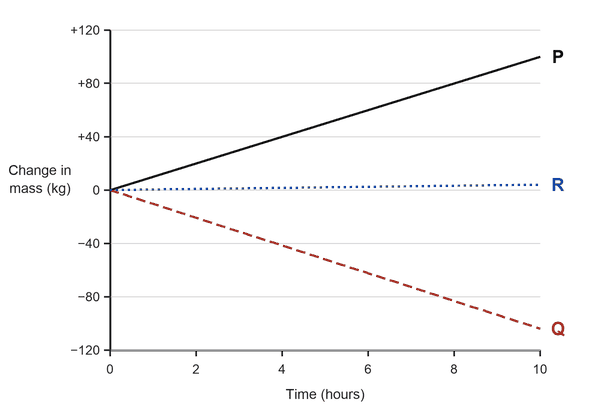
Which row names the three lines correctly?
- 221 mark
Question 22
Cognitive domain: Analysis
The labels fell off four beakers P, Q, R and S. The beakers hold: concentrated sodium chloride solution, dilute copper sulphate solution, dilute sulphuric acid, and molten lead bromide. A teacher electrolyses each one between inert electrodes and records what happens.
Beaker At the cathode At the anode P Pink-brown solid forms Colourless gas that relights a glowing splinter Q Colourless gas that burns with a pop Greenish-yellow gas R Silvery-grey metal collects Dark reddish-brown fumes S Colourless gas that burns with a pop Colourless gas that relights a glowing splinter Which option names the contents of the beakers correctly?
- 231 mark
Question 23
Cognitive domain: Understanding
In a furnace, fused potassium bromide is electrolysed between inert electrodes. Reeta lists four statements about the electrolysis.
- Statement 1: Potassium is formed at the cathode.
- Statement 2: Bromide ions move to the anode.
- Statement 3: Hydrogen gas is also given off at the cathode.
- Statement 4: Reddish-brown fumes of bromine appear at the anode.
Which statements are correct?
- 241 mark
Question 24
Cognitive domain: Understanding
Four electrode reactions take place in different electrolytic cells:
- P:
- Q:
- R:
- S:
Which row sorts them correctly?
- 251 mark
Question 25
Cognitive domain: Application
In a school laboratory, a concentrated solution of copper(II) chloride is electrolysed between two graphite rods.
What is observed at the cathode and at the anode?
- 261 mark
Question 26
Cognitive domain: Application
Aluminium is obtained by electrolysing fused (molten) alumina, , between graphite electrodes. The electrode reactions are
Assume that the oxygen is simply set free as a gas, and ignore any reaction of the oxygen with the hot graphite.
How many molecules of oxygen are set free at the anode while 4 atoms of aluminium are formed at the cathode?
- 272 marks
Question 27
Cognitive domain: Analysis
Kiran sets up a voltameter with dilute sulphuric acid and two platinum foils. Two graduated tubes, X and Y, are inverted over the foils. The foil under tube X is joined to the negative terminal of the battery. After 6 minutes the gas in the tubes is as shown. (Hypothetical data.)

Kiran now swaps the two battery connections without touching the tubes, and passes the same steady current for 3 more minutes. Assume that the gases do not dissolve or react with each other.
(a) Name the gas that is added to each tube in the 3 minutes, and state its volume.
(b) State what each tube now contains, and why a flame must be kept away from the tubes.
- 282 marks
Question 28
Cognitive domain: Analysis
Naveen has no platinum foil, so he electrolyses dilute sulphuric acid between two copper rods. Colourless bubbles rise at one rod. Near the other rod no gas forms, but the solution slowly turns pale blue.
(a) Name the gas, and say at which electrode it forms.
(b) Explain why no oxygen forms at the other electrode, name the ion that makes the solution blue, and write the electrode reaction.
- 292 marks
Question 29
Cognitive domain: Application
The degree of dissociation of an electrolyte is
.
In an acetic acid solution, 5 out of every 250 dissolved molecules are found to be ionised. (Hypothetical data.)
(a) Find the degree of dissociation of the acid.
(b) Out of these 250 dissolved molecules, state how many ions, how many ions and how many molecules are present. Then compare the number of ions with the 500 ions given by 250 molecules of hydrogen chloride, which is almost completely ionised, and say what this means for conduction.
- 302 marks
Question 30
Cognitive domain: Evaluation
A school adds dilute sulphuric acid to the water in its voltameter, which has platinum electrodes. To save money, Reeta says, "Use hydrochloric acid instead. Hydrogen chloride is also a strong electrolyte, so it will do the same job."
To test her idea, the teacher fills the voltameter with concentrated hydrochloric acid. In 10 minutes, 20 cm³ of a colourless gas collects over the cathode, and a greenish-yellow gas is set free at the anode. (Hypothetical data.)
(Equal volumes of all gases, under the same conditions of temperature and pressure, contain equal numbers of molecules.)
(a) Name the gas at each electrode, and write the reaction at the anode.
(b) Using the electrode reactions, find the volume of the greenish-yellow gas set free at the anode in the same 10 minutes, under the same conditions. Then judge whether hydrochloric acid does "the same job" as dilute sulphuric acid.
- 312 marks
Question 31
Cognitive domain: Application
A student drops equal strips of four metals into dilute hydrochloric acid in four test tubes.
- Magnesium: rapid stream of bubbles.
- Zinc: steady stream of bubbles.
- Copper: no bubbles.
- Silver: no bubbles.
A clean copper wire placed in silver nitrate solution soon gets a grey-white coating.
(a) Arrange the four metals in order of their tendency to form positive ions, starting with the highest. Give your reasoning.
(b) The aqueous salts of magnesium and of silver are electrolysed separately between inert electrodes. Which of the two metals is deposited at the cathode? Explain.
- 322 marks
Question 32
Cognitive domain: Application
A solution of 5 g of sodium hydroxide in 95 g of water is electrolysed for a long time between platinum electrodes, until 15 g of water has been decomposed. Assume that no water evaporates. (Hypothetical data.)
(Percentage by mass of a solute .)
(a) Name the gas set free at each electrode, and explain why the sodium hydroxide is not used up.
(b) Find the percentage by mass of sodium hydroxide at the start and at the end, and state how the concentration of the solution has changed.
- 333 marks
Question 33
Cognitive domain: Analysis
Aisha electrolyses dilute sulphuric acid between platinum electrodes in an unstirred U-tube. She places a pH sensor near each electrode and one in the middle, and records the readings at the start and after 20 minutes. (The lower the pH, the more acidic the solution.) (Hypothetical data.)
Position of the sensor pH at the start pH after 20 minutes Near the cathode 1.30 1.40 Near the anode 1.30 1.22 In the middle 1.30 1.30 (a) Which electrode region becomes less acidic? Name the ion used up there, and write the reaction.
(b) Why does the region near the anode become more acidic?
(c) If Aisha stirs the whole solution well, will the acidity of the solution as a whole change much? Explain.
- 343 marks
Question 34
Cognitive domain: Evaluation
A shopkeeper has two iron buckets. One is coated with zinc (galvanised) and the other with tin (tinned). Both get deep scratches that reach the iron, and both are left out in the rain for a month. The tinned bucket shows big patches of rust. The galvanised bucket shows hardly any rust. (Hypothetical data.)
(Rusting is the slow oxidation of iron by air and water. When two metals are in contact in the presence of moisture, the one that loses electrons more easily is oxidised first and so protects the other.)
(a) Write zinc, iron and tin in order of their tendency to lose electrons, starting with the highest.
(b) Explain the two observations.
(c) Evaluate the statement: "A coating of any metal protects iron from rusting for as long as the coating is unbroken." Is it also true when the coating is scratched?
- 353 marks
Question 35
Cognitive domain: Creativity
Anita wants to make a "decision card" for her class, to predict the product at an electrode when an aqueous electrolyte is electrolysed.
(a) Write three questions, in the order in which they should be asked, that make up the card.
(b) Use the card to predict the product at each electrode when dilute magnesium sulphate solution is electrolysed between platinum electrodes.
(c) Use the card to predict what happens at each electrode when silver nitrate solution is electrolysed between two silver electrodes.
- 363 marks
Question 36
Cognitive domain: Analysis
A student tests three unknown solids X, Y and Z in a school laboratory. (Hypothetical data.)
Test X Y Z Appearance White, hard crystals White, soft waxy solid Shiny grey solid Conducts as a solid No No Yes Conducts when molten Yes No Yes Effect of water Dissolves; the solution conducts Does not dissolve Does not dissolve Effect of kerosene Does not dissolve Dissolves Does not dissolve (a) Name the kind of substance each of X, Y and Z is (a metal, an electrovalent compound or a covalent compound).
(b) Rahul says, "X dissolves in water and its solution conducts, so X must be an electrovalent compound." Explain why this evidence alone is not enough, and name the test in the table that best shows that X is made of ions.
(c) In an industrial cell, molten X is electrolysed between graphite electrodes. A silvery metal forms at the cathode and a greenish-yellow gas at the anode. Name the kind of ion that moves to each electrode, and suggest one compound that X could be.
- 373 marks
Question 37
Cognitive domain: Evaluation
Sameer says, "Salt solution conducts because the electric current breaks the salt into ions. If no current passes, there are no ions in the solution."
To test this, his teacher wets a strip of filter paper with sodium sulphate solution, lays it on a glass slide and clips its two ends to the terminals of a 12 V battery, with the switch open. She places one small crystal of potassium permanganate, , at the centre of the strip. Potassium permanganate is made of colourless potassium ions, , and permanganate ions, . Before the switch is closed, a small purple patch spreads out evenly around the crystal. After the switch has been closed for 15 minutes, the purple patch has moved towards the end joined to the positive terminal.
(a) Is Sameer correct? Give evidence from solid sodium chloride and from its molten state.
(b) Which ion gives the purple colour? Explain why the patch moves towards the positive end.
(c) Use the demonstration to state what the current really does to the ions, and rewrite Sameer's statement correctly.
- 384 marks
Question 38
Cognitive domain: Analysis
A handicraft workshop in Moradabad nickel-plates small brass key rings. The cleaned rings hang from the rack that serves as the cathode, in a bath of nickel sulphate solution acidified with a little dilute sulphuric acid. The anode is a plate of pure nickel, and a steady, low direct current is passed. The supervisor weighs the rack with its rings at intervals. (Hypothetical data.)
Time (minutes) 0 20 40 60 90 Mass of rack with rings (g) 120.00 120.40 120.80 121.20 121.80 (a) Find the gain in mass in every 20 minutes, and predict the mass of the rack with its rings after 120 minutes.
(b) Write the reaction at each electrode during normal plating. On another day a fresh batch of rings, again 120.00 g with the rack, is plated with the same current. After 40 minutes the leads are swapped by mistake, so for the next 20 minutes the rack is joined to the positive terminal. Assume that the nickel coat covers each ring completely. Predict the mass of the rack with its rings at 60 minutes, and explain what happens at each electrode during those 20 minutes.
(c) To save money, the supervisor wants to use a lump of scrap nickel containing iron and copper as the anode. Using the electrochemical series, say what would happen to each impurity, and give your advice.
- 395 marks
Question 39
Cognitive domain: Creativity
After practicals, the chemistry laboratory of a school in Pune collects a can of used blue copper sulphate solution. The can holds about two litres of deep blue solution, to which a little dilute sulphuric acid was added in the practicals. The lab assistant wants to recover the copper before the solution is thrown away, and she must leave nothing harmful for the drain. She has a d.c. power pack, graphite rods, strips of pure copper, a beaker and connecting wires.
(a) Design the recovery. Name the electrodes you would use, say how you would join them, and state what forms at each electrode.
(b) How will she know that all the copper has been recovered?
(c) The colourless liquid that is left is poured away. Name the substance that makes it acidic, and say why the assistant should not pour it into the sink untreated.
- 404 marks
Question 40
Cognitive domain: Evaluation
A start-up company, Metalab, wants to make copper, magnesium and aluminium by electrolysis at its small plant. In three trial runs its engineers electrolyse the solutions given below between graphite electrodes. In the fourth run they electrolyse alumina dissolved in molten cryolite. The engineers record the electrolyte and the products of every run in the table, and the founder then reads the results to decide which plans to put into production. (Hypothetical data.)
Run Electrolyte Product at the cathode Product at the anode 1 Aqueous copper(II) sulphate Copper Oxygen 2 Aqueous magnesium sulphate Hydrogen Oxygen 3 Aqueous aluminium sulphate Hydrogen Oxygen 4 Alumina dissolved in molten cryolite Aluminium Oxygen The founder says, "Run 2 uses a cheap solution, so we only need to use a larger current to get magnesium."
(a) Explain, using the electrochemical series, why run 1 gives a metal but runs 2 and 3 do not.
(b) Evaluate the founder's claim, and suggest a change that would give magnesium.
(c) State why run 4 succeeds, and write the cathode reaction for it.