
Cognitive domain: Application
In the weeks before Diwali, a brassware workshop silver-plates brass pooja thalis. Each thali is scrubbed clean, hung in a bath of sodium argentocyanide solution and joined to the negative terminal of a d.c. supply. A plate dipping in the same bath is joined to the positive terminal.
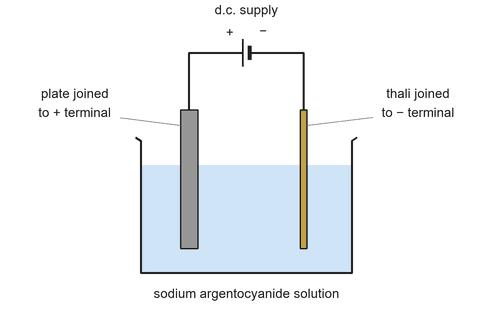
Farhan, a new apprentice, plates three identical thalis in three separate, freshly made baths and notes down what he finds.
| Trial | Plate joined to the positive terminal | Current | Time | Result |
|---|---|---|---|---|
| 1 | Silver | Large | 4 minutes | Dull, rough coating that rubs off; bath as strong as before |
| 2 | Silver | Small | 40 minutes | Smooth, bright, firm coating; bath as strong as before |
| 3 | Graphite | Small | 40 minutes | Smooth, bright coating; bath weaker than before |
(a) What do Trials 1 and 2 show about the current and the time that should be used for electroplating?
(b) Explain why the bath stays as strong as before in Trial 2 but becomes weaker in Trial 3. Write the equation for the reaction at the silver plate in Trial 2.
(c) In Trial 2 the silver plate became lighter by 2.16 g. Find the mass of silver deposited on the thali and the number of electrons taken up by the silver ions at the thali. (Ag = 108; Avogadro's number = )