
Opening your dashboard
Class 10 Chemistry Chapter 6 Electrolysis: Practice Questions
45 questions on Chapter 6, each worked through on its own page with the AI tutor. Class 10 Chemistry, ICSE 2026-27.
45 questions
1–5 marks · Mixed difficulty
- 11 mark
Question 1
Bloom's level: Remember
Which of the following allows an electric current to pass through it without undergoing any chemical change?
- 21 mark
Question 2
Bloom's level: Apply
Four liquids are tested one by one in a circuit containing a bulb.
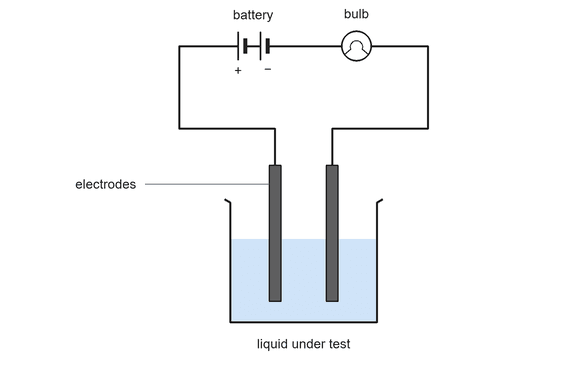
Which liquid will make the bulb glow only dimly?
- 31 mark
Question 3
Bloom's level: Apply
Blue copper (II) sulphate solution is kept in four vessels made of different metals. In which vessel will the solution stay blue?
- 41 mark
Question 4
Bloom's level: Remember
Which of the following is not one of the factors that decide the selective discharge of ions?
- 51 mark
Question 5
Bloom's level: Apply
Silver nitrate solution is electrolysed using platinum electrodes. The products at the cathode and at the anode respectively are:
- 61 mark
Question 6
Bloom's level: Understand
Electrolysis is carried out with direct current (d.c.) and not alternating current (a.c.) because:
- 71 mark
Question 7
Bloom's level: Analyse
A student electrolyses blue copper (II) sulphate solution for an hour and records:
- the blue colour of the solution has faded;
- the solution has become acidic;
- a reddish-brown layer has formed on the cathode, and the anode has not changed in mass.
Which electrodes did the student use?
- 81 mark
Question 8
Bloom's level: Apply
Kavya wants to electroplate a copper bracelet with nickel. Which set-up will work?
- 91 mark
Question 9
Bloom's level: Analyse
Three metals P, Q and R are tested. P displaces Q from a solution of a salt of Q, and Q displaces R from a solution of a salt of R. Arrange the cations of these metals in the order in which they are discharged at the cathode, most easily discharged first.
- 101 mark
Question 10
Bloom's level: Understand
Assertion (A): Pure water is a good conductor of electricity.
Reason (R): Water ionises very slightly:
- 111 mark
Question 11
Bloom's level: Understand
Assertion (A): When concentrated sodium chloride solution is electrolysed with inert electrodes, chlorine and not oxygen is liberated at the anode.
Reason (R): In concentrated sodium chloride solution, chloride ions are present in a much higher concentration than hydroxide ions.
- 121 mark
Question 12
Bloom's level: Understand
Assertion (A): A solution of sugar in water does not conduct electricity.
Reason (R): Sugar is a covalent compound.
- 132 marks
Question 13
Bloom's level: Remember
(a) Write the first five metals of the electrochemical series, in order, starting from the top.
(b) Between which two metals is hydrogen placed in the series?
- 141 mark
Question 14
Bloom's level: Remember
The word electrolysis is made of two parts. Name them and give the meaning of each.
- 152 marks
Question 15
Bloom's level: Understand
Explain how the polar water molecules set free the sodium and chloride ions when solid sodium chloride dissolves in water.
- 162 marks
Question 16
Bloom's level: Apply
Write equations to show the ions formed when:
(a) hydrogen chloride gas is dissolved in water (show the ion formed with water)
(b) potassium chloride is dissolved in water
State which process is ionisation and which is electrolytic dissociation.
- 172 marks
Question 17
Bloom's level: Apply
An aqueous solution of sodium sulphate is electrolysed using platinum electrodes. Name the product at each electrode, giving a reason in each case.
- 182 marks
Question 18
Bloom's level: Understand
Explain why only hydrogen and metals are liberated at the cathode, while non-metals are liberated at the anode, during electrolysis.
- 192 marks
Question 19
Bloom's level: Apply
Molten calcium chloride is electrolysed using graphite electrodes. Write the equation for the dissociation of the electrolyte and the reactions at the cathode and the anode. Name the product at each electrode.
- 202 marks
Question 20
Bloom's level: Evaluate
For the electro-refining of copper, a student plans to use a block of pure copper as the anode and the impure copper as the cathode, with acidified copper sulphate solution. Judge the plan and correct it.
- 212 marks
Question 21
Bloom's level: Analyse
During the electrolysis of acidified water with platinum electrodes, 24 cm³ of gas is collected at the cathode. Name the gases at the two electrodes and find the volume of gas at the anode (same conditions). Explain your answer using the electrode reactions.
- 222 marks
Question 22
Bloom's level: Understand
Copy and complete the table for three electrolyses studied in this chapter.
Electrolyte Electrodes Product at cathode Product at anode Molten lead bromide Graphite (a) (b) Acidified water Platinum (c) (d) Copper (II) sulphate solution Copper (e) (f) - 235 marks
Question 23
Bloom's level: Apply
A bicycle shop nickel-plates steel handlebars so that they do not rust and look shiny. (Ni = 59)
(a) Name the cathode, the anode and the electrolyte used.
(b) Write the reactions at the cathode and at the anode.
(c) During one plating, the nickel anode loses 2.95 g. What mass of nickel is deposited on the handlebar, and how many moles of electrons pass through the circuit? Explain why the concentration of nickel ions in the electrolyte stays the same.
- 245 marks
Question 24
Bloom's level: Analyse
A factory refines impure copper that contains small amounts of zinc, iron, silver and gold.
(a) Name the anode, the cathode and the electrolyte used.
(b) Write the reactions at the anode and at the cathode for copper.
(c) Using the electrochemical series, explain what happens to the zinc and iron impurities and to the silver and gold impurities. Hence explain why the mass gained by the cathode is less than the mass lost by the anode.
- 254 marks
Question 25
Bloom's level: Evaluate
A farmer prepares a copper sulphate spray and stores it overnight in a galvanised (zinc-coated) iron bucket. Next morning the solution has lost its blue colour and a reddish-brown powder lies at the bottom.
(a) Explain the observation using the electrochemical series.
(b) Write the equation for the reaction.
(c) The farmer can choose a plastic, an aluminium, an iron or a copper container for storing the spray. Judge each choice and recommend the best ones.
- 264 marks
Question 26
Bloom's level: Analyse
A solution contains equal concentrations of copper (II) nitrate, zinc nitrate and silver nitrate. It is electrolysed for a long time using platinum electrodes.
(a) In what order are the cations discharged at the cathode? Give a reason.
(b) What is formed at the cathode after all the silver and copper ions have been discharged? Will zinc be deposited?
(c) Name the product at the anode, and state how the nature of the solution changes during the electrolysis.
- 274 marks
Question 27
Bloom's level: Evaluate
While revising this chapter, a student writes four statements. Judge whether each is correct, and correct the wrong ones with a reason.
(a) Metals conduct electricity by the movement of ions.
(b) In an electrolytic cell, the anode is connected to the negative terminal of the battery.
(c) The reaction at the cathode is always a reduction.
(d) Strong electrolytes contain both ions and molecules in solution.
- 285 marks
Question 28
Bloom's level: Create
You are given a battery, a torch bulb in a holder, two carbon rods, connecting wires, beakers and these liquids: dilute hydrochloric acid, vinegar (acetic acid solution), sugar solution, sodium hydroxide solution and kerosene.
(a) Describe how you would set up the circuit and carry out a fair test.
(b) Design a results table, fill in the expected observations and classify each liquid as a strong electrolyte, a weak electrolyte or a non-electrolyte.
(c) Name the particles present in each class of liquid.
- 295 marks
Question 29
Bloom's level: Create
Plan the electrolysis of water in a voltameter to collect hydrogen and oxygen separately.
(a) Choose the electrodes and say what must be added to the water, giving a reason for each choice.
(b) Write the reactions at the cathode and the anode.
(c) Predict the volumes of hydrogen and oxygen (at S.T.P.) you would collect when 0.02 mole of electrons passes through the cell.
- 304 marks
Question 30
Bloom's level: Apply
Element X has atomic number 12 and element Y has atomic number 17. They combine to form compound Z.
(a) Write the formula of Z and state the type of bond in it.
(b) Predict whether Z conducts electricity in the solid state, in the molten state and in aqueous solution. Explain each prediction.
(c) Molten Z is electrolysed using graphite electrodes. Write the reactions at the cathode and at the anode.
- 311 mark
Question 31
Which pair consists of a strong electrolyte followed by a non-electrolyte ?
- 321 mark
Question 32
An aqueous solution contains silver nitrate, copper(II) nitrate and zinc nitrate in equal concentrations. It is electrolysed using platinum electrodes. The metal deposited first at the cathode is :
- 331 mark
Question 33
Assertion (A): Solid sodium chloride does not conduct electricity, but molten sodium chloride does.
Reason (R): Sodium chloride contains ions only when it is in the molten state.
- 342 marks
Question 34
Sodium chloride and hydrogen chloride both give ions when they are dissolved in water.
(i) For which of the two is the process called dissociation, and for which is it called ionisation ? Give a reason for your answer.
(ii) Write the equation to show how hydrogen chloride forms ions in water.
- 352 marks
Question 35
The two electrode reactions given below take place during the electrolysis of a molten salt.
X :
Y :
(i) State which of the reactions takes place at the cathode and which at the anode.
(ii) State which of the reactions is an oxidation and which is a reduction. Give a reason in terms of electrons.
- 362 marks
Question 36
Aqueous copper(II) sulphate is electrolysed using platinum electrodes. The solution contains the ions , , and .
(i) Name the ion discharged at the cathode and the ion discharged at the anode. Give a reason for each choice.
(ii) State and explain the change in the colour of the solution as the electrolysis continues.
- 372 marks
Question 37
Acidified water is electrolysed using platinum electrodes. In a certain time 30 cm³ of gas collects at the cathode.
(i) Name the gas collected at each electrode and state the volume of gas collected at the anode in the same time, measured under the same conditions.
(ii) Why is the water acidified with a little dilute sulphuric acid before it is electrolysed ?
- 384 marks
Question 38
Lead bromide is electrolysed in a silica crucible using graphite electrodes. The crucible is heated strongly throughout the experiment.
(i) Explain why the crucible has to be heated throughout the experiment.
(ii) Write the reactions taking place at the cathode and at the anode.
(iii) State what is observed at each electrode, and give one reason why graphite is preferred to platinum for the anode.
- 394 marks
Question 39
The diagram shows the apparatus used to refine impure copper by electrolysis. P and Q are the two copper electrodes, and R is a solid that collects below P as the process goes on.
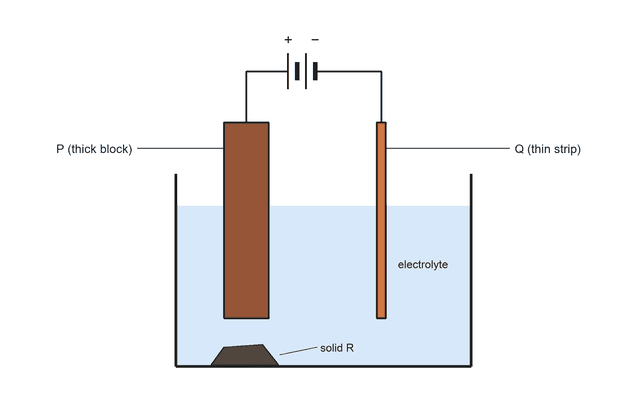
(i) Which electrode, P or Q, is the impure copper ? Give a reason based on the way it is connected to the battery.
(ii) Name the electrolyte used and write the reactions taking place at P and at Q.
(iii) Name the solid R and name one metal that may be present in it.
- 403 marks
Question 40
A brass trophy is to be electroplated with silver.
(i) Name the electrolyte used. Why is silver nitrate solution not used as the electrolyte ?
(ii) State what is used as the anode and as the cathode, and write the reaction taking place at each electrode.
(iii) State two conditions necessary to obtain a smooth and firm deposit of silver.
- 411 mark
Question 41
A clean copper strip is left in colourless silver nitrate solution. After some time the solution turns blue and a shiny grey deposit covers the strip.
Give a balanced equation for the change.
- 422 marks
Question 42
Each aqueous solution below contains the ions shown and is electrolysed using inert electrodes. Name the ion that is discharged in preference to the others.
(a) At the anode: , ,
(b) At the cathode: , ,
- 433 marks
Question 43
Give the term for each of the following.
(a) A compound that conducts electricity when molten or dissolved in water and is decomposed by the current.
(b) A compound of this kind that is almost completely ionised, so that a large current passes through its solution.
(c) The electrode that is wired to the positive pole of the battery.
- 443 marks
Question 44
Aqueous copper(II) sulphate is electrolysed using platinum electrodes.
(a) State what is seen at each electrode and what happens to the colour of the solution.
(b) How does the mass of each electrode change during the electrolysis?
- 453 marks
Question 45
(a) An aluminium wire conducts electricity very well, yet aluminium is not called an electrolyte. Explain.
(b) Acidified water is electrolysed using platinum electrodes. Name the gas collected at each electrode and give the ratio of their volumes.