
Opening your dashboard
Class 10 Maths Chapter 15: Similarity Solutions
120 textbook questions with step-by-step answers, free to read, for ICSE 2026-27.
Get talked through Ch 15, not just shown the answer
Reading a finished solution is not the same as being able to do it. The AI tutor takes one question at a time and works it with you, in your own words, until you can.
- Ask it out loud, in your own words
- It gives you the next step, not the answer
- Stuck on part (ii)? Start there
120 questions with solutions
1–3 marks · Mixed difficulty
The first 58 solutions are on this page. This chapter is a long one, so the rest open on their own page to keep this one quick to load.
- 11 mark
Question 1
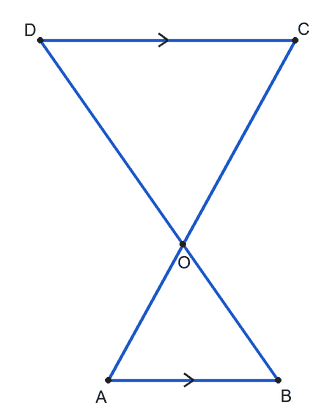
In the given diagram OC = 1·5 × OA, then OB is equal to :
 Solve with AI
Answer
(A) 3 × OD
(B) 1·5 × OD
- Correct
(C) × OD
(D) OD
Answer: (C) × OD
Concept: When two straight lines cross at a point O and the segments joining their ends are parallel, the two triangles formed at O are similar (AA). The angles at O are vertically opposite, so they are equal, and the parallel lines make equal alternate angles with each crossing line.
Step 1 — Name the similar triangles.
In the figure DC ∥ AB, and the lines AC and BD cross at O. In ΔOAB and ΔOCD, ∠AOB = ∠COD because they are vertically opposite, and ∠OAB = ∠OCD because they are alternate angles (AB ∥ DC, with AC as the crossing line). So ΔOAB ~ ΔOCD by AA, with A matching C and B matching D.
Step 2 — Write the ratio of corresponding sides.
Corresponding sides are in the same ratio, so OB is to OD as OA is to OC:
Step 3 — Put in OC = 1.5 × OA.
Since OC = 1.5 × OA, the ratio OA : OC does not depend on the actual lengths:
Therefore , which means OB = × OD.
Watch out: OC is the LONGER part (1.5 times OA), so OB, which matches OA, is the shorter part: OB is less than OD.
Why the other options are wrong:
- (A) 3 × OD: this would make OB three times OD, but OB matches OA, which is the shorter of OA and OC.
- (B) 1·5 × OD: this turns the ratio upside down. OD matches OC, so OD = 1.5 × OB, not OB = 1.5 × OD.
- (D) OD: this needs OA and OC to be equal (O the mid-point of AC), but here OC = 1.5 × OA.
Therefore, OB = × OD, option (C).
- 21 mark
Question 2
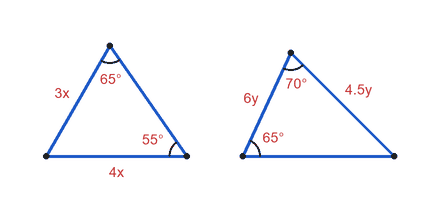
Are the given triangles similar ?
 Solve with AI
Answer
(A) Yes
- Correct
(B) No
(C) None of these
Answer: (B) No
Concept: AA rule: If two angles of one triangle are equal to two angles of another triangle, the third angles are equal too (the angles of a triangle add up to 180°), so the triangles are similar. Their corresponding sides are then in the same ratio.
Step 1 — Find the third angle of each triangle.
The angles of a triangle add up to 180°. In the first triangle the two marked angles are 65° and 55°, so the third angle (between the sides 3x and 4x) is:
In the second triangle the marked angles are 70° and 65°, so its third angle is:
Step 2 — Compare the angles.
The first triangle has angles 65°, 55° and 60°. The second has angles 70°, 65° and 45°. Only the 65° angle is common; the other angles do not match, so the triangles are not equiangular.
Step 3 — Check the sides as well.
The sides 3x and 4x are in the ratio 3 : 4, and the sides 4.5y and 6y are also in the ratio 3 : 4. But SAS needs the angles BETWEEN these sides to be equal, and they are 60° and 70°. So SAS does not apply either.
Watch out: Sides in the same ratio are not enough: for SAS the angle between those two sides must also be equal.
Why the other options are wrong:
- (A) Yes: similar triangles have all three angles equal, but here only one angle (65°) is common.
- (C) None of these: the question has a definite answer: the angles show that the triangles are not similar.
Therefore, the triangles are not similar, option (B).
- 31 mark
Question 3
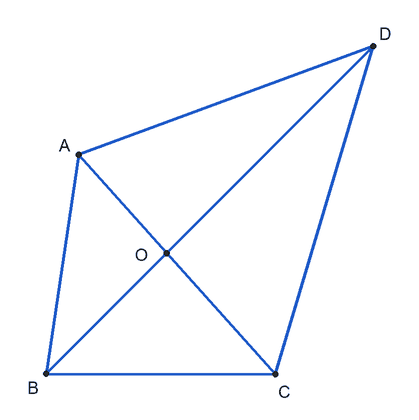
In the given figure, OA = 5, OB = 6, OC = 3 and OD = 10, then :
 Solve with AI
Answer
(A) ΔAOB ~ ΔAOD
(B) ΔAOB ~ ΔBOC
(C) ΔBOC ~ ΔCOD
- Correct
(D) ΔAOD ~ ΔCOB
Answer: (D) ΔAOD ~ ΔCOB
Concept: SAS rule for similarity: If one angle of a triangle equals one angle of another triangle, and the sides that form these angles are in the same ratio, the two triangles are similar.
Step 1 — Look for an equal angle.
The diagonals AC and BD cross at O, so ∠AOD and ∠COB are vertically opposite angles. Hence ∠AOD = ∠COB.
Step 2 — Compare the sides around these angles.
In ΔAOD the sides around ∠AOD are OA and OD. In ΔCOB the sides around ∠COB are OC and OB. We pair the shorter with the shorter and the longer with the longer:
Both ratios are , so the sides around the equal angles are in proportion.
Step 3 — Apply SAS.
One pair of equal angles with the sides around them in proportion gives ΔAOD ~ ΔCOB, with A matching C, O matching O and D matching B.
Watch out: Write the triangles in matching order. Find which angle equals which first, then read the corresponding sides from the same positions in the two names.
Why the other options are wrong:
- (A) ΔAOB ~ ΔAOD: ∠AOB and ∠AOD are not equal (together they make a straight angle), and the side ratio OB : OD, which is 6 : 10, is not OA : OA, which is 1.
- (B) ΔAOB ~ ΔBOC: in this order OA would match OB and OB would match OC, but is not equal to .
- (C) ΔBOC ~ ΔCOD: in this order OB would match OC and OC would match OD, but is not equal to .
Therefore, ΔAOD ~ ΔCOB, option (D).
- 41 mark
Question 4
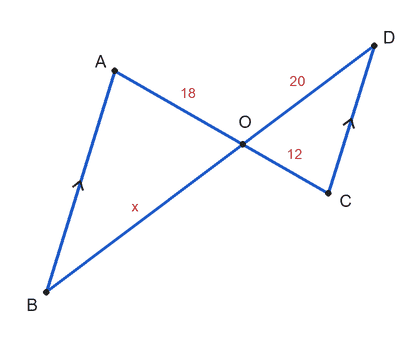
In the given figure, AB ∥ DC, AO = 18, OD = 20, OC = 12 and BO = . The value of is :
 Solve with AI
Answer
(A) 15
- Correct
(B) 30
(C) 36
(D) 40
Answer: (B) 30
Concept: When two straight lines cross at a point O and the segments joining their ends are parallel, the two triangles formed at O are similar (AA). The angles at O are vertically opposite, so they are equal, and the parallel lines make equal alternate angles with each crossing line.
Step 1 — Name the similar triangles.
AB ∥ DC, and AC and BD cross at O. ∠AOB = ∠COD (vertically opposite) and ∠OAB = ∠OCD (alternate angles), so ΔAOB ~ ΔCOD with A matching C and B matching D.
Step 2 — Write the ratio and put in the lengths.
Corresponding sides are in the same ratio. AO matches CO, and BO matches DO:
Step 3 — Solve for x.
We multiply both sides by 20:
Check: and . ✓
Watch out: BO lies on the same line as OD, so BO is compared with OD; AO, on the other line, is compared with CO.
Why the other options are wrong:
- (A) 15: with x = 15 the ratio BO : DO is 15 : 20, that is 0.75, but it must equal AO : CO, which is 1.5.
- (C) 36: with x = 36 the ratio BO : DO is 36 : 20, that is 1.8, not 1.5.
- (D) 40: with x = 40, , which would need AO to be twice CO; but 18 is not 24.
Therefore, x = 30, option (B).
- 53 marks
Question 5
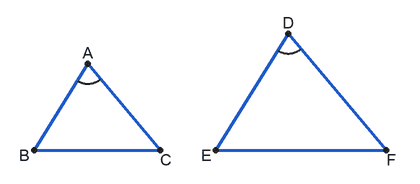
In triangles ABC and DEF, ∠A = ∠D and , then prove that ΔABC ~ ΔDEF.
 Solve with AI
Written solution
Solution:
Concept: SAS rule for similarity: If one angle of a triangle equals one angle of another triangle, and the sides that form these angles are in the same ratio, the two triangles are similar.
Given: ∠A = ∠D and .
Step 1 — Rearrange the given ratio.
Cross-multiplying the given ratio gives AB × DF = AC × DE. Dividing both sides by DE × DF compares each side of ΔABC with a side of ΔDEF:
Step 2 — Look at the angle between these sides.
AB and AC are the two sides that form ∠A in ΔABC. DE and DF are the two sides that form ∠D in ΔDEF. We are also given ∠A = ∠D.
Step 3 — Apply SAS.
One angle of ΔABC equals one angle of ΔDEF, and the sides forming these angles are in the same ratio. By the SAS rule, the triangles are similar, with A matching D, B matching E and C matching F.
Watch out: The ratio must compare the two sides that make the EQUAL angle; the third sides BC and EF are not used.
Therefore, ΔABC ~ ΔDEF (SAS). Hence proved.
- 63 marks
Question 6
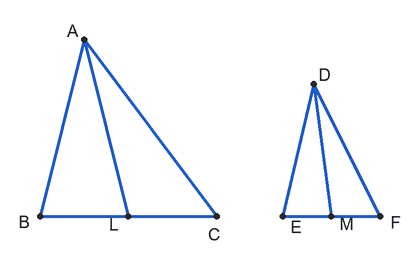
In ΔABC and ΔDEF, ∠A = ∠D, ∠B = ∠E and ∠C = ∠F. Also, AL and DM are medians. Prove that .
 Solve with AI
Written solution
Solution:
Concept: SAS rule for similarity: If one angle of a triangle equals one angle of another triangle, and the sides that form these angles are in the same ratio, the two triangles are similar.
Given: ∠A = ∠D, ∠B = ∠E, ∠C = ∠F; AL and DM are medians.
Step 1 — The two triangles are similar.
All three angles of ΔABC equal those of ΔDEF, so ΔABC ~ ΔDEF and their corresponding sides are in proportion:
Step 2 — Use the mid-points.
AL is a median, so L is the mid-point of BC and BL = BC. In the same way, M is the mid-point of EF and EM = EF. Halving both sides of a ratio keeps the ratio the same:
Step 3 — Show ΔABL ~ ΔDEM.
In ΔABL and ΔDEM, ∠B = ∠E (given), and the sides forming these angles are in proportion, from Step 2. So ΔABL ~ ΔDEM by SAS, with A matching D, B matching E and L matching M.
Step 4 — Compare the medians.
Corresponding sides of ΔABL and ΔDEM are in the same ratio, so the third sides AL and DM are in the ratio . From Step 1 this ratio is also :
Watch out: A median goes to the MID-POINT of the opposite side; that is what makes BL and EM halves of BC and EF.
Therefore, . Hence proved.
- 73 marks
Question 7
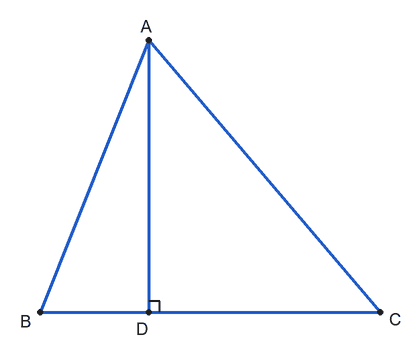
In ΔABC, AD is perpendicular to side BC and AD² = BD × CD, prove that ∠BAC = 90°.
 Solve with AI
Written solution
Solution:
Concept: SAS rule for similarity: If one angle of a triangle equals one angle of another triangle, and the sides that form these angles are in the same ratio, the two triangles are similar.
Given: AD ⟂ BC and AD² = BD × CD.
Step 1 — Rewrite the given condition as a ratio.
We are given AD² = BD × CD, that is AD × AD = BD × CD. Dividing both sides by BD × AD gives:
Step 2 — Show ΔADB ~ ΔCDA.
In ΔADB and ΔCDA, the angles ∠ADB and ∠CDA are both 90°, because AD ⟂ BC. The sides forming these right angles are AD, BD in the first triangle and CD, AD in the second, and Step 1 shows they are in proportion. So ΔADB ~ ΔCDA by SAS, with A matching C, D matching D and B matching A.
Step 3 — Read off equal angles.
Corresponding angles of similar triangles are equal. ∠BAD (at A in ΔADB) matches ∠ACD (at C in ΔCDA), so ∠BAD = ∠ACD.
Step 4 — Add the two angles at A.
∠BAC is made of ∠BAD and ∠DAC. We replace ∠BAD by the equal angle ∠ACD:
In ΔADC the angle at D is 90°, so the other two angles, ∠ACD and ∠DAC, add up to 90°. Hence ∠BAC = 90°.
Watch out: Match the vertices with care: the angle at A in ΔADB matches the angle at C in ΔCDA, not the angle at A.
Therefore, ∠BAC = 90°. Hence proved.
- 83 marks
Question 8
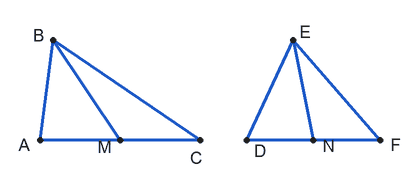
In the given figure, ΔABC and ΔDEF are similar. BM and EN are their medians. If ΔABC is similar to ΔDEF, prove that :
(i) ΔAMB ~ ΔDNE (ii) ΔCMB ~ ΔFNE (iii)
 Solve with AI
Written solution
Solution:
Concept: SAS rule for similarity: If one angle of a triangle equals one angle of another triangle, and the sides that form these angles are in the same ratio, the two triangles are similar.
Given: ΔABC ~ ΔDEF; BM and EN are medians, so M and N are the mid-points of AC and DF.
Step 1 — Write what the similarity gives.
Since ΔABC ~ ΔDEF, the corresponding angles are equal, ∠A = ∠D and ∠C = ∠F, and the corresponding sides are in proportion:
Step 2 — Use the mid-points M and N.
BM is a median, so M is the mid-point of AC, and AM and MC are each half of AC. In the same way DN and NF are each half of DF. Halves of two lengths are in the same ratio as the lengths:
Step 3 — Part (i): ΔAMB ~ ΔDNE.
In ΔAMB and ΔDNE, ∠A = ∠D, and the sides forming these angles are in proportion: (Step 2). So ΔAMB ~ ΔDNE by SAS.
Step 4 — Part (ii): ΔCMB ~ ΔFNE.
In ΔCMB and ΔFNE, ∠C = ∠F. The sides forming them are CB, CM and FE, FN, and , because both equal (Steps 1 and 2). So ΔCMB ~ ΔFNE by SAS.
Step 5 — Part (iii): compare the medians.
From part (i), the third sides BM and EN of the similar triangles AMB and DNE are in the same ratio as AB and DE, and from Step 1 that ratio equals :
Watch out: For SAS use the equal angle (∠A or ∠C) and the two sides that form it, not any two sides.
Therefore, (i) ΔAMB ~ ΔDNE, (ii) ΔCMB ~ ΔFNE and (iii) . Hence proved.
- 93 marks
Question 9
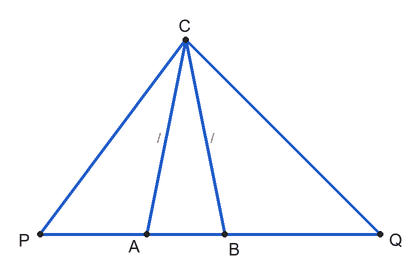
In the given figure, ΔABC is isosceles and AP × BQ = AC², prove that ΔACP ~ ΔBCQ.
 Solve with AI
Written solution
Solution:
Concept: SAS rule for similarity: If one angle of a triangle equals one angle of another triangle, and the sides that form these angles are in the same ratio, the two triangles are similar.
Given: CA = CB, and P, A, B, Q are on one line with AP × BQ = AC².
Step 1 — Find a pair of equal angles.
ΔABC is isosceles with CA = CB (the tick marks), so the base angles are equal: ∠CAB = ∠CBA. P, A, B and Q lie on one straight line, so ∠CAP and ∠CBQ are the supplements of these equal angles:
Step 2 — Turn the product into a ratio.
Since AC and BC are equal, AC² can be written as AC × BC, so the given product becomes AP × BQ = AC × BC. Dividing both sides by BC × BQ gives:
Step 3 — Apply SAS.
In ΔCAP the sides forming ∠CAP are AP and AC. In ΔQBC the sides forming the equal angle ∠CBQ are BC and BQ. By Step 2, AP matches BC and AC matches BQ, and the ratios are equal. So the triangles are similar by SAS, with A matching B, P matching C and C matching Q:
Watch out: The equal angles are the angles OUTSIDE the triangle, ∠CAP and ∠CBQ, not the base angles themselves.
Note: Written with the vertices in matching order the result is ΔACP ~ ΔBQC; the book's ΔBCQ names the same triangle.
Therefore, ΔACP ~ ΔBCQ. Hence proved.
- 101 mark
Question 10
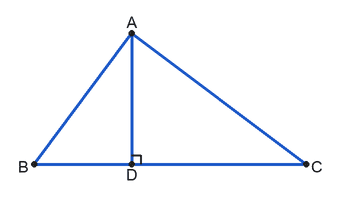
In triangle ABC, ∠BAC = 90° and AD is perpendicular to side BC. Triangle ABD is similar to triangle CBA by :
 Solve with AI
Answer
(A) SAS
(B) ASA
- Correct
(C) AAA
(D) RHS
Answer: (C) AAA
Concept: AA rule: If two angles of one triangle are equal to two angles of another triangle, the third angles are equal too (the angles of a triangle add up to 180°), so the triangles are similar. Their corresponding sides are then in the same ratio.
Step 1 — Match the right angles.
AD ⟂ BC, so ∠ADB is 90°. We are given ∠BAC = 90°, which is ∠CAB in ΔCBA. So the angle at D in ΔABD equals the angle at A in ΔCBA.
Step 2 — Find the common angle.
∠ABD and ∠CBA are the same angle at B, because D lies on BC. So the angle at B is common to both triangles.
Step 3 — The third angles are equal too.
The angles of each triangle add up to 180°, so once two pairs of angles are equal, the third pair (∠BAD and ∠BCA) must be equal as well. All three angles match, which is the AAA (or AA) rule of similarity.
Watch out: RHS proves CONGRUENCE (equal triangles). Similar triangles may have different sizes, so a congruence rule is not the reason here.
Why the other options are wrong:
- (A) SAS: SAS needs two sides of each triangle in the same ratio, and no lengths are given at all.
- (B) ASA: ASA is a congruence rule; it needs a pair of EQUAL sides, and ΔABD is smaller than ΔCBA.
- (D) RHS: RHS is a congruence rule for right triangles with equal hypotenuses and equal sides; these triangles are not equal in size.
Therefore, ΔABD ~ ΔCBA by AAA, option (C).
- 111 mark
Question 11
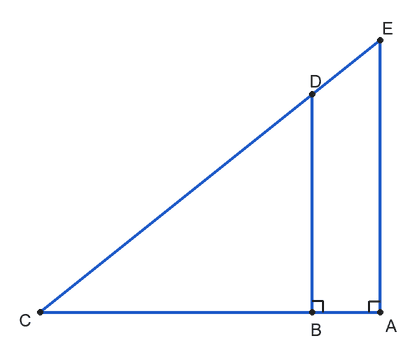
If AE = 10 cm, BD = 8 cm and BC = 10 cm, then AB is equal to :
 Solve with AI
Answer
(A) 5 cm
(B) 25 cm
(C) 12·5 cm
- Correct
(D) 2·5 cm
Answer: (D) 2·5 cm
Concept: AA rule: If two angles of one triangle are equal to two angles of another triangle, the third angles are equal too (the angles of a triangle add up to 180°), so the triangles are similar. Their corresponding sides are then in the same ratio.
Step 1 — See the parallel lines.
In the figure DB ⟂ CA and EA ⟂ CA. Two lines perpendicular to the same line are parallel, so DB ∥ EA.
Step 2 — Name the similar triangles.
In ΔCBD and ΔCAE, ∠C is common, and ∠CBD and ∠CAE are both 90°. So ΔCBD ~ ΔCAE by AA, with B matching A and D matching E.
Step 3 — Find CA.
Corresponding sides are in the same ratio, so CB is to CA as BD is to AE:
Cross-multiplying gives 8 × CA = 100:
Step 4 — Find AB.
B lies between C and A, so AB is the part of CA beyond CB:
Watch out: 12.5 cm is the whole of CA. The question asks for AB, the short piece between B and A.
Why the other options are wrong:
- (A) 5 cm: if AB were 5 cm, CA would be 15 cm and BD : AE would have to be 10 : 15, but it is 8 : 10.
- (B) 25 cm: if AB were 25 cm, CA would be 35 cm, and 10 : 35 is not 8 : 10.
- (C) 12·5 cm: 12.5 cm is the length of CA, the whole side, not of AB.
Therefore, AB = 2.5 cm, option (D).
- 121 mark
Question 12
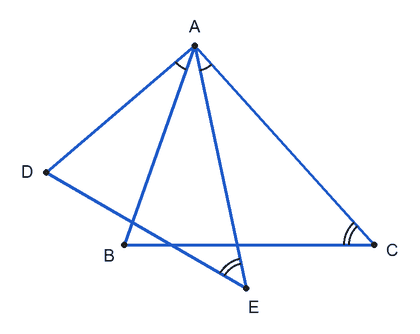
In the given figure (∠DAB = ∠EAC and ∠AED = ∠ACB, as marked) :
 Solve with AI
Answer
(A) ΔABE ~ ΔADE
- Correct
(B) ΔADE ~ ΔABC
(C) ΔADE ~ ΔBAC
(D) ΔADE ~ ΔCAB
Answer: (B) ΔADE ~ ΔABC
Concept: AA rule: If two angles of one triangle are equal to two angles of another triangle, the third angles are equal too (the angles of a triangle add up to 180°), so the triangles are similar. Their corresponding sides are then in the same ratio.
Step 1 — Make the angles at A match.
We add the same angle ∠BAE to both of the equal angles ∠DAB and ∠EAC. Equal angles plus the same angle stay equal. ∠DAB + ∠BAE makes ∠DAE, and ∠BAE + ∠EAC makes ∠BAC:
Step 2 — Use the second pair of angles.
We are also given ∠AED = ∠ACB (the double arcs). So ΔADE and ΔABC have two pairs of equal angles.
Step 3 — Write the similarity in matching order.
The angle at A matches the angle at A, the angle at E matches the angle at C, so D matches B. By AA, ΔADE ~ ΔABC.
Watch out: Write the triangles in matching order. Find which angle equals which first, then read the corresponding sides from the same positions in the two names.
Why the other options are wrong:
- (A) ΔABE ~ ΔADE: the given equal angles are not angles of ΔABE, so nothing given links ΔABE with ΔADE.
- (C) ΔADE ~ ΔBAC: in this order A would match B and E would match C; but the equal angles pair A with A, and E with C.
- (D) ΔADE ~ ΔCAB: in this order A would match C and D would match A; the equal angles pair A with A, so this order is wrong.
Therefore, ΔADE ~ ΔABC, option (B).
- 131 mark
Question 13
The value of is :
 Solve with AI
Answer
- Correct
(A) 2
(B) 3
(C) 1
(D) none of these
Answer: (A) 2
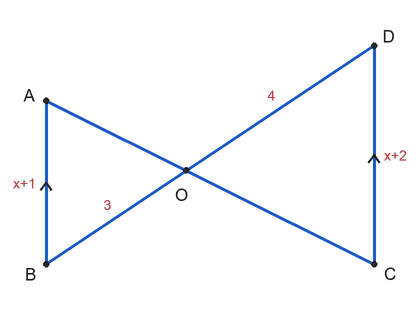
Concept: When two straight lines cross at a point O and the segments joining their ends are parallel, the two triangles formed at O are similar (AA). The angles at O are vertically opposite, so they are equal, and the parallel lines make equal alternate angles with each crossing line.
Step 1 — Name the similar triangles.
AB ∥ DC, and AC and BD cross at O. ∠AOB = ∠COD (vertically opposite) and ∠ABO = ∠CDO (alternate angles), so ΔOAB ~ ΔOCD, with A matching C and B matching D.
Step 2 — Write the ratio of sides.
AB matches CD, and BO matches DO, so their ratios are equal:
Step 3 — Solve the equation.
We cross-multiply and collect the x terms on one side:
Check: With x = 2, AB = 3 and DC = 4, and . ✓
Watch out: AB, with x + 1, is the side opposite O in the triangle with BO = 3, so it is compared with DC, not with DO.
Why the other options are wrong:
- (B) 3: with x = 3, AB : DC is 4 : 5, not 3 : 4.
- (C) 1: with x = 1, AB : DC is 2 : 3, not 3 : 4.
- (D) none of these: x = 2 satisfies the equation, so an answer is listed.
Therefore, x = 2, option (A).
- 143 marks
Question 14
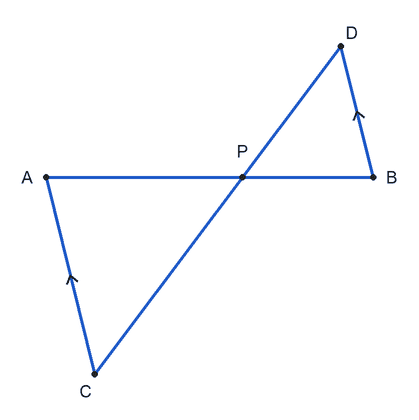
In the figure, given below, straight lines AB and CD intersect at P; and AC ∥ BD. Prove that :
(i) ΔAPC and ΔBPD are similar.
(ii) If BD = 2·4 cm, AC = 3·6 cm, PD = 4·0 cm and PB = 3·2 cm; find the lengths of PA and PC.
 Solve with AI
Written solution
Solution:
Concept: When two straight lines cross at a point O and the segments joining their ends are parallel, the two triangles formed at O are similar (AA). The angles at O are vertically opposite, so they are equal, and the parallel lines make equal alternate angles with each crossing line.
Given: AB and CD meet at P; AC ∥ BD; BD = 2.4 cm, AC = 3.6 cm, PD = 4 cm, PB = 3.2 cm.
Step 1 — Part (i): find two pairs of equal angles.
AB and CD cross at P, so ∠APC = ∠BPD (vertically opposite angles). AC ∥ BD and AB is a line crossing them, so ∠PAC = ∠PBD (alternate angles).
Step 2 — Part (i): conclude.
Two angles of ΔAPC equal two angles of ΔBPD, so ΔAPC ~ ΔBPD by AA, with A matching B, P matching P and C matching D.
Step 3 — Part (ii): write the ratios.
Corresponding sides of the similar triangles are in the same ratio:
The last ratio has both lengths known:
Step 4 — Part (ii): find PA.
Since , PA is 1.5 times PB:
Step 5 — Part (ii): find PC.
Since , PC is 1.5 times PD:
Watch out: PA is on line AB, so it is compared with PB (the other part of AB), and PC with PD.
Therefore, (i) ΔAPC ~ ΔBPD; (ii) PA = 4.8 cm and PC = 6 cm.
- 153 marks
Question 15
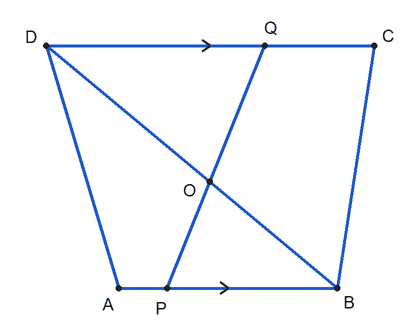
In the given figure, AB ∥ DC, BO = 6 cm and DQ = 8 cm; find: BP × DO.
 Solve with AI
Written solution
Solution:
Concept: When two straight lines cross at a point O and the segments joining their ends are parallel, the two triangles formed at O are similar (AA). The angles at O are vertically opposite, so they are equal, and the parallel lines make equal alternate angles with each crossing line.
Given: AB ∥ DC, BO = 6 cm, DQ = 8 cm; we need BP × DO.
Step 1 — Find two pairs of equal angles.
PQ and DB cross at O, so ∠BOP = ∠DOQ (vertically opposite). AB ∥ DC and DB crosses them, so ∠OBP = ∠ODQ (alternate angles).
Step 2 — Name the similar triangles.
By AA, ΔOBP ~ ΔODQ, with B matching D and P matching Q.
Step 3 — Write the ratio and cross-multiply.
Corresponding sides are in the same ratio, so BP is to DQ as BO is to DO:
Cross-multiplying puts the two lengths we want on one side:
Step 4 — Put in the lengths.
BO = 6 cm and DQ = 8 cm:
Watch out: We cannot find BP and DO separately, but we do not need to: cross-multiplying gives their product at once.
Therefore, BP × DO = 48 cm².
- 163 marks
Question 16
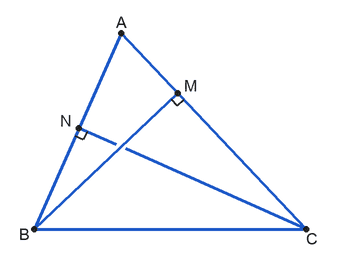
In ΔABC; BM ⟂ AC and CN ⟂ AB; show that :
 Solve with AI
Written solution
Solution:
Concept: AA rule: If two angles of one triangle are equal to two angles of another triangle, the third angles are equal too (the angles of a triangle add up to 180°), so the triangles are similar. Their corresponding sides are then in the same ratio.
Given: BM ⟂ AC and CN ⟂ AB in ΔABC.
Step 1 — Find two pairs of equal angles.
BM ⟂ AC, so ∠AMB is 90°. CN ⟂ AB, so ∠ANC is 90°. Also ∠BAM and ∠CAN are the same angle, ∠A, of ΔABC.
Step 2 — Name the similar triangles.
ΔABM and ΔACN each have a right angle and the angle A, so ΔABM ~ ΔACN by AA, with A matching A, B matching C and M matching N.
Step 3 — Write the ratio of corresponding sides.
Corresponding sides are in the same ratio: AB matches AC, BM matches CN and AM matches AN.
Watch out: BM is the side opposite ∠A in ΔABM and CN is the side opposite ∠A in ΔACN, so they match; read every pair from the same position in the two names.
Therefore, the three ratios , and are equal. Hence proved.
- 173 marks
Question 17
Given : ∠GHE = ∠DFE = 90°, DH = 8, DF = 12, DG = and DE = . Find : the lengths of segments DG and DE.
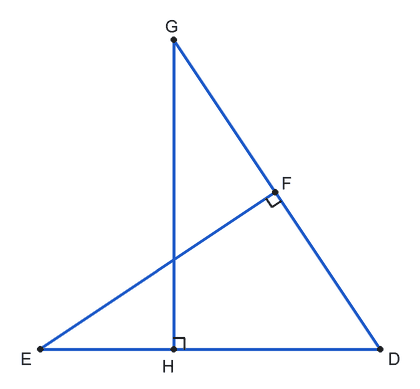 Solve with AI
Written solution
Solution:
Concept: AA rule: If two angles of one triangle are equal to two angles of another triangle, the third angles are equal too (the angles of a triangle add up to 180°), so the triangles are similar. Their corresponding sides are then in the same ratio.
Given: ∠GHE and ∠DFE are right angles, DH = 8, DF = 12, DG = 3x − 1, DE = 4x + 2.
Step 1 — Name the similar triangles.
In ΔDHG and ΔDFE, ∠DHG and ∠DFE are both 90° (given), and ∠D is common to both. So ΔDHG ~ ΔDFE by AA, with H matching F and G matching E.
Step 2 — Write the ratio of sides.
DH (next to the right angle at H) matches DF, and DG (opposite that right angle) matches DE:
Step 3 — Solve for x.
We cross-multiply, open the brackets and collect like terms:
Step 4 — Find DG and DE.
We put x = 7 into both expressions:
Check: DG : DE is 20 : 30, which simplifies to 2 : 3, the same as DH : DF, which is 8 : 12. ✓
Watch out: DG and DE are the sides opposite the right angles (the hypotenuses), so they match each other; DH matches DF.
Therefore, DG = 20 and DE = 30.
- 183 marks
Question 18
In Δ PQR, ∠Q = 90° and QM is perpendicular to PR. Prove that :

(i) PQ² = PM × PR (ii) QR² = PR × MR (iii) PQ² + QR² = PR²
Solve with AIWritten solution
Solution:
Concept: In a right-angled triangle, the perpendicular from the right angle to the hypotenuse splits it into two triangles. Each of them shares an acute angle with the whole triangle and has a right angle, so by AA all three triangles are similar.
Given: In ΔPQR, ∠Q = 90° and QM ⟂ PR.
Step 1 — Part (i): ΔPMQ ~ ΔPQR.
In ΔPMQ and ΔPQR, ∠PMQ = 90° (QM ⟂ PR) and ∠PQR = 90° (given), and ∠P is common. So ΔPMQ ~ ΔPQR by AA, with P matching P, M matching Q and Q matching R.
Step 2 — Part (i): cross-multiply.
Corresponding sides are in the same ratio, so PQ is to PR as PM is to PQ:
Cross-multiplying gives the result:
Step 3 — Part (ii): ΔQMR ~ ΔPQR.
In ΔQMR and ΔPQR, ∠QMR = 90° and ∠PQR = 90°, and ∠R is common. So ΔQMR ~ ΔPQR by AA, with M matching Q and Q matching P.
Step 4 — Part (ii): cross-multiply.
QR is to PR as MR is to QR:
Cross-multiplying gives:
Step 5 — Part (iii): add the two results.
We add (i) and (ii) and take PR out as a common factor. M lies on PR, so PM + MR is the whole of PR:
Watch out: In part (i) the common angle is ∠P and in part (ii) it is ∠R; each small triangle is compared with the WHOLE triangle PQR.
Note: Part (iii) is Pythagoras' theorem, proved here using similar triangles.
Therefore, (i) PQ² = PM × PR, (ii) QR² = PR × MR and (iii) PQ² + QR² = PR². Hence proved.
- 193 marks
Question 19
In ΔABC, ∠B = 90° and BD ⟂ AC.
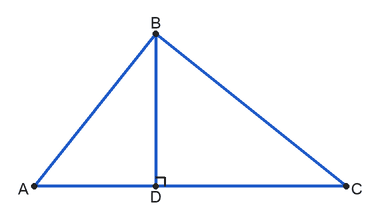
(i) If CD = 10 cm and BD = 8 cm; find AD.
(ii) If AC = 18 cm and AD = 6 cm; find BD.
(iii) If AC = 9 cm and AB = 7 cm; find AD.
Solve with AIWritten solution
Solution:
Concept: In a right-angled triangle, the perpendicular from the right angle to the hypotenuse splits it into two triangles. Each of them shares an acute angle with the whole triangle and has a right angle, so by AA all three triangles are similar.
Given: In ΔABC, ∠B = 90° and BD ⟂ AC.
Step 1 — Two useful results.
ΔADB and ΔBDC both have a right angle at D. Also ∠ABD and ∠C are both equal to 90° − ∠A, so ΔADB ~ ΔBDC by AA. Hence BD is to DC as AD is to BD:
Cross-multiplying gives:
In the same way ΔADB ~ ΔABC (right angles at D and B, and the common angle A). Hence AB is to AC as AD is to AB:
Cross-multiplying gives:
Step 2 — Part (i): find AD.
We use (1) with BD = 8 cm and DC = 10 cm, and divide by 10:
Step 3 — Part (ii): find DC, then BD.
D lies on AC, so DC is the rest of AC after AD:
Now (1) gives BD², and we take the square root:
As a decimal, 6√2 is about 8.49 cm.
Step 4 — Part (iii): find AD.
We use (2) with AB = 7 cm and AC = 9 cm, and divide by 9:
Watch out: In (2) AD is the part of AC NEXT TO A, the end of the side AB; using DC there instead of AD gives a wrong answer.
Therefore, (i) AD = 6.4 cm, (ii) BD = 6√2 cm ≈ 8.49 cm and (iii) AD = cm.
- 203 marks
Question 20
In the right-angled triangle QPR, PM is an altitude. Given that QR = 8 cm and MQ = 3·5 cm, calculate the value of PR.
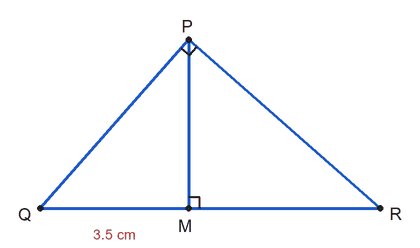 Solve with AI
Written solution
Solution:
Concept: In a right-angled triangle, the perpendicular from the right angle to the hypotenuse splits it into two triangles. Each of them shares an acute angle with the whole triangle and has a right angle, so by AA all three triangles are similar.
Given: ∠QPR = 90°, PM ⟂ QR, QR = 8 cm, MQ = 3.5 cm.
Step 1 — Name the similar triangles.
The right angle of ΔQPR is at P, and PM ⟂ QR. In ΔPMR and ΔQPR, ∠PMR and ∠QPR are both 90°, and ∠R is common. So ΔPMR ~ ΔQPR by AA, with M matching P and P matching Q.
Step 2 — Write the ratio and cross-multiply.
PR matches QR (each is opposite the right angle of its triangle), and MR matches PR:
Cross-multiplying gives:
Step 3 — Find MR.
M lies on QR, so MR is the rest of QR after MQ:
Step 4 — Find PR.
Now we put the numbers in and take the positive square root, since PR is a length:
Watch out: PR is next to MR (both end at R), so PR² uses MR, not MQ. Using MQ gives PQ instead.
Therefore, PR = 6 cm.
- 211 mark
Question 21
In the given figure, OD = 2 × OB, OC = 2 × OA and CD = 2 × AB then ΔAOB ~ ΔCOD by :
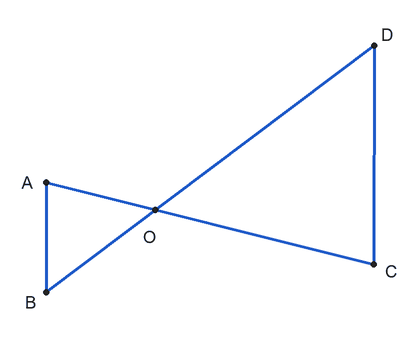 Solve with AI
Answer
(A) AA
(B) SS
- Correct
(C) SAS and SSS
(D) SSS
Answer: (C) SAS and SSS
Concept: SSS rule for similarity: If the three sides of one triangle are in the same ratio to the three sides of another triangle, the two triangles are similar.
Step 1 — Check SSS.
Each side of ΔAOB is half the matching side of ΔCOD: OA is half of OC, OB is half of OD and AB is half of CD. So all three pairs of sides are in the same ratio:
This is the SSS rule.
Step 2 — Check SAS.
∠AOB = ∠COD because they are vertically opposite. The sides forming ∠AOB are OA and OB, and the sides forming ∠COD are OC and OD; their ratios are both . This is the SAS rule.
Step 3 — Choose the option.
Both rules prove ΔAOB ~ ΔCOD, and option (C) names both.
Watch out: Use only what is GIVEN. The angles at A and C are not given equal, so AA cannot be used to start with.
Why the other options are wrong:
- (A) AA: AA needs two pairs of equal angles, but only one pair (the vertically opposite angles at O) is known from the data.
- (B) SS: there is no 'SS' rule: two sides in proportion are not enough without the angle between them or the third side.
- (D) SSS: SSS does apply, but SAS applies as well, so (C), which names both rules, is the complete answer.
Therefore, ΔAOB ~ ΔCOD by SAS and by SSS, option (C).
- 221 mark
Question 22
Are the two congruent triangles always similar ?
Solve with AIAnswer
- Correct
(A) Yes
(B) No
(C) None of these
Answer: (A) Yes
Concept: Two triangles are similar when their corresponding angles are equal. Then their corresponding sides are in the same ratio. In the letters are written in matching order: A matches D, B matches E and C matches F.
Step 1 — Recall what congruent means.
Congruent triangles are exact copies: their corresponding angles are equal and their corresponding sides are equal.
Step 2 — Test the similarity conditions.
Similar triangles need equal corresponding angles, and congruent triangles have them. Their sides are in the ratio 1 : 1, which is a ratio like any other. So every pair of congruent triangles is similar, with scale factor 1.
Watch out: The converse is false: similar triangles need not be congruent, because they can be of different sizes.
Why the other options are wrong:
- (B) No: congruent triangles always have equal angles, so they always meet the condition for similarity.
- (C) None of these: the question has a definite answer, Yes, so 'None of these' is wrong.
Therefore, congruent triangles are always similar, option (A).
- 231 mark
Question 23
If , then :
Solve with AIAnswer
(A) ΔABC ~ ΔEDF
- Correct
(B) ΔABC ~ ΔDEF
(C) ΔABC ~ ΔFDE
(D) none of these
Answer: (B) ΔABC ~ ΔDEF
Concept: SSS rule for similarity: If the three sides of one triangle are in the same ratio to the three sides of another triangle, the two triangles are similar.
Step 1 — Read the matching sides.
The given ratios pair AB with DE, BC with EF and AC with DF. All three ratios are equal, so the triangles are similar by SSS.
Step 2 — Read the matching vertices.
B is the vertex shared by AB and BC; E is the vertex shared by DE and EF. So B matches E. In the same way A (on AB and AC) matches D (on DE and DF), and C matches F.
Step 3 — Write the similarity in order.
A, B, C match D, E, F in that order, so ΔABC ~ ΔDEF.
Watch out: Write the triangles in matching order. Find which angle equals which first, then read the corresponding sides from the same positions in the two names.
Why the other options are wrong:
- (A) ΔABC ~ ΔEDF: ΔEDF would match A with E and B with D, so BC would pair with DF; but the given ratio pairs BC with EF.
- (C) ΔABC ~ ΔFDE: ΔFDE would match A with F, so AB would pair with FD; but the given ratio pairs AB with DE.
- (D) none of these: option (B) is correct, so 'none of these' is wrong.
Therefore, ΔABC ~ ΔDEF, option (B).
- 241 mark
Question 24
If ΔABC ~ ΔDEF, then :
Solve with AIAnswer
(A)
(B)
- Correct
(C)
(D)
Answer: (C)
Concept: Two triangles are similar when their corresponding angles are equal. Then their corresponding sides are in the same ratio. In the letters are written in matching order: A matches D, B matches E and C matches F.
Step 1 — List the corresponding sides.
In ΔABC ~ ΔDEF, A matches D, B matches E and C matches F. So AB matches DE, BC matches EF and AC matches DF.
Step 2 — Test each option.
A correct statement must divide each side of ΔABC by its OWN partner. Only option (C) does that: AC is divided by DF and AB by DE.
Watch out: Write the triangles in matching order. Find which angle equals which first, then read the corresponding sides from the same positions in the two names.
Why the other options are wrong:
- (A) : AB is divided by EF, but the partner of AB is DE.
- (B) : BC is divided by DF, but the partner of BC is EF.
- (D) : AC is divided by DE, but the partner of AC is DF.
Therefore, , option (C).
- 253 marks
Question 25
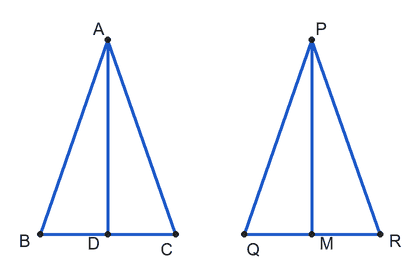
Sides AB, BC and median AD of triangle ABC are respectively proportional to sides PQ, QR and median PM of triangle PQR. Prove that :
(i) ΔABD ~ ΔPQM (ii) ΔABC ~ ΔPQR
 Solve with AI
Written solution
Solution:
Concept: SSS rule for similarity: If the three sides of one triangle are in the same ratio to the three sides of another triangle, the two triangles are similar.
Given: AB, BC and the median AD of ΔABC are proportional to PQ, QR and the median PM of ΔPQR.
Step 1 — Write down the given ratios.
AB, BC and the median AD are proportional to PQ, QR and the median PM:
Step 2 — Use the mid-points.
D is the mid-point of BC and M is the mid-point of QR, so BD and QM are halves of BC and QR. Halves are in the same ratio as the wholes:
Step 3 — Part (i): SSS for ΔABD and ΔPQM.
Putting Steps 1 and 2 together, all three sides of ΔABD are in the same ratio to the sides of ΔPQM:
So ΔABD ~ ΔPQM by SSS.
Step 4 — Part (ii): SAS for ΔABC and ΔPQR.
Similar triangles have equal corresponding angles, so part (i) gives ∠B = ∠Q. In ΔABC and ΔPQR the sides forming these angles are AB, BC and PQ, QR, and is given. So ΔABC ~ ΔPQR by SAS.
Watch out: In part (ii) the angle used is ∠B = ∠Q, the angle BETWEEN the sides AB and BC; it comes from part (i).
Therefore, (i) ΔABD ~ ΔPQM and (ii) ΔABC ~ ΔPQR. Hence proved.
- 263 marks
Question 26
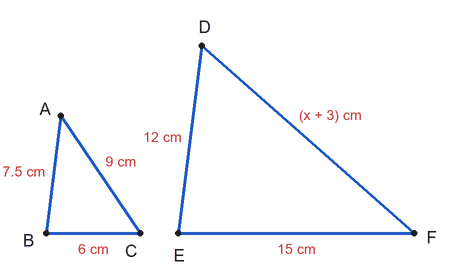
Find the value of , if ∠B = ∠E.
 Solve with AI
Written solution
Solution:
Concept: SAS rule for similarity: If one angle of a triangle equals one angle of another triangle, and the sides that form these angles are in the same ratio, the two triangles are similar.
Given: ∠B = ∠E; AB = 7.5 cm, BC = 6 cm, AC = 9 cm, DE = 12 cm, EF = 15 cm, DF = (x + 3) cm.
Step 1 — Find the sides around the equal angles.
We are given ∠B = ∠E. In ΔABC the sides forming ∠B are AB (7.5 cm) and BC (6 cm). In ΔDEF the sides forming ∠E are DE (12 cm) and EF (15 cm).
Step 2 — Pair them in the same ratio.
We pair the shorter with the shorter and the longer with the longer: BC with DE and AB with EF.
The ratios are equal, so ΔABC ~ ΔFED by SAS, with A matching F, B matching E and C matching D.
Step 3 — Use the third pair of sides.
The third sides AC and FD must be in the same ratio :
Cross-multiplying gives:
Watch out: AB is NOT paired with DE just because both are on the left in the figure; pair the sides so that the two ratios are equal.
Therefore, x = 15.
- 273 marks
Question 27
In the given figure, if ΔABC ~ ΔDEF. Find the lengths of the sides of both the triangles (Each side is in cm).
 Solve with AI
Written solution
Solution:
Concept: Two triangles are similar when their corresponding angles are equal. Then their corresponding sides are in the same ratio. In the letters are written in matching order: A matches D, B matches E and C matches F.
Given: ΔABC ~ ΔDEF; AB = 2x + 1, BC = 2(x + 1), AC = 4x, DE = 18, EF = 3(x + 1), DF = 6x (cm).
Step 1 — Find the ratio of the triangles.
ΔABC ~ ΔDEF, so AB : DE, BC : EF and AC : DF are all equal. The pair BC and EF contains the same bracket (x + 1), which cancels:
Step 2 — Find x from AB and DE.
AB : DE must also be :
Cross-multiplying and solving:
Step 3 — Check with AC and DF.
AC : DF also contains x in both terms, and it gives the same ratio:
Step 4 — Find the sides of ΔABC.
We put x = 5.5 into each expression:
Step 5 — Find the sides of ΔDEF.
DE is given; the other two come from x:
Watch out: Start with a pair whose ratio does not depend on x (here BC and EF); then one equation gives x.
Therefore, AB = 12 cm, BC = 13 cm, AC = 22 cm; DE = 18 cm, EF = 19.5 cm, DF = 33 cm.
- 283 marks
Question 28
In ΔABC and ΔDEF, AB = 3 × DF, BC = 3 × DE and AC = 3 × EF. Show that the given triangles are similar. Name the two similar triangles in proper way.
Solve with AIWritten solution
Solution:
Concept: SSS rule for similarity: If the three sides of one triangle are in the same ratio to the three sides of another triangle, the two triangles are similar.
Given: AB = 3 × DF, BC = 3 × DE and AC = 3 × EF.
Step 1 — Write the three ratios.
Dividing each given equation by the side on its right:
All three pairs of sides are in the same ratio, so the triangles are similar by SSS.
Step 2 — Match the vertices.
B is the vertex shared by AB and BC. Their partners DF and DE share the vertex D, so B matches D. A is shared by AB and AC, whose partners DF and EF share F, so A matches F. The last pair is C and E. In the figure, the matching angles carry the same number of arcs.

Step 3 — Name the triangles in proper order.
Writing A, B, C first and their partners F, D, E in the same order:
Watch out: The words 'in proper way' mean in matching order. ΔABC ~ ΔDEF would be wrong here, because AB does not pair with DE.
Therefore, the triangles are similar, ΔABC ~ ΔFDE.
- 293 marks
Question 29
In a trapezium ABCD, side AB is parallel to side DC; and the diagonals AC and BD intersect each other at point P. Prove that :
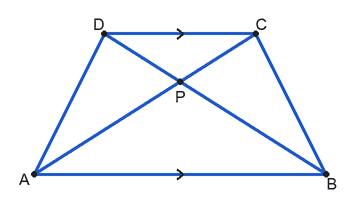
(i) Δ APB is similar to Δ CPD.
(ii) PA × PD = PB × PC.
Solve with AIWritten solution
Solution:
Concept: When two straight lines cross at a point O and the segments joining their ends are parallel, the two triangles formed at O are similar (AA). The angles at O are vertically opposite, so they are equal, and the parallel lines make equal alternate angles with each crossing line.
Given: ABCD is a trapezium with AB ∥ DC; the diagonals meet at P.
Step 1 — Part (i): find two pairs of equal angles.
The diagonals AC and BD cross at P, so ∠APB = ∠CPD (vertically opposite). AB ∥ DC and AC crosses them, so ∠PAB = ∠PCD (alternate angles).
Step 2 — Part (i): conclude.
By AA, ΔAPB ~ ΔCPD, with A matching C, P matching P and B matching D.
Step 3 — Part (ii): write the ratio of sides.
PA matches PC, and PB matches PD, so:
Step 4 — Part (ii): cross-multiply.
Multiplying both sides by PC × PD gives:
Watch out: PA and PC are the two parts of the SAME diagonal AC; they are matched with each other, not multiplied.
Therefore, (i) ΔAPB ~ ΔCPD and (ii) PA × PD = PB × PC. Hence proved.
- 303 marks
Question 30
P is a point on side BC of a parallelogram ABCD. If DP produced meets AB produced at point L, prove that :

(i) DP : PL = DC : BL.
(ii) DL : DP = AL : DC.
Solve with AIWritten solution
Solution:
Concept: AA rule: If two angles of one triangle are equal to two angles of another triangle, the third angles are equal too (the angles of a triangle add up to 180°), so the triangles are similar. Their corresponding sides are then in the same ratio.
Given: ABCD is a parallelogram; P is on BC; DP produced meets AB produced at L.
Step 1 — Part (i): ΔDPC ~ ΔLPB.
DC ∥ AB, and L is on AB produced, so DC ∥ BL. In ΔDPC and ΔLPB, ∠DPC = ∠LPB (vertically opposite) and ∠PDC = ∠PLB (alternate angles, with DL crossing the parallel lines). So ΔDPC ~ ΔLPB by AA, with D matching L and C matching B.
Step 2 — Part (i): read the ratio.
DP matches LP and DC matches LB, so:
That is, DP : PL = DC : BL.
Step 3 — Part (ii): ΔDPC ~ ΔLDA.
In ΔDPC and ΔLDA, ∠PDC = ∠DLA (alternate angles, DC ∥ AL). Also ∠DCP = ∠LAD, because ∠DCB and ∠DAB are opposite angles of the parallelogram. So ΔDPC ~ ΔLDA by AA, with D matching L, P matching D and C matching A.
Step 4 — Part (ii): read the ratio and invert it.
DP matches LD and DC matches LA:
Turning both sides upside down gives:
Watch out: Opposite angles of a parallelogram are equal: ∠C = ∠A. That fact gives the second pair of angles in part (ii).
Therefore, (i) DP : PL = DC : BL and (ii) DL : DP = AL : DC. Hence proved.
- 313 marks
Question 31
In Δ ABC, angle ABC is equal to twice the angle ACB, and bisector of angle ABC meets the opposite side at point P. Show that :
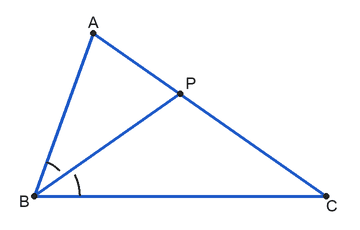
(i) CB : BA = CP : PA
(ii) AB × BC = BP × CA
Solve with AIWritten solution
Solution:
Concept: AA rule: If two angles of one triangle are equal to two angles of another triangle, the third angles are equal too (the angles of a triangle add up to 180°), so the triangles are similar. Their corresponding sides are then in the same ratio.
Given: ∠ABC = 2∠ACB and BP bisects ∠ABC, meeting AC at P.
Step 1 — Split the angle at B.
BP bisects ∠ABC, and ∠ABC is twice ∠ACB. So each half of ∠ABC equals ∠ACB:
Step 2 — Show PB = PC.
In ΔPBC, ∠PBC = ∠PCB (Step 1). Sides opposite equal angles are equal, so PB = PC.
Step 3 — Show ΔABP ~ ΔACB.
In ΔABP and ΔACB, ∠ABP = ∠ACB (Step 1) and ∠A is common. So ΔABP ~ ΔACB by AA, with A matching A, B matching C and P matching B. Their sides are in proportion:
Step 4 — Part (i).
From , cross-multiplying gives BP × AB = AP × CB, and dividing by AB × AP:
Since BP = CP (Step 2), we replace BP by CP:
Step 5 — Part (ii).
From , cross-multiplying gives:
Watch out: The key step is PB = PC: the bisector makes ∠PBC equal to ∠C, so ΔPBC is isosceles.
Therefore, (i) CB : BA = CP : PA and (ii) AB × BC = BP × CA. Hence proved.
- 323 marks
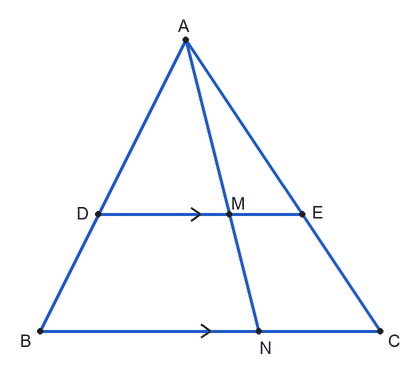
Question 32
In the given figure, DE ∥ BC, AE = 15 cm, EC = 9 cm, NC = 6 cm and BN = 24 cm.
(i) Write all possible pairs of similar triangles.
(ii) Find lengths of ME and DM.
 Solve with AI
Written solution
Solution:
Concept: Basic Proportionality Theorem (BPT): A line drawn parallel to one side of a triangle divides the other two sides in the same ratio. The small triangle it cuts off is similar to the whole triangle, because the parallel line makes equal corresponding angles.
Given: DE ∥ BC, AE = 15 cm, EC = 9 cm, NC = 6 cm, BN = 24 cm.
Step 1 — Part (i): list the similar triangles.
DE ∥ BC, and the lines AB, AN and AC run from A to BC. Each small triangle at A is cut off by the parallel line DE from a bigger triangle with the same angle at A, and the parallel line makes equal corresponding angles. So:
Step 2 — Part (ii): find the ratio of the small triangles to the big ones.
E lies on AC, so AC is AE + EC:
From ΔAME ~ ΔANC, the ratio of matching sides is AE : AC, and it also equals AM : AN:
Step 3 — Part (ii): find ME.
ME is of NC:
Step 4 — Part (ii): find DM.
From ΔADM ~ ΔABN, the ratio DM : BN equals AM : AN, and Step 2 showed that AM : AN is 15 : 24:
Watch out: AE is compared with the WHOLE of AC (24 cm), not with EC; the small triangles are compared with the big ones.
Therefore, (i) ΔADE ~ ΔABC, ΔADM ~ ΔABN, ΔAME ~ ΔANC; (ii) ME = 3.75 cm and DM = 15 cm.
- 333 marks
Question 33
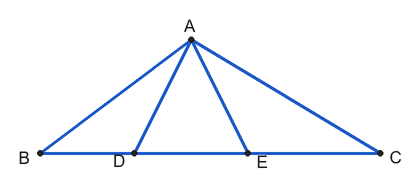
In the given figure, AD = AE and AD² = BD × EC. Prove that : triangles ABD and CAE are similar.
 Solve with AI
Written solution
Solution:
Concept: SAS rule for similarity: If one angle of a triangle equals one angle of another triangle, and the sides that form these angles are in the same ratio, the two triangles are similar.
Given: AD = AE and AD² = BD × EC.
Step 1 — Find a pair of equal angles.
AD = AE, so ΔADE is isosceles and ∠ADE = ∠AED. B, D, E and C lie on one line, so ∠ADB and ∠AEC are supplements of these equal angles:
Step 2 — Turn the product into a ratio.
Since AD and AE are equal, AD² can be written as AD × AE, so the given condition becomes AD × AE = BD × EC. Dividing both sides by EC × AE gives:
Step 3 — Apply SAS.
In ΔABD the sides forming ∠ADB are DA and DB. In ΔCAE the sides forming ∠CEA are EC and EA. Step 2 pairs DA with EC and DB with EA in the same ratio, and Step 1 gives ∠ADB = ∠CEA. So by SAS, ΔABD ~ ΔCAE, with A matching C, B matching A and D matching E.
Watch out: The equal angles are ∠ADB and ∠AEC, the angles next to BD and EC, not the angles inside ΔADE.
Therefore, ΔABD ~ ΔCAE. Hence proved.
- 343 marks
Question 34
State, true or false :
(i) Two similar polygons are necessarily congruent.
(ii) Two congruent polygons are necessarily similar.
(iii) All equiangular triangles are similar.
(iv) All isosceles triangles are similar.
(v) Two isosceles-right triangles are similar.
(vi) Two isosceles triangles are similar, if an angle of one is congruent to the corresponding angle of the other.
(vii) The diagonals of a trapezium divide each other into proportional segments.
Solve with AIWritten solution
Solution:
Concept: Two triangles are similar when their corresponding angles are equal. Then their corresponding sides are in the same ratio. In the letters are written in matching order: A matches D, B matches E and C matches F.
Step 1 — Part (i): False.
Similar polygons have the same shape but may have different sizes, for example a small and a large square. So they need not be congruent.
Step 2 — Part (ii): True.
Congruent polygons have equal angles and sides in the ratio 1 : 1, so they are similar.
Step 3 — Part (iii): True.
Equiangular triangles have all three angles equal in pairs, so by AA (or AAA) they are similar.
Step 4 — Part (iv): False.
Two isosceles triangles can have different angles, for example angles 40°, 70°, 70° and angles 100°, 40°, 40°. Such triangles are not similar.
Step 5 — Part (v): True.
Every isosceles right triangle has angles 90°, 45° and 45°, so any two of them are equiangular and similar.
Step 6 — Part (vi): True.
In an isosceles triangle one angle fixes the other two (the base angles are equal and the three add up to 180°). So if a corresponding angle (vertical angle with vertical angle, or base angle with base angle) is equal, all three angles are equal.
Step 7 — Part (vii): True.
The diagonals of a trapezium form two triangles at their crossing point that are similar (AA, as in Q6). So each diagonal is divided in the same ratio as the other: if the diagonals AC and BD of trapezium ABCD meet at P, then PA : PC = PB : PD.
Watch out: 'similar' means same shape; 'congruent' means same shape AND same size. Every congruent pair is similar, but not the other way round.
Therefore, (i) False, (ii) True, (iii) True, (iv) False, (v) True, (vi) True, (vii) True.
- 353 marks
Question 35
D is a point on the side BC of triangle ABC such that angle ADC is equal to angle BAC. Prove that : CA² = CB × CD.
 Solve with AI
Written solution
Solution:
Concept: AA rule: If two angles of one triangle are equal to two angles of another triangle, the third angles are equal too (the angles of a triangle add up to 180°), so the triangles are similar. Their corresponding sides are then in the same ratio.
Given: D is on BC and ∠ADC = ∠BAC.
Step 1 — Find two pairs of equal angles.
In ΔADC and ΔBAC, ∠ADC = ∠BAC (given), and ∠C is common to both triangles (D lies on BC).
Step 2 — Name the similar triangles.
By AA, ΔADC ~ ΔBAC, with A matching B, D matching A and C matching C.
Step 3 — Write the ratio and cross-multiply.
CA (in ΔADC) matches CB (in ΔBAC), and CD matches CA:
Cross-multiplying gives:
Watch out: Write the triangles in matching order. Find which angle equals which first, then read the corresponding sides from the same positions in the two names.
Therefore, CA² = CB × CD. Hence proved.
- 363 marks
Question 36
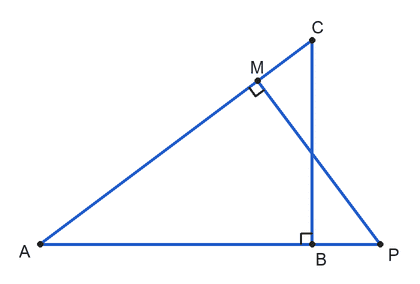
In the given figure, Δ ABC and Δ AMP are right angled at B and M respectively. Given AC = 10 cm, AP = 15 cm and PM = 12 cm.
(i) Prove that : Δ ABC ~ Δ AMP
(ii) Find : AB and BC.
 Solve with AI
Written solution
Solution:
Concept: AA rule: If two angles of one triangle are equal to two angles of another triangle, the third angles are equal too (the angles of a triangle add up to 180°), so the triangles are similar. Their corresponding sides are then in the same ratio.
Given: ∠ABC and ∠AMP are right angles; AC = 10 cm, AP = 15 cm, PM = 12 cm.
Step 1 — Part (i): find two pairs of equal angles.
ΔABC is right-angled at B and ΔAMP at M, so ∠ABC and ∠AMP are both 90°. M lies on AC and B on AP, so ∠A is common to both triangles. By AA, ΔABC ~ ΔAMP, with B matching M and C matching P.
Step 2 — Part (ii): find AM.
ΔAMP is right-angled at M, so by Pythagoras' theorem:
Step 3 — Part (ii): write the ratio.
Corresponding sides of ΔABC and ΔAMP are in the same ratio:
Step 4 — Part (ii): find AB and BC.
Each side of ΔABC is of its partner in ΔAMP:
Check: In ΔABC, 6² + 8² = 36 + 64, and 100 is 10², so AC = 10 cm as given. ✓
Watch out: AC (opposite the right angle in ΔABC) matches AP (opposite the right angle in ΔAMP), not AM.
Therefore, (i) ΔABC ~ ΔAMP; (ii) AB = 6 cm and BC = 8 cm.
- 373 marks
Question 37
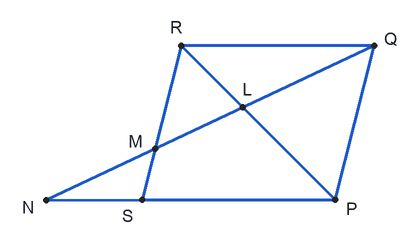
In the figure, PQRS is a parallelogram with PQ = 16 cm and QR = 10 cm. L is a point on PR such that RL : LP = 2 : 3. QL produced meets RS at M and PS produced at N. Find the lengths of PN and RM.
 Solve with AI
Written solution
Solution:
Concept: When two straight lines cross at a point O and the segments joining their ends are parallel, the two triangles formed at O are similar (AA). The angles at O are vertically opposite, so they are equal, and the parallel lines make equal alternate angles with each crossing line.
Given: PQRS is a parallelogram, PQ = 16 cm, QR = 10 cm, RL : LP = 2 : 3.
Step 1 — Find RM: name the similar triangles.
RS ∥ PQ (opposite sides of the parallelogram). In ΔRLM and ΔPLQ, ∠RLM = ∠PLQ (vertically opposite) and ∠LRM = ∠LPQ (alternate angles, with PR crossing RS and PQ). So ΔRLM ~ ΔPLQ by AA.
Step 2 — Find RM: use the ratio RL : LP.
RM matches PQ, and RL matches PL:
Step 3 — Find PN: name the similar triangles.
PS ∥ QR, and N lies on PS produced, so PN ∥ QR. In ΔLRQ and ΔLPN, ∠RLQ = ∠PLN (vertically opposite) and ∠LRQ = ∠LPN (alternate angles). So ΔLRQ ~ ΔLPN by AA.
Step 4 — Find PN: use the ratio.
RQ matches PN, and RL matches PL:
Watch out: RL : LP = 2 : 3 is the ratio of the SMALL triangle to the big one, so RM is less than PQ but PN is more than QR.
Therefore, PN = 15 cm and RM = cm.
- 383 marks
Question 38
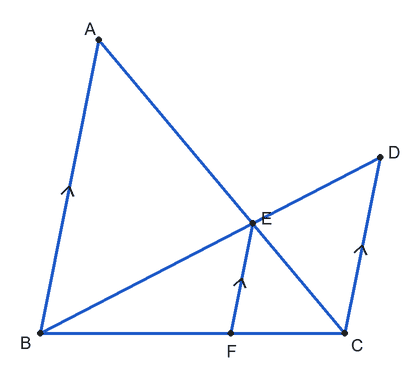
In the given figure, AB ∥ EF ∥ DC; AB = 67·5 cm, DC = 40·5 cm and AE = 52·5 cm.
(i) Name the three pairs of similar triangles.
(ii) Find the lengths of EC and EF.
 Solve with AI
Written solution
Solution:
Concept: Basic Proportionality Theorem (BPT): A line drawn parallel to one side of a triangle divides the other two sides in the same ratio. The small triangle it cuts off is similar to the whole triangle, because the parallel line makes equal corresponding angles.
Given: AB ∥ EF ∥ DC; AB = 67.5 cm, DC = 40.5 cm, AE = 52.5 cm.
Step 1 — Part (i): name the three pairs.
AB ∥ DC, so the triangles at E made by AC and BD are similar: ΔEAB ~ ΔECD. EF ∥ AB, so ΔCEF ~ ΔCAB (BPT in ΔCAB). EF ∥ DC, so ΔBEF ~ ΔBDC (BPT in ΔBDC).
Step 2 — Part (ii): find EC.
From ΔEAB ~ ΔECD, AE matches CE and AB matches CD:
So EC is of AE:
Step 3 — Part (ii): find EF.
From ΔCEF ~ ΔCAB, EF matches AB and CE matches CA. First, CA is the whole diagonal:
Rounded to two decimal places, EF ≈ 25.31 cm.
Check: From ΔBEF ~ ΔBDC, EF is of DC, and BE : ED is also 5 : 3, so EF is of 40.5, which is 25.3125. ✓
Watch out: In ΔCEF ~ ΔCAB compare CE with the WHOLE of CA (84 cm), not with EA.
Therefore, (i) ΔEAB ~ ΔECD, ΔCEF ~ ΔCAB, ΔBEF ~ ΔBDC; (ii) EC = 31.5 cm and EF = 25.3125 cm ≈ 25.31 cm.
- 393 marks
Question 39
In the given figure, P is a point on AB such that AP : PB = 4 : 3. PQ is parallel to AC.
(i) Calculate the ratio PQ : AC, giving reason for your answer.
(ii) In triangle ARC, ∠ARC = 90° and in triangle PQS, ∠PSQ = 90°. Given QS = 6 cm, calculate the length of AR.
 Solve with AI
Written solution
Solution:
Concept: Basic Proportionality Theorem (BPT): A line drawn parallel to one side of a triangle divides the other two sides in the same ratio. The small triangle it cuts off is similar to the whole triangle, because the parallel line makes equal corresponding angles.
Given: AP : PB = 4 : 3, PQ ∥ AC, ∠ARC and ∠PSQ are right angles, QS = 6 cm.
Step 1 — Part (i): name the similar triangles.
PQ ∥ AC, so in ΔBAC the line PQ cuts off ΔBPQ, and ΔBPQ ~ ΔBAC (∠B common, and corresponding angles at P and A are equal).
Step 2 — Part (i): find the ratio.
AP : PB = 4 : 3, so if AP is 4 parts, PB is 3 parts and BA is 7 parts. PQ matches AC, and BP matches BA:
So PQ : AC = 3 : 7.
Step 3 — Part (ii): name the similar triangles.
In ΔARC and ΔQSP, ∠ARC and ∠QSP are both 90°. AC ∥ PQ and CP crosses them, so ∠ACR = ∠QPS (alternate angles). So ΔARC ~ ΔQSP by AA, with A matching Q, R matching S and C matching P.
Step 4 — Part (ii): find AR.
AR matches QS, and AC matches QP:
Watch out: PQ matches AC through BP : BA = 3 : 7, not AP : PB = 4 : 3.
Therefore, (i) PQ : AC = 3 : 7; (ii) AR = 14 cm.
- 403 marks
Question 40
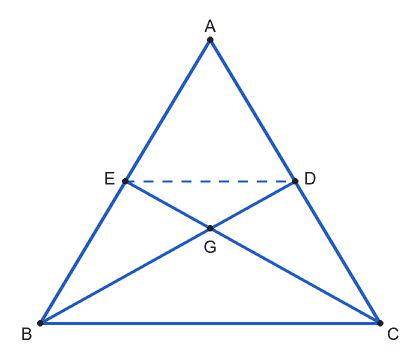
In the figure, given below, the medians BD and CE of a triangle ABC meet at G. Prove that :
(i) Δ EGD ~ Δ CGB and
(ii) BG = 2 GD from (i) above.
 Solve with AI
Written solution
Solution:
Concept: Mid-point theorem: The line joining the mid-points of two sides of a triangle is parallel to the third side and equal to half of it. Its converse: a line through the mid-point of one side, parallel to a second side, bisects the third side.
Given: BD and CE are medians of ΔABC meeting at G.
Step 1 — Use the mid-point theorem.
BD and CE are medians, so D is the mid-point of AC and E is the mid-point of AB. By the mid-point theorem, ED ∥ BC and ED is half of BC.
Step 2 — Part (i): find two pairs of equal angles.
In ΔEGD and ΔCGB, ∠EGD = ∠CGB (vertically opposite), and ∠GED = ∠GCB (alternate angles, ED ∥ BC with EC crossing them). So ΔEGD ~ ΔCGB by AA, with E matching C, G matching G and D matching B.
Step 3 — Part (ii): use the ratio of sides.
GD matches GB, and ED matches CB. Since BC is twice ED:
So BG = 2GD.
Watch out: ED is parallel to BC because D and E are MID-POINTS; this is what makes the alternate angles equal.
Note: This shows that the medians of a triangle cut each other in the ratio 2 : 1.
Therefore, (i) ΔEGD ~ ΔCGB and (ii) BG = 2GD. Hence proved.
- 411 mark
Question 41
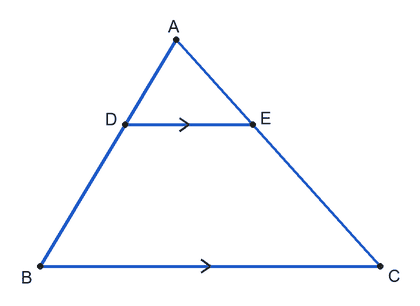
In the given figure, DE is parallel to BC. If AD : BD = 3 : 5 then DE : BC is :
 Solve with AI
Answer
- Correct
(A) 3 : 8
(B) 3 : 5
(C) 5 : 3
(D) 8 : 3
Answer: (A) 3 : 8
Concept: Basic Proportionality Theorem (BPT): A line drawn parallel to one side of a triangle divides the other two sides in the same ratio. The small triangle it cuts off is similar to the whole triangle, because the parallel line makes equal corresponding angles.
Step 1 — Name the similar triangles.
DE ∥ BC, so ΔADE ~ ΔABC (∠A common, and the corresponding angles at D and B are equal). DE matches BC, and AD matches the whole side AB.
Step 2 — Find AD : AB.
If AD is 3 parts and BD is 5 parts, the whole side AB is 3 + 5 = 8 parts:
Watch out: In BPT the small side is compared with the WHOLE side: , not .
Why the other options are wrong:
- (B) 3 : 5: 3 : 5 is AD : BD, the ratio of the two PARTS of AB; DE must be compared with BC using AD : AB.
- (C) 5 : 3: 5 : 3 is BD : AD, the parts of AB the other way round.
- (D) 8 : 3: 8 : 3 is BC : DE, the ratio turned upside down.
Therefore, DE : BC = 3 : 8, option (A).
- 421 mark
Question 42
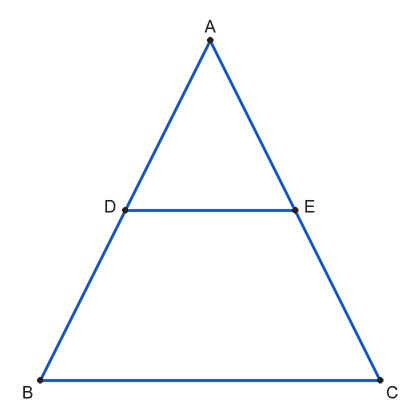
If AD = AE and BD = CE then :
 Solve with AI
Answer
(A) ΔADE ~ ΔACB
(B) ΔABC ~ ΔACB
(C) ΔABD ~ ΔABC
- Correct
(D) ΔADE ~ ΔABC
Answer: (D) ΔADE ~ ΔABC
Concept: SAS rule for similarity: If one angle of a triangle equals one angle of another triangle, and the sides that form these angles are in the same ratio, the two triangles are similar.
Step 1 — Show that AB = AC.
D lies on AB and E lies on AC. Adding the equal lengths AD = AE and BD = CE:
Step 2 — Compare the sides around ∠A.
Since AD = AE and AB = AC, the sides of ΔADE forming ∠A are in the same ratio as the sides of ΔABC forming ∠A:
Step 3 — Apply SAS.
∠A is common to ΔADE and ΔABC, so by SAS, ΔADE ~ ΔABC, with D matching B and E matching C.
Watch out: List the vertices in matching order: D, on AB, matches B; E, on AC, matches C.
About the other options:
- (A) ΔADE ~ ΔACB: this is also true in this figure. Because AB = AC, the ratio AD : AC equals AE : AB, so with the common angle A, SAS gives ΔADE ~ ΔACB as well. The book keys (D), the similarity the data are built for.
- (B) ΔABC ~ ΔACB: this is also true here, but only because AB = AC makes ΔABC isosceles, so it matches itself with B and C swapped. It says nothing about D and E.
- (C) ΔABD ~ ΔABC: A, B and D lie on one straight line, so ABD is not a triangle at all.
Note: With AB = AC, options (A) and (B) are true statements too; the printed key (D) is kept, as it is the direct result of the given data.
Therefore, ΔADE ~ ΔABC, option (D).
- 431 mark
Question 43
In the given figure, AB = 10 cm, CD = 8 cm = OB, then OD is equal to :
 Solve with AI
Answer
(A) 10 cm
(B) 3·2 cm
- Correct
(C) 6·4 cm
(D) 8 cm
Answer: (C) 6·4 cm
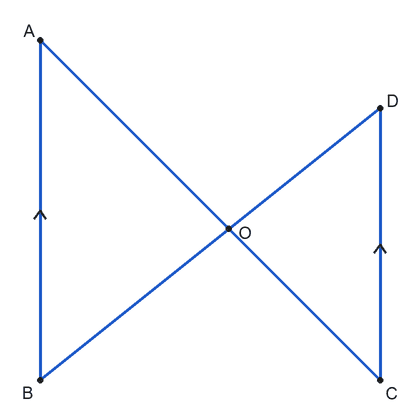
Concept: When two straight lines cross at a point O and the segments joining their ends are parallel, the two triangles formed at O are similar (AA). The angles at O are vertically opposite, so they are equal, and the parallel lines make equal alternate angles with each crossing line.
Step 1 — Name the similar triangles.
AB ∥ DC (the arrows), and AC and BD cross at O. ∠AOB = ∠COD (vertically opposite) and ∠OBA = ∠ODC (alternate angles). So ΔOAB ~ ΔOCD, with A matching C and B matching D.
Step 2 — Write the ratio and solve.
OD matches OB, and CD matches AB, so OD is to OB as CD is to AB. We are given OB = 8 cm:
Watch out: CD = 8 cm and OB = 8 cm are different segments that happen to have the same length; read the stem carefully.
Why the other options are wrong:
- (A) 10 cm: 10 cm would need OD : OB to be 10 : 8, which is AB : CD, the ratio turned upside down.
- (B) 3·2 cm: 3.2 cm would make OD : OB equal to 0.4, but CD : AB is 0.8.
- (D) 8 cm: 8 cm would make OD equal to OB, which needs CD equal to AB; but CD is 8 cm and AB is 10 cm.
Therefore, OD = 6.4 cm, option (C).
- 441 mark
Question 44
In the given figure, AE : EC = 2 : 3 and BC = 20 cm then DE is equal to :
Solve with AIAnswer
(A) 10 cm
(B) 12 cm
- Correct
(C) 8 cm
(D) 16 cm
Answer: (C) 8 cm
Concept: Basic Proportionality Theorem (BPT): A line drawn parallel to one side of a triangle divides the other two sides in the same ratio. The small triangle it cuts off is similar to the whole triangle, because the parallel line makes equal corresponding angles.
Step 1 — Name the similar triangles.
DE ∥ BC, so ΔADE ~ ΔABC. DE matches BC, and AE matches the whole of AC.
Step 2 — Find DE.
AE is 2 parts and EC is 3 parts, so AC is 5 parts:
Watch out: In BPT the small side is compared with the WHOLE side: , not .
Why the other options are wrong:
- (A) 10 cm: 10 cm is half of BC; it would need AE : AC to be 1 : 2, but it is 2 : 5.
- (B) 12 cm: 12 cm is of BC; it uses EC : AC instead of AE : AC.
- (D) 16 cm: 16 cm is of BC, which matches no ratio in the question.
Therefore, DE = 8 cm, option (C).
- 451 mark
Question 45
Two congruent triangles are :
Solve with AIAnswer
(A) not equal in area
- Correct
(B) similar
(C) not similar
(D) not similar but congruent
Answer: (B) similar
Concept: Two triangles are similar when their corresponding angles are equal. Then their corresponding sides are in the same ratio. In the letters are written in matching order: A matches D, B matches E and C matches F.
Step 1 — Recall what congruent triangles are.
Congruent triangles have equal corresponding angles and equal corresponding sides; they also have equal areas.
Step 2 — Check similarity.
Equal corresponding angles are exactly the condition for similarity. So congruent triangles are always similar (with sides in the ratio 1 : 1).
Why the other options are wrong:
- (A) not equal in area: congruent triangles cover each other exactly, so their areas ARE equal.
- (C) not similar: congruent triangles have equal angles, so they are similar.
- (D) not similar but congruent: this says congruent but not similar, which is impossible: every congruent pair is similar.
Therefore, two congruent triangles are similar, option (B).
- 463 marks
Question 46
In the following figure, point D divides AB in the ratio 3 : 5. Find :
(i) (ii) (iii)
Also, if :
(iv) DE = 2·4 cm, find the length of BC.
(v) BC = 4·8 cm, find the length of DE.
Solve with AIWritten solution
Solution:
Concept: Basic Proportionality Theorem (BPT): A line drawn parallel to one side of a triangle divides the other two sides in the same ratio. The small triangle it cuts off is similar to the whole triangle, because the parallel line makes equal corresponding angles.
Given: DE ∥ BC and AD : DB = 3 : 5.
Step 1 — Part (i): use BPT.
DE ∥ BC, so DE divides AB and AC in the same ratio. AD : DB = 3 : 5, so:
Step 2 — Part (ii): compare AD with the whole of AB.
AD is 3 parts and DB is 5 parts, so AB is 8 parts:
Step 3 — Part (iii): the same for AE.
AE : EC is also 3 : 5 (part (i)), so AC is 8 parts:
Step 4 — Part (iv): find BC.
ΔADE ~ ΔABC, so DE : BC equals AD : AB, which is 3 : 8. So BC is of DE:
Step 5 — Part (v): find DE.
Now BC = 4.8 cm, and DE is of BC:
Watch out: In BPT the small side is compared with the WHOLE side: , not .
Therefore, (i) , (ii) , (iii) , (iv) BC = 6.4 cm and (v) DE = 1.8 cm.
- 473 marks
Question 47
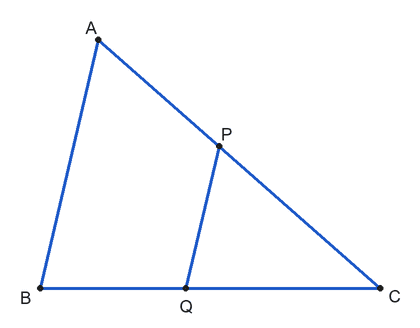
In the given figure, PQ ∥ AB; CQ = 4·8 cm, QB = 3·6 cm and AB = 6·3 cm. Find :
(i) (ii) PQ
(iii) If AP = , then the value of AC in terms of .
 Solve with AI
Written solution
Solution:
Concept: Basic Proportionality Theorem (BPT): A line drawn parallel to one side of a triangle divides the other two sides in the same ratio. The small triangle it cuts off is similar to the whole triangle, because the parallel line makes equal corresponding angles.
Given: PQ ∥ AB, CQ = 4.8 cm, QB = 3.6 cm, AB = 6.3 cm.
Step 1 — Part (i): use BPT.
PQ ∥ AB in ΔCAB, so P and Q divide CA and CB in the same ratio:
Step 2 — Part (ii): find PQ.
ΔCPQ ~ ΔCAB, so PQ matches AB and CQ matches the whole of CB. First:
Step 3 — Part (iii): AC in terms of x.
CP is of PA by part (i), and PA = x. AC is CP + PA:
Watch out: For PQ use CQ : CB (the part to the WHOLE side), not CQ : QB.
Therefore, (i) , (ii) PQ = 3.6 cm and (iii) AC = .
- 483 marks
Question 48
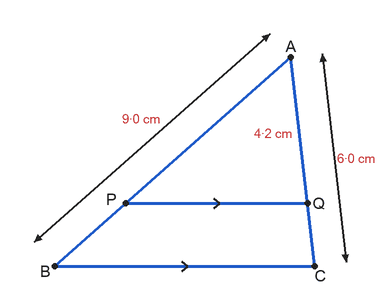
A line PQ is drawn parallel to the side BC of Δ ABC which cuts side AB at P and side AC at Q. If AB = 9·0 cm, CA = 6·0 cm and AQ = 4·2 cm, find the length of AP.
 Solve with AI
Written solution
Solution:
Concept: Basic Proportionality Theorem (BPT): A line drawn parallel to one side of a triangle divides the other two sides in the same ratio. The small triangle it cuts off is similar to the whole triangle, because the parallel line makes equal corresponding angles.
Given: PQ ∥ BC, AB = 9 cm, CA = 6 cm, AQ = 4.2 cm.
Step 1 — Name the similar triangles.
PQ ∥ BC, so ΔAPQ ~ ΔABC, and AP : AB equals AQ : AC.
Step 2 — Find AP.
We multiply both sides by AB:
Watch out: AP is on AB and AQ is on AC; each part is compared with the whole side it lies on.
Therefore, AP = 6.3 cm.
- 493 marks
Question 49
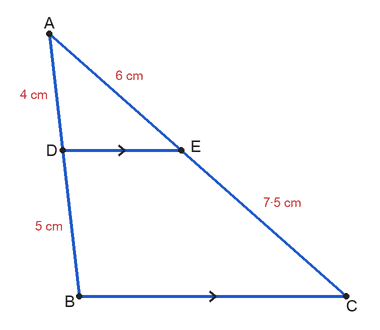
In Δ ABC, D and E are the points on sides AB and AC respectively. Find whether DE ∥ BC, if :
(i) AB = 9 cm, AD = 4 cm, AE = 6 cm and EC = 7·5 cm.
(ii) AB = 6·3 cm, EC = 11·0 cm, AD = 0·8 cm and AE = 1·6 cm.
Solve with AIWritten solution
Solution:
Concept: Converse of the Basic Proportionality Theorem: If a line divides two sides of a triangle in the same ratio, then it is parallel to the third side.
Given: D on AB and E on AC in ΔABC.
Step 1 — Part (i): find DB.
D lies on AB, so DB is AB − AD:
Step 2 — Part (i): compare the ratios.
We compare AD : DB with AE : EC:
The ratios are equal, so DE ∥ BC.
Step 3 — Part (ii): find DB.
Again DB is AB − AD:
Step 4 — Part (ii): compare the ratios.
We compare the two ratios as fractions:
The ratios are equal, so DE ∥ BC.
Watch out: In part (i) the length given is the WHOLE side AB = 9 cm; subtract AD to get DB before comparing.
Therefore, DE ∥ BC in both (i) and (ii).
- 503 marks
Question 50
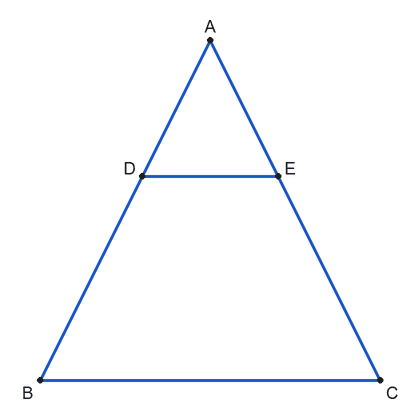
In the given figure, Δ ABC ~ Δ ADE. If AE : EC = 4 : 7 and DE = 6·6 cm, find BC. If '' be the length of the perpendicular from A to DE, find the length of perpendicular from A to BC in terms of ''.
 Solve with AI
Written solution
Solution:
Concept: In similar triangles, every corresponding length (side, altitude, median, angle bisector and perimeter) is in the same ratio as the corresponding sides. Only areas behave differently: they go as the square of that ratio.
Given: ΔABC ~ ΔADE, AE : EC = 4 : 7, DE = 6.6 cm, and x is the perpendicular from A to DE.
Step 1 — Find the ratio of the triangles.
ΔABC ~ ΔADE. E lies on AC with AE : EC = 4 : 7, so AE is 4 parts of the 11 parts of AC. Every length of ΔADE is of the matching length of ΔABC.
Step 2 — Find BC.
BC matches DE, so BC is of DE:
Step 3 — Find the perpendicular from A to BC.
Corresponding altitudes of similar triangles are in the same ratio as the sides. The perpendicular from A to DE is x, so the perpendicular from A to BC is of x:
Watch out: AE : AC is 4 : 11, not 4 : 7: compare AE with the WHOLE of AC.
Therefore, BC = 18.15 cm and the perpendicular from A to BC is .
- 513 marks
Question 51
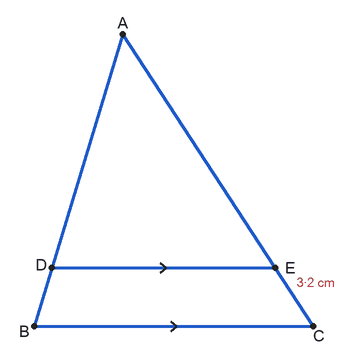
A line segment DE is drawn parallel to base BC of Δ ABC which cuts AB at point D and AC at point E. If AB = 5 BD and EC = 3·2 cm, find the length of AE.
 Solve with AI
Written solution
Solution:
Concept: Basic Proportionality Theorem (BPT): A line drawn parallel to one side of a triangle divides the other two sides in the same ratio. The small triangle it cuts off is similar to the whole triangle, because the parallel line makes equal corresponding angles.
Given: DE ∥ BC, AB = 5BD and EC = 3.2 cm.
Step 1 — Find AD : DB.
AB is 5 times BD, so if BD is 1 part, AB is 5 parts and AD is the other 4 parts:
Step 2 — Use BPT.
DE ∥ BC, so E divides AC in the same ratio as D divides AB:
Step 3 — Find AE.
AE is 4 times EC:
Watch out: The ratio AD : DB is not 5 : 1. AB is 5 parts in all, and AD is AB minus BD, so AD is 4 of those parts.
Therefore, AE = 12.8 cm.
- 523 marks
Question 52
In the given figure, AB, CD and EF are parallel lines. Given AB = 7·5 cm, DC = cm, EF = 4·5 cm, BC = cm and CE = 3 cm, calculate the values of and .
 Solve with AI
Written solution
Solution:
Concept: When two straight lines cross at a point O and the segments joining their ends are parallel, the two triangles formed at O are similar (AA). The angles at O are vertically opposite, so they are equal, and the parallel lines make equal alternate angles with each crossing line.
Given: AB ∥ CD ∥ EF; AB = 7.5 cm, EF = 4.5 cm, CE = 3 cm, BC = x cm, DC = y cm.
Step 1 — Find x: name the similar triangles.
AB ∥ EF. AF and BE cross at C. ∠ACB = ∠FCE (vertically opposite) and ∠BAC = ∠EFC (alternate angles). So ΔABC ~ ΔFEC, with A matching F and B matching E.
Step 2 — Find x: write the ratio and solve.
BC matches EC, and AB matches FE:
Step 3 — Find y: name the similar triangles.
CD ∥ EF, so in ΔBEF the line CD cuts off ΔBCD, and ΔBCD ~ ΔBEF (∠B common, corresponding angles at C and E equal).
Step 4 — Find y: write the ratio and solve.
CD matches EF, and BC matches the whole of BE. BE is BC + CE:
Watch out: For y, BC is compared with the WHOLE of BE (5 + 3 = 8), not with CE.
Therefore, x = 5 and y = 2.8125 (about 2.81).
- 533 marks
Question 53
In the figure, given alongside, PQR is a right-angled triangle right angled at Q. XY is parallel to QR, PQ = 6 cm, PY = 4 cm and PX : XQ = 1 : 2. Calculate the lengths of PR and QR.
 Solve with AI
Written solution
Solution:
Concept: Basic Proportionality Theorem (BPT): A line drawn parallel to one side of a triangle divides the other two sides in the same ratio. The small triangle it cuts off is similar to the whole triangle, because the parallel line makes equal corresponding angles.
Given: ∠Q = 90°, XY ∥ QR, PQ = 6 cm, PY = 4 cm, PX : XQ = 1 : 2.
Step 1 — Use BPT to find PR.
XY ∥ QR, so ΔPXY ~ ΔPQR and PY : PR equals PX : PQ. PX is 1 part and XQ is 2 parts, so PQ is 3 parts:
So PR is 3 times PY:
Step 2 — Use Pythagoras' theorem to find QR.
ΔPQR is right-angled at Q, so QR² = PR² − PQ²:
As a decimal, 6√3 is about 10.39 cm.
Watch out: PR is the hypotenuse (opposite the right angle at Q), so subtract PQ² from PR², do not add.
Therefore, PR = 12 cm and QR = 6√3 cm ≈ 10.39 cm.
- 543 marks
Question 54
In the following figure, M is mid-point of BC of a parallelogram ABCD. DM intersects the diagonal AC at P and AB produced at E. Prove that : PE = 2 PD
 Solve with AI
Written solution
Solution:
Concept: AA rule: If two angles of one triangle are equal to two angles of another triangle, the third angles are equal too (the angles of a triangle add up to 180°), so the triangles are similar. Their corresponding sides are then in the same ratio.
Given: ABCD is a parallelogram, M is the mid-point of BC, DM meets AC at P and AB produced at E.
Step 1 — Show BE = DC.
In ΔDMC and ΔEMB: CM = BM (M is the mid-point of BC), ∠DMC = ∠EMB (vertically opposite) and ∠DCM = ∠EBM (alternate angles, DC ∥ AE). So ΔDMC ≅ ΔEMB by ASA, and BE = DC.
Step 2 — Find AE.
In a parallelogram AB = DC, so AE is twice DC:
Step 3 — Show ΔAPE ~ ΔCPD.
In ΔAPE and ΔCPD, ∠APE = ∠CPD (vertically opposite) and ∠PAE = ∠PCD (alternate angles, AE ∥ DC with AC crossing them). So ΔAPE ~ ΔCPD by AA, with A matching C and E matching D.
Step 4 — Compare PE with PD.
PE matches PD, and AE matches CD:
So PE = 2PD.
Watch out: BE = DC comes from CONGRUENT triangles (equal sizes); the similar triangles are used only in the last step.
Therefore, PE = 2PD. Hence proved.
- 553 marks
Question 55
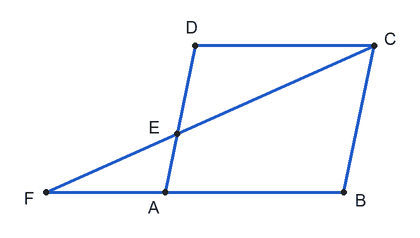
The given figure shows a parallelogram ABCD. E is a point in AD and CE produced meets BA produced at point F. If AE = 4 cm, AF = 8 cm and AB = 12 cm, find the perimeter of the parallelogram ABCD.
 Solve with AI
Written solution
Solution:
Concept: AA rule: If two angles of one triangle are equal to two angles of another triangle, the third angles are equal too (the angles of a triangle add up to 180°), so the triangles are similar. Their corresponding sides are then in the same ratio.
Given: ABCD is a parallelogram, AE = 4 cm, AF = 8 cm, AB = 12 cm.
Step 1 — Name the similar triangles.
AD ∥ BC (opposite sides of the parallelogram), and E lies on AD, so AE ∥ BC. In ΔFAE and ΔFBC, ∠F is common and ∠FAE = ∠FBC (corresponding angles). So ΔFAE ~ ΔFBC by AA.
Step 2 — Find BC.
AE matches BC, and FA matches FB. FB is FA + AB:
Step 3 — Find the perimeter.
Opposite sides of a parallelogram are equal, so the perimeter is twice (AB + BC):
Watch out: FA is compared with the WHOLE of FB (8 + 12), because AE matches BC, the side of the big triangle.
Therefore, the perimeter of ABCD is 44 cm.
- 561 mark
Question 56
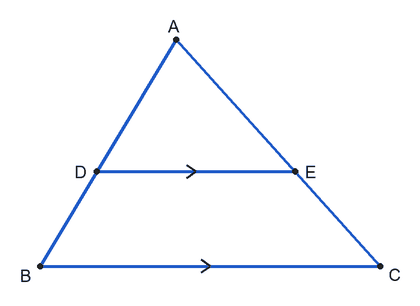
In the given figure, AE = 5 cm and EC = 7 cm, then area of ΔADE : area of ΔABC is :
 Solve with AI
Answer
(A) 5 : 7
(B) 7 : 5
- Correct
(C) 25 : 144
(D) 144 : 25
Answer: (C) 25 : 144
Concept: The ratio of the areas of two similar triangles equals the square of the ratio of their corresponding sides: if the sides are in the ratio , the areas are in the ratio .
Step 1 — Find the ratio of the sides.
DE ∥ BC (the arrows), so ΔADE ~ ΔABC, and AE matches the whole of AC. AC is 5 + 7 = 12 cm:
Step 2 — Square it for the areas.
The areas are in the square of this ratio:
Watch out: Areas go as the SQUARE of the side ratio. Do not use the side ratio itself for areas.
Why the other options are wrong:
- (A) 5 : 7: 5 : 7 is AE : EC, a ratio of two lengths, not of the areas.
- (B) 7 : 5: 7 : 5 is EC : AE, again a ratio of lengths.
- (D) 144 : 25: 144 : 25 is the area of ΔABC to ΔADE, the ratio turned upside down.
Therefore, the areas are in the ratio 25 : 144, option (C).
- 571 mark
Question 57
In the given figure, DE ∥ BC. If AD = 5 cm and BD = 2 cm, then area of ΔADE : area of trapezium DBCE is equal to :
Solve with AIAnswer
(A) 5 : 2
(B) 2 : 5
(C) 24 : 25
- Correct
(D) 25 : 24
Answer: (D) 25 : 24
Concept: The ratio of the areas of two similar triangles equals the square of the ratio of their corresponding sides: if the sides are in the ratio , the areas are in the ratio .
Step 1 — Ratio of the triangles.
DE ∥ BC, so ΔADE ~ ΔABC with side ratio AD : AB, and AB is 5 + 2 = 7 cm:
Step 2 — Area of the trapezium.
If ΔADE has 25 equal parts of area, ΔABC has 49 parts, and the trapezium DBCE is what is left:
So area ADE : area DBCE = 25 : 24.
Watch out: The trapezium is not similar to anything; find it as the big triangle minus the small one.
Why the other options are wrong:
- (A) 5 : 2: 5 : 2 is AD : DB, a ratio of lengths.
- (B) 2 : 5: 2 : 5 is DB : AD, again a ratio of lengths.
- (C) 24 : 25: 24 : 25 is the trapezium to the triangle, the ratio turned upside down.
Therefore, area ADE : area DBCE = 25 : 24, option (D).
- 581 mark
Question 58
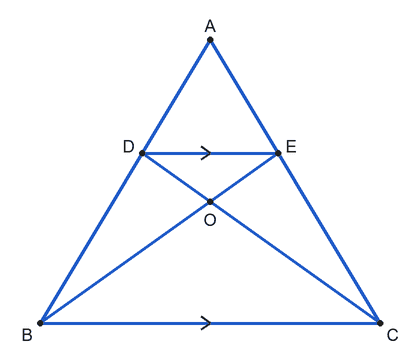
In the given figure, AD : DB = 2 : 5, then area of ΔODE : area of ΔOCB is :
 Solve with AI
Answer
- Correct
(A) 4 : 49
(B) 49 : 4
(C) 4 : 25
(D) 25 : 4
Answer: (A) 4 : 49
Concept: The ratio of the areas of two similar triangles equals the square of the ratio of their corresponding sides: if the sides are in the ratio , the areas are in the ratio .
Step 1 — Find DE : BC.
DE ∥ BC, so ΔADE ~ ΔABC and DE : BC equals AD : AB. AB is 2 + 5 = 7 parts:
Step 2 — Show ΔODE ~ ΔOCB.
DC and EB cross at O. ∠DOE = ∠COB (vertically opposite) and ∠ODE = ∠OCB (alternate angles, DE ∥ BC). So ΔODE ~ ΔOCB, with DE matching CB.
Step 3 — Square the ratio for the areas.
The side ratio of these triangles is DE : CB:
Watch out: In BPT the small side is compared with the WHOLE side: , not .
Why the other options are wrong:
- (B) 49 : 4: 49 : 4 is area OCB : area ODE, the ratio turned upside down.
- (C) 4 : 25: 4 : 25 squares AD : DB = 2 : 5, but DE must be compared with BC using AD : AB = 2 : 7.
- (D) 25 : 4: 25 : 4 squares DB : AD, which is not a ratio of corresponding sides.
Therefore, area ODE : area OCB = 4 : 49, option (A).
- 591 mark
Question 59
In the given figure, area of ΔADE : area of trapezium BCED = 25 : 39, then AD : BD is :
- 601 mark
Question 60
In the given figure, ∠BAC = 90°, AD is perpendicular to BC, BC = 13 cm and AC = 5 cm, then area of ΔADC : area of ΔDBA is :
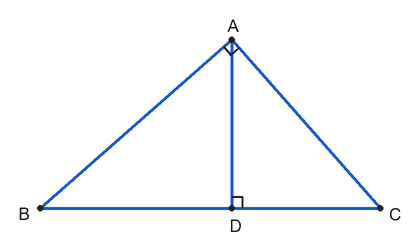
- 613 marks
Question 61
A line PQ is drawn parallel to the base BC of Δ ABC which meets sides AB and AC at points P and Q respectively. If AP = PB; find the value of :
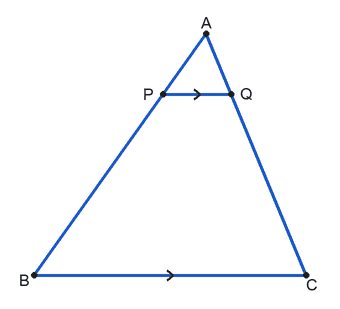
(i) (ii)
- 623 marks
Question 62
The perimeters of two similar triangles are 30 cm and 24 cm. If one side of the first triangle is 12 cm, determine the corresponding side of the second triangle.
- 633 marks
Question 63
In the given figure, AX : XB = 3 : 5. Find :
(i) the length of BC, if the length of XY is 18 cm.
(ii) the ratio between the areas of trapezium XBCY and triangle ABC.
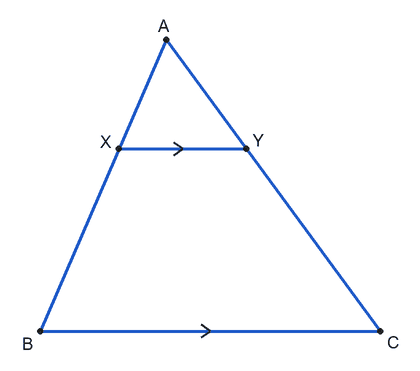
- 643 marks
Question 64
ABC is a triangle. PQ is a line segment intersecting AB in P and AC in Q such that PQ ∥ BC and divides triangle ABC into two parts equal in area. Find the value of ratio BP : AB.
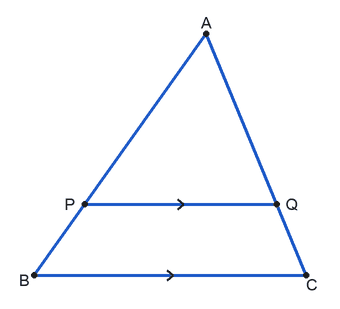
- 653 marks
Question 65
In the given triangle PQR, LM is parallel to QR and PM : MR = 3 : 4. Calculate the value of ratio :
(i) and then (ii) (iii)
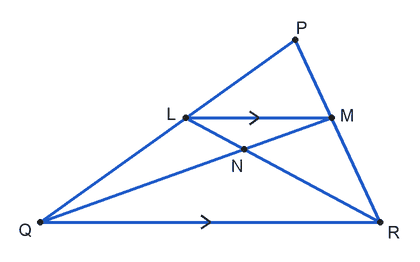
- 663 marks
Question 66
In the figure, given below, ABCD is a parallelogram. P is a point on BC such that BP : PC = 1 : 2. DP produced meets AB produced at Q. Given the area of triangle CPQ = 20 cm². Calculate :
(i) area of triangle CDP,
(ii) area of parallelogram ABCD.
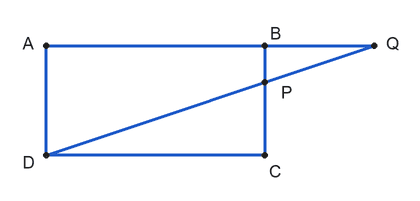
- 673 marks
Question 67
In the given figure, BC is parallel to DE. Area of triangle ABC = 25 cm², Area of trapezium BCED = 24 cm² and DE = 14 cm. Calculate the length of BC. Also, find the area of triangle BCD.
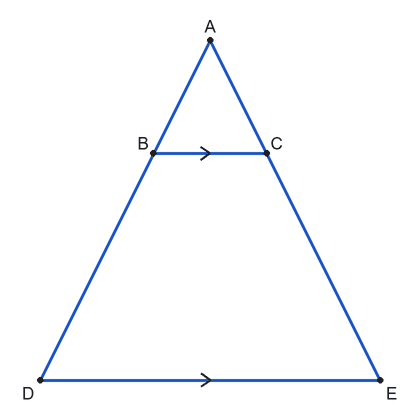
- 683 marks
Question 68
In the given figure, ABC is a triangle. DE is parallel to BC and .
(i) Determine the ratios and .
(ii) Prove that ΔDEF is similar to ΔCBF. Hence, find .
(iii) What is the ratio of the areas of ΔDEF and Δ BFC ?
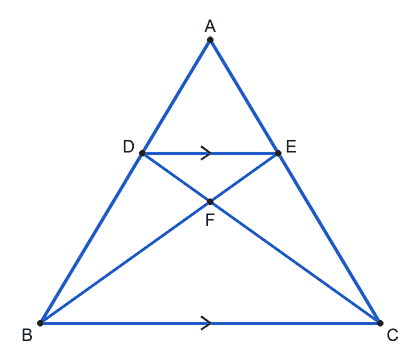
- 693 marks
Question 69
In the given figure, ∠B = ∠E, ∠ACD = ∠BCE, AB = 10·4 cm and DE = 7·8 cm. Find the ratio between areas of the Δ ABC and Δ DEC.
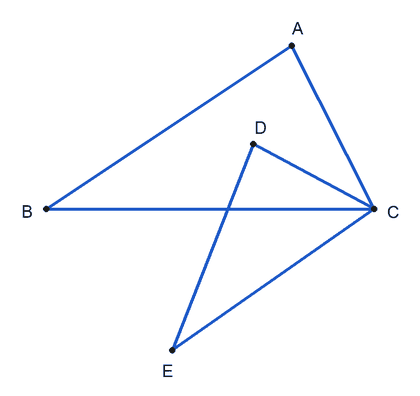
- 701 mark
Question 70
A model of a vehicle is made to a scale of 1 : 25. If length of the vehicle is 1·6 m; the length of its model is :
- 711 mark
Question 71
The length and the breadth of the model of a rectangular object are 12 cm and 7 cm respectively. If the scale factor is 1 : 20, the actual length and breadth of the object are:
- 721 mark
Question 72
The length of a boat is 2·4 m and the length of its model is 16 cm. The scale factor is :
- 731 mark
Question 73
The floor area of a room is 96 m² and area of the floor in the model of the room is 96 cm². The scale factor is :
- 741 mark
Question 74
A and B are two similar containers with capacities 216 m³ and 1000 m³ respectively. The scale factor of B with respect to A is :
- 753 marks
Question 75
A triangle ABC has been enlarged by scale factor to the triangle A′ B′ C′.
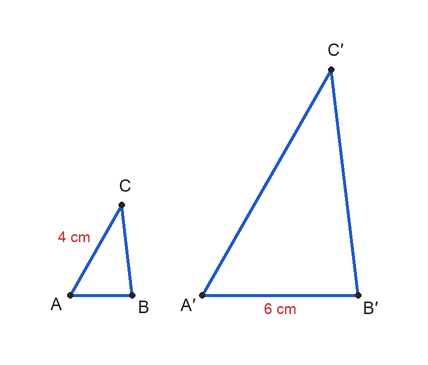
Calculate :
(i) the length of AB, if A′ B′ = 6 cm.
(ii) the length of C′ A′ if CA = 4 cm.
- 763 marks
Question 76
A triangle LMN has been reduced by scale factor 0·8 to the triangle L′ M′ N′.
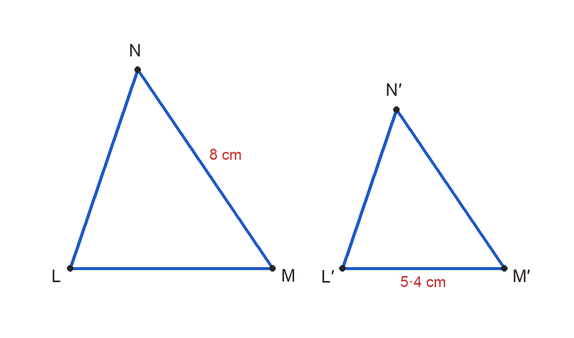
Calculate:
(i) the length of M′ N′, if MN = 8 cm.
(ii) the length of LM, if L′ M′ = 5·4 cm.
- 773 marks
Question 77
A model of an aeroplane is made to a scale of 1 : 400. Calculate :
(i) the length, in cm, of the model; if the length of the aeroplane is 40 m.
(ii) the length, in m, of the aeroplane, if length of its model is 16 cm.
- 783 marks
Question 78
The dimensions of the model of a multistorey building are 1·2 m × 75 cm × 2 m. If the scale factor is 1 : 30; find the actual dimensions of the building.
- 793 marks
Question 79
On a map drawn to a scale of 1 : 2,50,000; a triangular plot of land has the following measurements : AB = 3 cm, BC = 4 cm and angle ABC = 90°. Calculate :
(i) the actual lengths of AB and BC in km.
(ii) the area of the plot in sq. km.
- 803 marks
Question 80
A model of a ship is made to a scale 1 : 300.
(i) The length of the model of the ship is 2 m. Calculate the length of the ship.
(ii) The area of the deck of the ship is 180,000 m². Calculate the area of the deck of the model.
(iii) The volume of the model is 6·5 m³. Calculate the volume of the ship.
- 811 mark
Question 81
Triangles ABC and A′B′C′ are similar to each other, the corresponding vertices of the two triangles are :
- 821 mark
Question 82
Triangles ABC and RSP are similar to each other, the corresponding sides of the two triangles are :
- 831 mark
Question 83
A : Two similar triangles are congruent. B : Two congruent triangles are similar, then :
- 841 mark
Question 84
Triangles ABC and PQR are similar to each other, then :
- 851 mark
Question 85
In the given figure, EF is parallel to BC. If area of triangle ABC is 576 cm², the area of triangle AEF is :
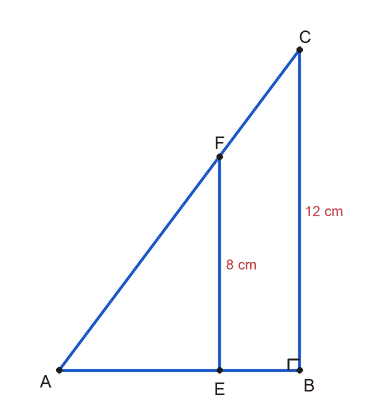
- 861 mark
Question 86
In ΔABD, C is a point on side BD such that ∠ACD = ∠BAD. Is ΔBAD similar to triangle ACD ? If yes, then which axiom is satisfied :
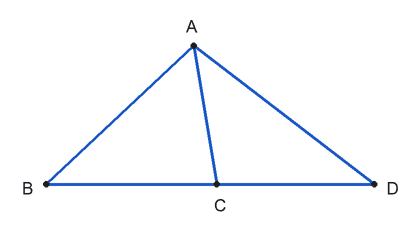
- 871 mark
Question 87
The model of a ship is made to a scale of 3 : 500. If the length of the model is 1·5 m, the length of ship is :
- 881 mark
Question 88
The perpendicular BD drawn from the vertex of a right triangle ABC.
Assertion (A) : Triangles ABD and BCD are similar to each other.
Reason (R) : Triangles, which are similar to the same triangle, are similar to each other.

- 891 mark
Question 89
ΔABC and ΔPQR are congruent to each other.
Assertion (A) : Triangles ABC and PQR are similar to each other.
Reason (R) : Two similar triangles are congruent to each other.
- 901 mark
Question 90
ΔABC is reflected in origin to get ΔA′B′C′.
Statement (1) : ΔABC is congruent to ΔA′B′C′.
Statement (2) : The two triangles are similar to each other.
- 911 mark
Question 91
Two similar triangles ABC and DEF such that the area of ΔABC = 64 sq. unit and area of ΔDEF = 121 sq. unit.
Statement (1) : .
Statement (2) : The ratio of perimeters of two similar triangles is equal to the ratio of their areas.
- 921 mark
Question 92
In triangle ABC, AD : DB = 2 : 3, DE is parallel to BC.
Assertion (A) : .
Reason (R) :

- 931 mark
Question 93
In triangle ODQ, ∠Q = ∠BPO = 90°, AB = 2 × OA, BC = 3 × OA and CD = 4 × OA.
Assertion (A) : .
Reason (R) : ΔOBP ~ ΔODQ and
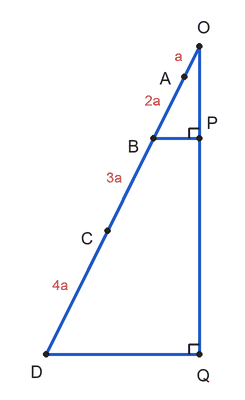
- 941 mark
Question 94
In triangle ABC, ∠B = 90° and in triangle ADE, ∠D = 90°.
Statement (1) :
Statement (2) : Triangles AED and ACB are similar.
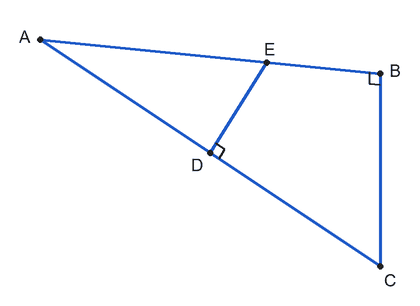
- 951 mark
Question 95
Area of triangle ADE = 9 cm² and area of trapezium DBCE = 16 cm².
Statement (1) :
Statement (2) :

- 963 marks
Question 96
In the following figure, XY is parallel to BC, AX = 9 cm, XB = 4·5 cm and BC = 18 cm. Find :
(i) (ii) (iii) XY
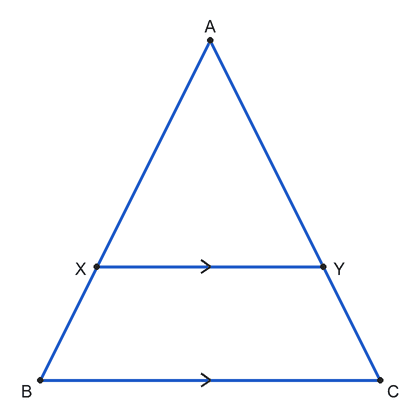
- 973 marks
Question 97
In the following figure, ABCD is a trapezium with AB ∥ DC. If AB = 9 cm, DC = 18 cm, CF = 13·5 cm, AP = 6 cm and BE = 15 cm, Calculate :
(i) EC (ii) AF (iii) PE
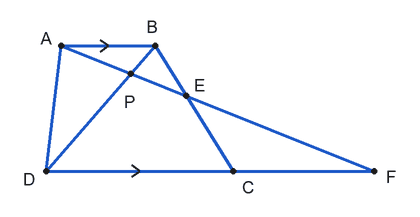
- 983 marks
Question 98
In the following figure, AB, CD and EF are perpendicular to the straight line BDF. If AB = and, CD = unit and EF = unit, prove that :
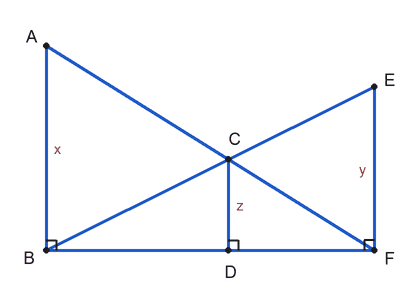
- 993 marks
Question 99
Triangle ABC is similar to triangle PQR. If AD and PM are corresponding medians of the two triangles, prove that : .
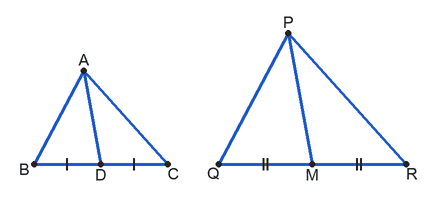
- 1003 marks
Question 100
Triangle ABC is similar to triangle PQR. If AD and PM are altitudes of the two triangles, prove that : .
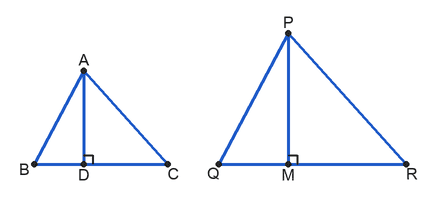
- 1013 marks
Question 101
Triangle ABC is similar to triangle PQR. If bisector of angle BAC meets BC at point D and bisector of angle QPR meets QR at point M, prove that : .
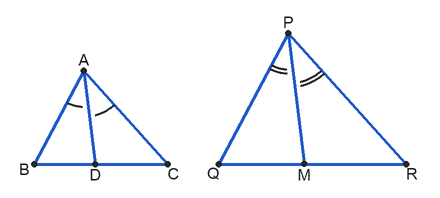
- 1023 marks
Question 102
In the following figure, ∠AXY = ∠AYX. If , show that triangle ABC is isosceles.

- 1033 marks
Question 103
In the following figure, DE ∥ AC and DC ∥ AP. Prove that : .

- 1043 marks
Question 104
In the figure given below, AB ∥ EF ∥ CD. If AB = 22·5 cm, EP = 7·5 cm, PC = 15 cm and DC = 27 cm. Calculate : (i) EF (ii) AC
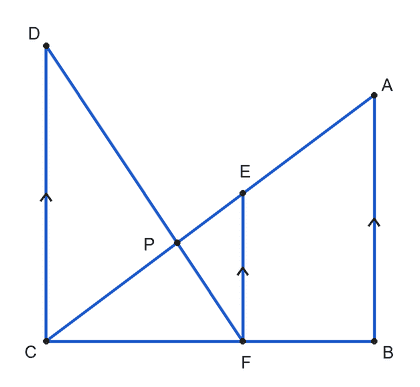
- 1053 marks
Question 105
In ΔABC, ∠ABC = ∠DAC, AB = 8 cm, AC = 4 cm and AD = 5 cm.
(i) Prove that ΔACD is similar to ΔBCA.
(ii) Find BC and CD.
(iii) Find area of ΔACD : area of ΔABC.

- 1063 marks
Question 106
In the following figure, AD and CE are medians of Δ ABC. DF is drawn parallel to CE. Prove that :
(i) EF = FB, (ii) AG : GD = 2 : 1.
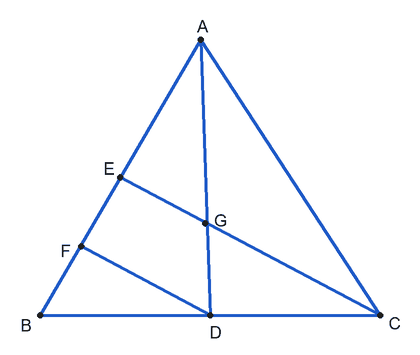
- 1073 marks
Question 107
The two similar triangles are equal in area. Prove that the triangles are congruent.
- 1083 marks
Question 108
The ratio between the altitudes of two similar triangles is 3 : 5; write the ratio between their :
(i) corresponding medians. (ii) perimeters. (iii) areas.
- 1093 marks
Question 109
The ratio between the areas of two similar triangles is 16 : 25. State the ratio between their :
(i) perimeters. (ii) corresponding altitudes. (iii) corresponding medians.
- 1103 marks
Question 110
On a map, drawn to a scale of 1 : 20000, a rectangular plot of land ABCD has AB = 24 cm and BC = 32 cm. Calculate :
(i) the diagonal distance of the plot in kilometre.
(ii) the area of the plot in sq. km.
- 1113 marks
Question 111
The dimensions of the model of a multistoreyed building are 1 m by 60 cm by 1·20 m. If the scale factor is 1 : 50, find the actual dimensions of the building.
Also, find :
(i) the floor area of a room of the building, if the floor area of the corresponding room in the model is 50 sq. cm.
(ii) the space (volume) inside a room of the model, if the space inside the corresponding room of the building is 90 m³.
- 1123 marks
Question 112
In a triangle PQR, L and M are two points on the base QR, such that ∠LPQ = ∠QRP and ∠RPM = ∠RQP. Prove that :
(i) Δ PQL ~ Δ RPM (ii) QL × RM = PL × PM (iii) PQ² = QR × QL
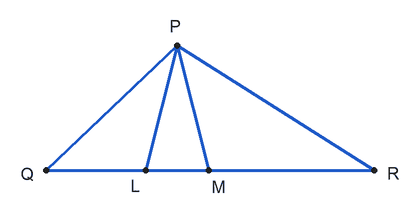
- 1133 marks
Question 113
A triangle ABC with AB = 3 cm, BC = 6 cm and AC = 4 cm is enlarged to Δ DEF such that the longest side of Δ DEF = 9 cm.

Find the scale factor and hence, the lengths of the other sides of Δ DEF.
- 1143 marks
Question 114
Two isosceles triangles have equal vertical angles. Show that the triangles are similar.

If the ratio between the areas of these two triangles is 16 : 25, find the ratio between their corresponding altitudes.
- 1153 marks
Question 115
In triangle ABC, AP : PB = 2 : 3. PO is parallel to BC and is extended to Q so that CQ is parallel to BA. Find :
(i) area Δ APO : area Δ ABC. (ii) area Δ APO : area Δ CQO.
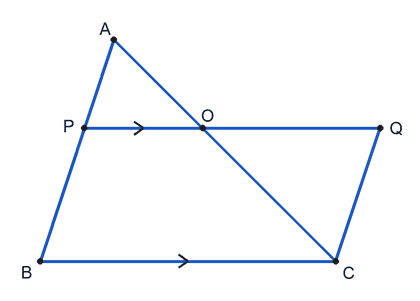
- 1163 marks
Question 116
In the given figure, ABC is a triangle with ∠EDB = ∠ACB. Prove that Δ ABC ~ Δ EBD. If BE = 6 cm, EC = 4 cm, BD = 5 cm and area of Δ BED = 9 cm². Calculate the : (i) length of AB (ii) area of Δ ABC
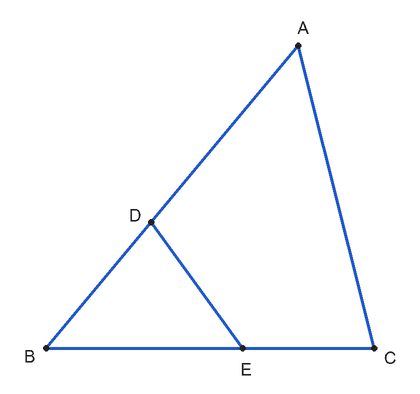
- 1173 marks
Question 117
In the given figure, ABC is a right angled triangle with ∠BAC = 90°.
(i) Prove that : ΔADB ~ ΔCDA.
(ii) If BD = 18 cm and CD = 8 cm, find AD.
(iii) Find the ratio of the area of ΔADB is to area of ΔCDA.
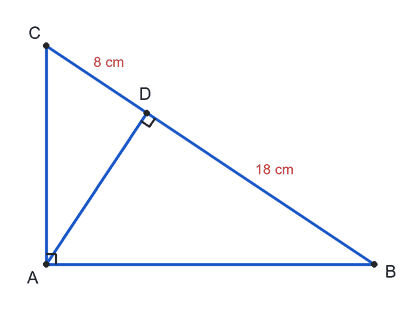
- 1183 marks
Question 118
ABC is a right angled triangle with ∠ABC = 90°. D is any point on AB and DE is perpendicular to AC. Prove that :
(i) ΔADE ~ ΔACB.
(ii) If AC = 13 cm, BC = 5 cm and AE = 4 cm. Find DE and AD.
(iii) Find, area of ΔADE : area of quadrilateral BCED.
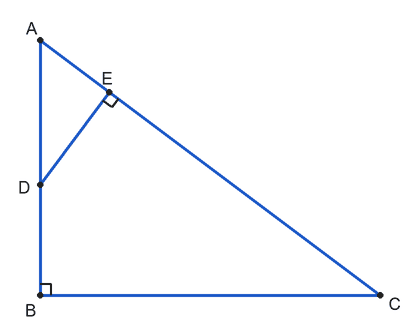
- 1193 marks
Question 119
Given : AB ∥ DE and BC ∥ EF. Prove that :
(i) (ii) Δ DFG ~ Δ ACG

- 1203 marks
Question 120
PQR is a triangle. S is a point on the side QR of ΔPQR such that ∠PSR = ∠QPR. Given QP = 8 cm, PR = 6 cm and SR = 3 cm.
(i) Prove ΔPQR ~ ΔSPR.
(ii) Find the lengths of QR and PS.
(iii)
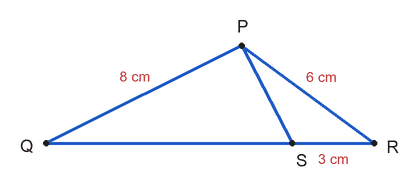
What Class 10 Maths Ch 15 covers
The sections of the chapter, in the order the book takes them. Every question above comes from one of these.
- 01Similar Triangles
- 02Corresponding Sides and Corresponding Angles
- 03Conditions for Similarity of Two Triangles
- 04Basic Proportionality Theorem With Applications
- 05Relation Between the Areas of Two Triangles
- 06Similarity as a Size Transformation
More ways to study this chapter
The same chapter asked three other ways. Practise it, revise it, and see what the board has set on Ch 15 before.
- Competency-Based Questions (CBQ)Case study questions: a situation, and the part of the chapter that answers it.40questionsOpen
- Previous Year QuestionsQuestions that have actually appeared in board papers, each tagged with its year.25questionsOpen
- Practice QuestionsExtra questions per chapter, for when one attempt at a method is not enough.43questionsOpen
Ch 15 in past ICSE papers
The same chapter as the board has actually asked it. These are worded differently from the textbook exercise, which is the point of reading them.
- 14 marks
Board paper question 1
In the given figure PQRS is a cyclic quadrilateral PQ and SR produced meet at T.
(i) Prove .
(ii) Find SP if TP = 18cm, RQ = 4 cm and TR = 6cm.
(iii) Find area of quadrilateral PQRS if area of cm.
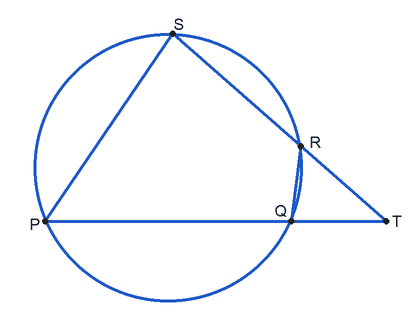 Solve with AI
Written solution
Solution:
Concept: In a cyclic quadrilateral (all four vertices on a circle) an exterior angle equals the interior opposite angle, because opposite angles add up to 180°. AA rule: if two angles of one triangle equal two angles of another, the third angles are equal too (the angles of a triangle add up to 180°), so the triangles are similar. Similar triangles have their corresponding sides in the same ratio. Writing means A matches D, B matches E and C matches F. The ratio of the areas of two similar triangles equals the square of the ratio of their corresponding sides: sides in the ratio give areas in the ratio .
Given: PQ and SR produced meet at T; TP = 18 cm, RQ = 4 cm, TR = 6 cm, ar(ΔPTS) = 27 cm².
Step 1 — Part (i): find two pairs of equal angles.
In ΔTPS and ΔTRQ the angle at T is common. PQRS is cyclic, so the exterior angle ∠TRQ (at R, between RQ and the extension RT of SR) equals the interior opposite angle ∠QPS, which is ∠TPS. Two pairs of angles are equal, so ΔTPS ~ ΔTRQ by AA, with T matching T, P matching R and S matching Q.
Step 2 — Part (ii): write the ratios.
Corresponding sides are in the same ratio. TP matches TR, and SP matches QR:
Step 3 — Part (ii): find SP.
We put in TP = 18 cm, TR = 6 cm and RQ = 4 cm:
Step 4 — Part (iii): ratio of the areas.
The side ratio is , so the areas are in the ratio :
Step 5 — Part (iii): area of PQRS.
So ar(ΔTRQ) is one-ninth of 27 cm². The quadrilateral PQRS is ΔTPS with ΔTRQ cut away:
Watch out: P matches R (not Q), because the equal angles are at P and R. So SP is compared with RQ.
Therefore, (i) ΔTPS ~ ΔTRQ (AA); (ii) SP = 12 cm; (iii) area of PQRS = 24 cm².
- 23 marks
Board paper question 2
A model of a ship is made to a scale 1 : 300
(i) The length of the model of the ship is 2 m. Calculate the length of the ship.
(ii) The area of the deck ship is 180, 000 m. Calculate the area of the deck of the model.
(iii) The volume of the model is 6.5 m. Calculate the volume of the ship.
Solve with AIWritten solution
Solution:
Concept: A scale compares a model (or map) with the real object: every real length is times the model length, every real area is times the model area, and every real volume is times the model volume.
Given: Scale 1 : 300; model length 2 m; real deck 1,80,000 m²; model volume 6.5 m³.
Step 1 — Part (i): length of the ship.
Every real length is 300 times the model length:
Step 2 — Part (ii): area of the model deck.
A model area is of the real area, and :
Step 3 — Part (iii): volume of the ship.
A real volume is times the model volume, and :
That is m³.
Watch out: Lengths scale by n, areas by and volumes by . Using n for an area or a volume is the usual slip.
Therefore, (i) 600 m; (ii) 2 m²; (iii) 17,55,00,000 m³ ( m³).
- 33 marks
Board paper question 3
PQR is a triangle. S is a point on the side QR of such that .
Given QP = 8 cm, PR = 6 cm and SR = 3 cm
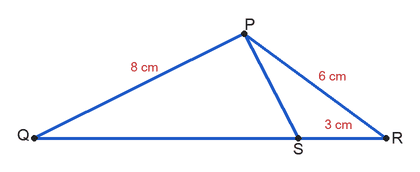
(i) Prove
(ii) Find the length of QR and PS
(iii)
Solve with AIWritten solution
Solution:
Concept: AA rule: if two angles of one triangle equal two angles of another, the third angles are equal too (the angles of a triangle add up to 180°), so the triangles are similar. Similar triangles have their corresponding sides in the same ratio. Writing means A matches D, B matches E and C matches F. The ratio of the areas of two similar triangles equals the square of the ratio of their corresponding sides: sides in the ratio give areas in the ratio .
Given: S on QR with ∠PSR = ∠QPR; QP = 8 cm, PR = 6 cm, SR = 3 cm.
Step 1 — Part (i): find two pairs of equal angles.
In ΔPQR and ΔSPR, ∠QPR = ∠PSR (given) and ∠R is common. So ΔPQR ~ ΔSPR by AA, with P matching S, Q matching P and R matching R.
Step 2 — Part (ii): write the ratios.
PR (in ΔPQR) matches SR (in ΔSPR), and both are known:
Step 3 — Part (ii): find QR and PS.
So QR is twice PR, and PQ is twice SP:
Step 4 — Part (iii): ratio of the areas.
The areas go as the square of the side ratio 2:
So the ratio is 4 : 1.
Watch out: Write the triangles in matching order: find which angle equals which first, then read corresponding sides from the same positions.
Therefore, (i) ΔPQR ~ ΔSPR (AA); (ii) QR = 12 cm and PS = 4 cm; (iii) 4 : 1.
- 43 marks
Board paper question 4
On a map drawn to a scale of 1 : 50,000, a rectangular plot of land ABCD has the following dimensions. AB = 6 cm ; BC = 8 cm and all angles are right angles. Find :
(i) the actual length of the diagonal distance AC of the plot in km.
(ii) the actual area of the plot in square km.
Solve with AIWritten solution
Solution:
Concept: A scale compares a model (or map) with the real object: every real length is times the model length, every real area is times the model area, and every real volume is times the model volume.
Given: Scale 1 : 50,000; AB = 6 cm, BC = 8 cm on the map; all angles right angles.
Step 1 — Change the scale to kilometres.
On a 1 : 50,000 map, 1 cm stands for 50,000 cm. Since 1 km = 1,00,000 cm, 1 cm stands for 0.5 km:
Step 2 — Part (i): the diagonal on the map.
All angles of ABCD are right angles, so ΔABC is right-angled at B and Pythagoras gives AC:
Step 3 — Part (i): the real diagonal.
Each map centimetre is 0.5 km:
Step 4 — Part (ii): the real area.
The map area is 6 × 8 = 48 cm². Each 1 cm² on the map stands for 0.5 km × 0.5 km, that is 0.25 km²:
Watch out: Areas go as the SQUARE of the side ratio; do not use the side ratio itself for areas. Here 1 cm² stands for 0.25 km², not 0.5 km².
Therefore, (i) AC = 5 km; (ii) the area is 12 km².
- 53 marks
Board paper question 5
In , MN is parallel to QR and
(i) Find .
(ii) Prove that and are similar.
(iii) Find, Area of : Area of .
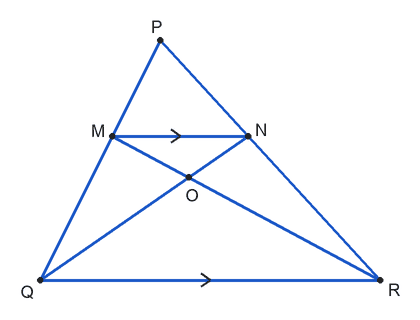 Solve with AI
Written solution
Solution:
Concept: Basic Proportionality Theorem (BPT): a line parallel to one side of a triangle divides the other two sides in the same ratio, and the small triangle it cuts off is similar to the whole triangle (equal corresponding angles). When two lines cross at O and the segments joining their ends are parallel, the two triangles at O are similar (AA): the angles at O are vertically opposite, and the parallel lines make equal alternate angles with each crossing line. The ratio of the areas of two similar triangles equals the square of the ratio of their corresponding sides: sides in the ratio give areas in the ratio .
Given: MN ∥ QR and .
Step 1 — Part (i): use the parallel line.
MN ∥ QR, so ΔPMN ~ ΔPQR (∠P common, ∠PMN = ∠PQR as corresponding angles). Since PM : MQ is 2 : 3, PM is 2 parts of the 5 parts of PQ:
Step 2 — Part (ii): find two pairs of equal angles.
In ΔOMN and ΔORQ, ∠OMN = ∠ORQ because they are alternate angles (MN ∥ QR, with MR as the crossing line), and ∠MON = ∠ROQ because they are vertically opposite. So ΔOMN ~ ΔORQ by AA, with M matching R and N matching Q.
Step 3 — Part (iii): ratio of the areas.
MN matches RQ, and :
Watch out: MN is compared with the WHOLE side PQ: the ratio is PM : PQ; this gives 2 parts out of 5, not 2 out of 3.
Therefore, (i) ; (ii) ΔOMN ~ ΔORQ (AA); (iii) 4 : 25.
- 63 marks
Board paper question 6
In the given figure, , PQ = 5 cm and PS = 2 cm.
(i) Prove that .
(ii) Find Area of : Area of quadrilateral SRQT.
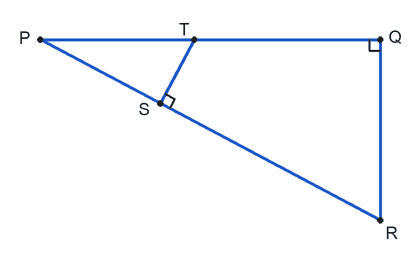 Solve with AI
Written solution
Solution:
Concept: AA rule: if two angles of one triangle equal two angles of another, the third angles are equal too (the angles of a triangle add up to 180°), so the triangles are similar. Similar triangles have their corresponding sides in the same ratio. Writing means A matches D, B matches E and C matches F. The ratio of the areas of two similar triangles equals the square of the ratio of their corresponding sides: sides in the ratio give areas in the ratio .
Given: ∠PQR and ∠PST are both 90°, PQ = 5 cm, PS = 2 cm.
Step 1 — Part (i): find two pairs of equal angles.
In ΔPQR and ΔPST, ∠PQR and ∠PST are both 90° (given), and ∠P is common. So ΔPQR ~ ΔPST by AA, with Q matching S and R matching T.
Step 2 — Part (ii): ratio of the areas of the triangles.
PQ matches PS, so the side ratio is and the areas go as its square:
Step 3 — Part (ii): area of the quadrilateral.
Let ar(ΔPQR) be 25 units, so ar(ΔPST) is 4 units. SRQT is ΔPQR with ΔPST cut away:
So ar(ΔPQR) : ar(SRQT) = 25 : 21.
Watch out: Q matches S (the right angles), so PQ is compared with PS; do not pair PQ with PT.
Therefore, (i) ΔPQR ~ ΔPST (AA); (ii) area of ΔPQR : area of SRQT = 25 : 21.
All 25 board paper questions for this chapter, solved the same way.
Class 10 Maths Ch 15 questions students ask
How many questions are there in Class 10 Maths Ch 15?
120 questions. Every one is solved step by step on this page.
Are these Class 10 Maths solutions free?
Yes. Every question and its full working is free to read, with no account needed.
Can I download the Class 10 Maths Ch 15 solutions as a PDF?
There is no PDF to download. Every solution is on this page instead, which means it is searchable, always the current syllabus, and readable on a phone. Use your browser's print option if you want it on paper.