
Question 313 marksMedium
In Δ ABC, angle ABC is equal to twice the angle ACB, and bisector of angle ABC meets the opposite side at point P. Show that :
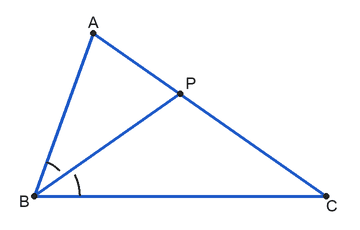
(i) CB : BA = CP : PA
(ii) AB × BC = BP × CA
Confirming your payment
Sign up now and get 250 free tokens.
Similarity · Question 31 of 120
In Δ ABC, angle ABC is equal to twice the angle ACB, and bisector of angle ABC meets the opposite side at point P. Show that :
(i) CB : BA = CP : PA
(ii) AB × BC = BP × CA
Solution:
Concept: AA rule: If two angles of one triangle are equal to two angles of another triangle, the third angles are equal too (the angles of a triangle add up to 180°), so the triangles are similar. Their corresponding sides are then in the same ratio.
Given: ∠ABC = 2∠ACB and BP bisects ∠ABC, meeting AC at P.
Step 1 — Split the angle at B.
BP bisects ∠ABC, and ∠ABC is twice ∠ACB. So each half of ∠ABC equals ∠ACB:
Step 2 — Show PB = PC.
In ΔPBC, ∠PBC = ∠PCB (Step 1). Sides opposite equal angles are equal, so PB = PC.
Step 3 — Show ΔABP ~ ΔACB.
In ΔABP and ΔACB, ∠ABP = ∠ACB (Step 1) and ∠A is common. So ΔABP ~ ΔACB by AA, with A matching A, B matching C and P matching B. Their sides are in proportion:
Step 4 — Part (i).
From , cross-multiplying gives BP × AB = AP × CB, and dividing by AB × AP:
Since BP = CP (Step 2), we replace BP by CP:
Step 5 — Part (ii).
From , cross-multiplying gives:
Watch out: The key step is PB = PC: the bisector makes ∠PBC equal to ∠C, so ΔPBC is isosceles.
Therefore, (i) CB : BA = CP : PA and (ii) AB × BC = BP × CA. Hence proved.