
Question 323 marksMedium
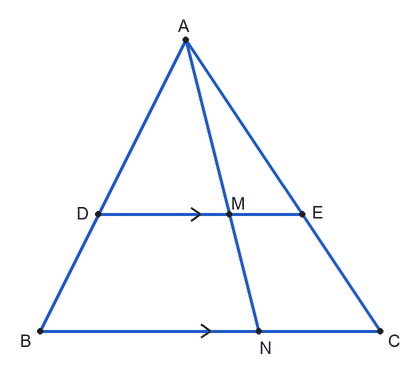
In the given figure, DE ∥ BC, AE = 15 cm, EC = 9 cm, NC = 6 cm and BN = 24 cm.
(i) Write all possible pairs of similar triangles.
(ii) Find lengths of ME and DM.
Confirming your payment
Sign up now and get 250 free tokens.
Similarity · Question 32 of 120
In the given figure, DE ∥ BC, AE = 15 cm, EC = 9 cm, NC = 6 cm and BN = 24 cm.
(i) Write all possible pairs of similar triangles.
(ii) Find lengths of ME and DM.
Solution:
Concept: Basic Proportionality Theorem (BPT): A line drawn parallel to one side of a triangle divides the other two sides in the same ratio. The small triangle it cuts off is similar to the whole triangle, because the parallel line makes equal corresponding angles.
Given: DE ∥ BC, AE = 15 cm, EC = 9 cm, NC = 6 cm, BN = 24 cm.
Step 1 — Part (i): list the similar triangles.
DE ∥ BC, and the lines AB, AN and AC run from A to BC. Each small triangle at A is cut off by the parallel line DE from a bigger triangle with the same angle at A, and the parallel line makes equal corresponding angles. So:
Step 2 — Part (ii): find the ratio of the small triangles to the big ones.
E lies on AC, so AC is AE + EC:
From ΔAME ~ ΔANC, the ratio of matching sides is AE : AC, and it also equals AM : AN:
Step 3 — Part (ii): find ME.
ME is of NC:
Step 4 — Part (ii): find DM.
From ΔADM ~ ΔABN, the ratio DM : BN equals AM : AN, and Step 2 showed that AM : AN is 15 : 24:
Watch out: AE is compared with the WHOLE of AC (24 cm), not with EC; the small triangles are compared with the big ones.
Therefore, (i) ΔADE ~ ΔABC, ΔADM ~ ΔABN, ΔAME ~ ΔANC; (ii) ME = 3.75 cm and DM = 15 cm.