
Question 463 marksEasy
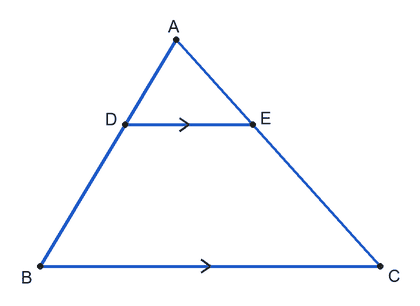
In the following figure, point D divides AB in the ratio 3 : 5. Find :
(i) (ii) (iii)
Also, if :
(iv) DE = 2·4 cm, find the length of BC.
(v) BC = 4·8 cm, find the length of DE.
Confirming your payment
Sign up now and get 250 free tokens.
Similarity · Question 46 of 120
In the following figure, point D divides AB in the ratio 3 : 5. Find :
(i) (ii) (iii)
Also, if :
(iv) DE = 2·4 cm, find the length of BC.
(v) BC = 4·8 cm, find the length of DE.
Solution:
Concept: Basic Proportionality Theorem (BPT): A line drawn parallel to one side of a triangle divides the other two sides in the same ratio. The small triangle it cuts off is similar to the whole triangle, because the parallel line makes equal corresponding angles.
Given: DE ∥ BC and AD : DB = 3 : 5.
Step 1 — Part (i): use BPT.
DE ∥ BC, so DE divides AB and AC in the same ratio. AD : DB = 3 : 5, so:
Step 2 — Part (ii): compare AD with the whole of AB.
AD is 3 parts and DB is 5 parts, so AB is 8 parts:
Step 3 — Part (iii): the same for AE.
AE : EC is also 3 : 5 (part (i)), so AC is 8 parts:
Step 4 — Part (iv): find BC.
ΔADE ~ ΔABC, so DE : BC equals AD : AB, which is 3 : 8. So BC is of DE:
Step 5 — Part (v): find DE.
Now BC = 4.8 cm, and DE is of BC:
Watch out: In BPT the small side is compared with the WHOLE side: , not .
Therefore, (i) , (ii) , (iii) , (iv) BC = 6.4 cm and (v) DE = 1.8 cm.