
Question 1043 marksMedium
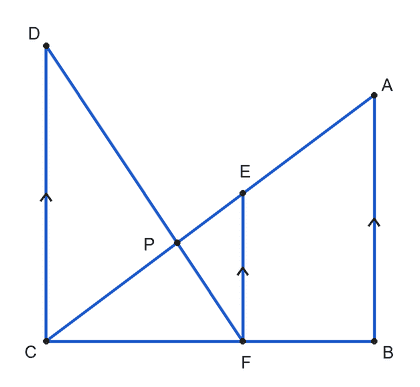
In the figure given below, AB ∥ EF ∥ CD. If AB = 22·5 cm, EP = 7·5 cm, PC = 15 cm and DC = 27 cm. Calculate : (i) EF (ii) AC
Confirming your payment
Sign up now and get 250 free tokens.
Similarity · Question 104 of 120
In the figure given below, AB ∥ EF ∥ CD. If AB = 22·5 cm, EP = 7·5 cm, PC = 15 cm and DC = 27 cm. Calculate : (i) EF (ii) AC
Solution:
Concept: When two straight lines cross at a point O and the segments joining their ends are parallel, the two triangles formed at O are similar (AA). The angles at O are vertically opposite, so they are equal, and the parallel lines make equal alternate angles with each crossing line.
Given: AB ∥ EF ∥ CD; AB = 22.5 cm, EP = 7.5 cm, PC = 15 cm, DC = 27 cm.
Step 1 — Part (i): show ΔPEF ~ ΔPCD.
EF ∥ DC, and CE and DF cross at P. ∠EPF = ∠CPD (vertically opposite) and ∠PEF = ∠PCD (alternate angles). So ΔPEF ~ ΔPCD.
Step 2 — Part (i): find EF.
EF matches CD, and EP matches CP:
Step 3 — Part (ii): show ΔCEF ~ ΔCAB.
EF ∥ AB, so in ΔCAB the line EF cuts off ΔCEF, and ΔCEF ~ ΔCAB. CE is CP + PE:
Step 4 — Part (ii): find AC.
CA matches CE, and AB matches EF:
Watch out: For AC use the whole of CE (15 + 7.5), because EF and AB are compared from the vertex C.
Therefore, (i) EF = 13.5 cm and (ii) AC = 37.5 cm.