
Question 1173 marksMedium
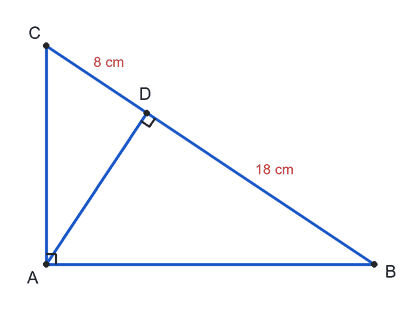
In the given figure, ABC is a right angled triangle with ∠BAC = 90°.
(i) Prove that : ΔADB ~ ΔCDA.
(ii) If BD = 18 cm and CD = 8 cm, find AD.
(iii) Find the ratio of the area of ΔADB is to area of ΔCDA.
Confirming your payment
Sign up now and get 250 free tokens.
Similarity · Question 117 of 120
In the given figure, ABC is a right angled triangle with ∠BAC = 90°.
(i) Prove that : ΔADB ~ ΔCDA.
(ii) If BD = 18 cm and CD = 8 cm, find AD.
(iii) Find the ratio of the area of ΔADB is to area of ΔCDA.
Solution:
Concept: In a right-angled triangle, the perpendicular from the right angle to the hypotenuse splits it into two triangles. Each of them shares an acute angle with the whole triangle and has a right angle, so by AA all three triangles are similar.
Given: ∠BAC = 90°, AD ⟂ BC, BD = 18 cm, CD = 8 cm.
Step 1 — Part (i): find two pairs of equal angles.
AD ⟂ BC, so ∠ADB and ∠CDA are both 90°. In ΔADB, ∠DAB is 90° − ∠B. In ΔABC, ∠C is also 90° − ∠B, because ∠BAC is 90°. So ∠DAB = ∠DCA, and ΔADB ~ ΔCDA by AA, with A matching C, D matching D and B matching A.
Step 2 — Part (ii): write the ratio.
AD (in ΔADB) matches CD, and BD matches AD:
Cross-multiplying gives AD² = BD × CD:
Step 3 — Part (iii): ratio of the areas.
The side ratio of ΔADB to ΔCDA is AD : CD, which is 12 : 8:
Watch out: The side ratio is AD : CD = 12 : 8 (matching sides), not BD : CD = 18 : 8.
Therefore, (i) ΔADB ~ ΔCDA; (ii) AD = 12 cm; (iii) area of ΔADB : area of ΔCDA = 9 : 4.