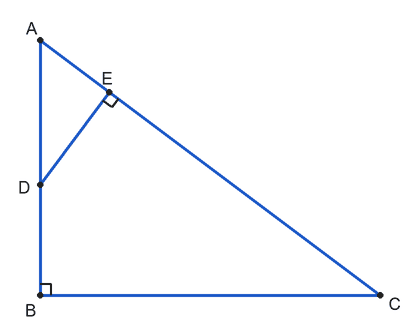
ABC is a right angled triangle with ∠ABC = 90°. D is any point on AB and DE is perpendicular to AC. Prove that
Question 1183 marksMedium
ABC is a right angled triangle with ∠ABC = 90°. D is any point on AB and DE is perpendicular to AC. Prove that :
(i) ΔADE ~ ΔACB.
(ii) If AC = 13 cm, BC = 5 cm and AE = 4 cm. Find DE and AD.
(iii) Find, area of ΔADE : area of quadrilateral BCED.
Solution:
Concept:AA rule: If two angles of one triangle are equal to two angles of another triangle, the third angles are equal too (the angles of a triangle add up to 180°), so the triangles are similar. Their corresponding sides are then in the same ratio.
Given: ∠ABC = 90°, D on AB, DE ⟂ AC; AC = 13 cm, BC = 5 cm, AE = 4 cm.
Step 1 — Part (i): find two pairs of equal angles.
In ΔADE and ΔACB, ∠AED and ∠ABC are both 90°, and ∠A is common. So ΔADE ~ ΔACB by AA, with D matching C and E matching B.
Step 2 — Part (ii): find AB.
ΔABC is right-angled at B:
AB=132−52=169−25=144=12 cm
Step 3 — Part (ii): write the ratios.
AE matches AB, DE matches CB and AD matches AC:
ABAE=CBDE=ACAD=124=31
Step 4 — Part (ii): find DE and AD.
Each length of ΔADE is 31 of its partner in ΔACB:
DE=31×5=132 cmAD=31×13=431 cm
Step 5 — Part (iii): area of the quadrilateral.
The areas of ΔADE and ΔACB are in the ratio 1² : 3², that is 1 : 9. The quadrilateral BCED is ΔACB without ΔADE:
BCED=9−1=8 parts
So area ADE : area BCED = 1 : 8.
Check: In ΔADE, AE² + DE² is 16 + 925, and this sum is 9169, the value of AD². ✓
Watch out: AE matches AB (each is next to ∠A and to the right angle), not AC.
Therefore, (i) ΔADE ~ ΔACB; (ii) DE = 132 cm and AD = 431 cm; (iii) 1 : 8.