
Question 483 marksEasy
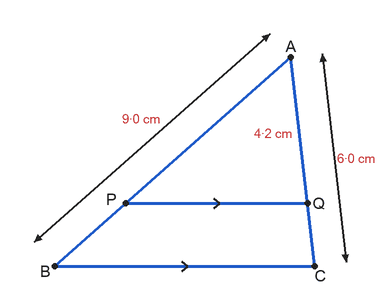
A line PQ is drawn parallel to the side BC of Δ ABC which cuts side AB at P and side AC at Q. If AB = 9·0 cm, CA = 6·0 cm and AQ = 4·2 cm, find the length of AP.
Confirming your payment
Sign up now and get 250 free tokens.
Similarity · Question 48 of 120
A line PQ is drawn parallel to the side BC of Δ ABC which cuts side AB at P and side AC at Q. If AB = 9·0 cm, CA = 6·0 cm and AQ = 4·2 cm, find the length of AP.
Solution:
Concept: Basic Proportionality Theorem (BPT): A line drawn parallel to one side of a triangle divides the other two sides in the same ratio. The small triangle it cuts off is similar to the whole triangle, because the parallel line makes equal corresponding angles.
Given: PQ ∥ BC, AB = 9 cm, CA = 6 cm, AQ = 4.2 cm.
Step 1 — Name the similar triangles.
PQ ∥ BC, so ΔAPQ ~ ΔABC, and AP : AB equals AQ : AC.
Step 2 — Find AP.
We multiply both sides by AB:
Watch out: AP is on AB and AQ is on AC; each part is compared with the whole side it lies on.
Therefore, AP = 6.3 cm.