
Question 493 marksEasy
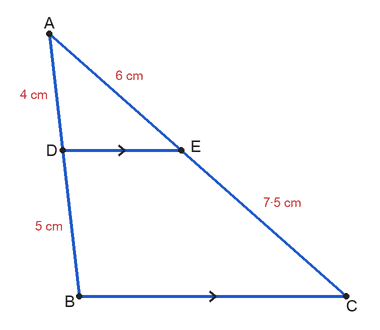
In Δ ABC, D and E are the points on sides AB and AC respectively. Find whether DE ∥ BC, if :
(i) AB = 9 cm, AD = 4 cm, AE = 6 cm and EC = 7·5 cm.
(ii) AB = 6·3 cm, EC = 11·0 cm, AD = 0·8 cm and AE = 1·6 cm.
Confirming your payment
Sign up now and get 250 free tokens.
Similarity · Question 49 of 120
In Δ ABC, D and E are the points on sides AB and AC respectively. Find whether DE ∥ BC, if :
(i) AB = 9 cm, AD = 4 cm, AE = 6 cm and EC = 7·5 cm.
(ii) AB = 6·3 cm, EC = 11·0 cm, AD = 0·8 cm and AE = 1·6 cm.
Solution:
Concept: Converse of the Basic Proportionality Theorem: If a line divides two sides of a triangle in the same ratio, then it is parallel to the third side.
Given: D on AB and E on AC in ΔABC.
Step 1 — Part (i): find DB.
D lies on AB, so DB is AB − AD:
Step 2 — Part (i): compare the ratios.
We compare AD : DB with AE : EC:
The ratios are equal, so DE ∥ BC.
Step 3 — Part (ii): find DB.
Again DB is AB − AD:
Step 4 — Part (ii): compare the ratios.
We compare the two ratios as fractions:
The ratios are equal, so DE ∥ BC.
Watch out: In part (i) the length given is the WHOLE side AB = 9 cm; subtract AD to get DB before comparing.
Therefore, DE ∥ BC in both (i) and (ii).