
Question 503 marksEasy
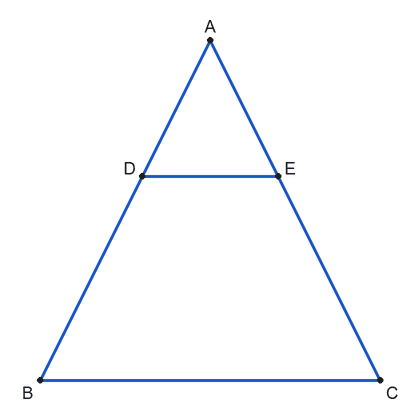
In the given figure, Δ ABC ~ Δ ADE. If AE : EC = 4 : 7 and DE = 6·6 cm, find BC. If '' be the length of the perpendicular from A to DE, find the length of perpendicular from A to BC in terms of ''.
Confirming your payment
Sign up now and get 250 free tokens.
Similarity · Question 50 of 120
In the given figure, Δ ABC ~ Δ ADE. If AE : EC = 4 : 7 and DE = 6·6 cm, find BC. If '' be the length of the perpendicular from A to DE, find the length of perpendicular from A to BC in terms of ''.
Solution:
Concept: In similar triangles, every corresponding length (side, altitude, median, angle bisector and perimeter) is in the same ratio as the corresponding sides. Only areas behave differently: they go as the square of that ratio.
Given: ΔABC ~ ΔADE, AE : EC = 4 : 7, DE = 6.6 cm, and x is the perpendicular from A to DE.
Step 1 — Find the ratio of the triangles.
ΔABC ~ ΔADE. E lies on AC with AE : EC = 4 : 7, so AE is 4 parts of the 11 parts of AC. Every length of ΔADE is of the matching length of ΔABC.
Step 2 — Find BC.
BC matches DE, so BC is of DE:
Step 3 — Find the perpendicular from A to BC.
Corresponding altitudes of similar triangles are in the same ratio as the sides. The perpendicular from A to DE is x, so the perpendicular from A to BC is of x:
Watch out: AE : AC is 4 : 11, not 4 : 7: compare AE with the WHOLE of AC.
Therefore, BC = 18.15 cm and the perpendicular from A to BC is .