
Question 93 marksMedium
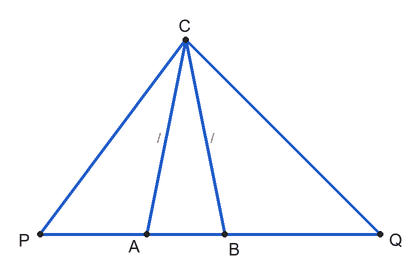
In the given figure, ΔABC is isosceles and AP × BQ = AC², prove that ΔACP ~ ΔBCQ.
Confirming your payment
Sign up now and get 250 free tokens.
Similarity · Question 9 of 120
In the given figure, ΔABC is isosceles and AP × BQ = AC², prove that ΔACP ~ ΔBCQ.
Solution:
Concept: SAS rule for similarity: If one angle of a triangle equals one angle of another triangle, and the sides that form these angles are in the same ratio, the two triangles are similar.
Given: CA = CB, and P, A, B, Q are on one line with AP × BQ = AC².
Step 1 — Find a pair of equal angles.
ΔABC is isosceles with CA = CB (the tick marks), so the base angles are equal: ∠CAB = ∠CBA. P, A, B and Q lie on one straight line, so ∠CAP and ∠CBQ are the supplements of these equal angles:
Step 2 — Turn the product into a ratio.
Since AC and BC are equal, AC² can be written as AC × BC, so the given product becomes AP × BQ = AC × BC. Dividing both sides by BC × BQ gives:
Step 3 — Apply SAS.
In ΔCAP the sides forming ∠CAP are AP and AC. In ΔQBC the sides forming the equal angle ∠CBQ are BC and BQ. By Step 2, AP matches BC and AC matches BQ, and the ratios are equal. So the triangles are similar by SAS, with A matching B, P matching C and C matching Q:
Watch out: The equal angles are the angles OUTSIDE the triangle, ∠CAP and ∠CBQ, not the base angles themselves.
Note: Written with the vertices in matching order the result is ΔACP ~ ΔBQC; the book's ΔBCQ names the same triangle.
Therefore, ΔACP ~ ΔBCQ. Hence proved.