
Question 83 marksMedium
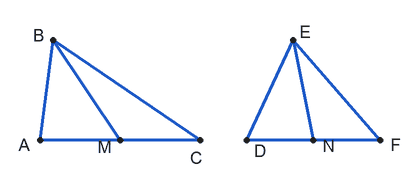
In the given figure, ΔABC and ΔDEF are similar. BM and EN are their medians. If ΔABC is similar to ΔDEF, prove that :
(i) ΔAMB ~ ΔDNE (ii) ΔCMB ~ ΔFNE (iii)
Confirming your payment
Sign up now and get 250 free tokens.
Similarity · Question 8 of 120
In the given figure, ΔABC and ΔDEF are similar. BM and EN are their medians. If ΔABC is similar to ΔDEF, prove that :
(i) ΔAMB ~ ΔDNE (ii) ΔCMB ~ ΔFNE (iii)
Solution:
Concept: SAS rule for similarity: If one angle of a triangle equals one angle of another triangle, and the sides that form these angles are in the same ratio, the two triangles are similar.
Given: ΔABC ~ ΔDEF; BM and EN are medians, so M and N are the mid-points of AC and DF.
Step 1 — Write what the similarity gives.
Since ΔABC ~ ΔDEF, the corresponding angles are equal, ∠A = ∠D and ∠C = ∠F, and the corresponding sides are in proportion:
Step 2 — Use the mid-points M and N.
BM is a median, so M is the mid-point of AC, and AM and MC are each half of AC. In the same way DN and NF are each half of DF. Halves of two lengths are in the same ratio as the lengths:
Step 3 — Part (i): ΔAMB ~ ΔDNE.
In ΔAMB and ΔDNE, ∠A = ∠D, and the sides forming these angles are in proportion: (Step 2). So ΔAMB ~ ΔDNE by SAS.
Step 4 — Part (ii): ΔCMB ~ ΔFNE.
In ΔCMB and ΔFNE, ∠C = ∠F. The sides forming them are CB, CM and FE, FN, and , because both equal (Steps 1 and 2). So ΔCMB ~ ΔFNE by SAS.
Step 5 — Part (iii): compare the medians.
From part (i), the third sides BM and EN of the similar triangles AMB and DNE are in the same ratio as AB and DE, and from Step 1 that ratio equals :
Watch out: For SAS use the equal angle (∠A or ∠C) and the two sides that form it, not any two sides.
Therefore, (i) ΔAMB ~ ΔDNE, (ii) ΔCMB ~ ΔFNE and (iii) . Hence proved.