
Question 73 marksMedium
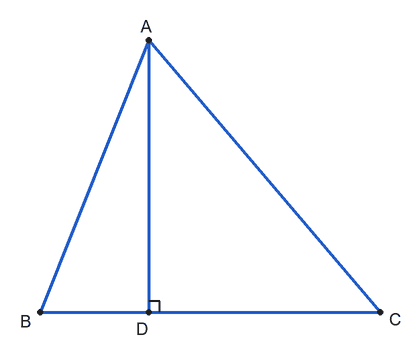
In ΔABC, AD is perpendicular to side BC and AD² = BD × CD, prove that ∠BAC = 90°.
Confirming your payment
Sign up now and get 250 free tokens.
Similarity · Question 7 of 120
In ΔABC, AD is perpendicular to side BC and AD² = BD × CD, prove that ∠BAC = 90°.
Solution:
Concept: SAS rule for similarity: If one angle of a triangle equals one angle of another triangle, and the sides that form these angles are in the same ratio, the two triangles are similar.
Given: AD ⟂ BC and AD² = BD × CD.
Step 1 — Rewrite the given condition as a ratio.
We are given AD² = BD × CD, that is AD × AD = BD × CD. Dividing both sides by BD × AD gives:
Step 2 — Show ΔADB ~ ΔCDA.
In ΔADB and ΔCDA, the angles ∠ADB and ∠CDA are both 90°, because AD ⟂ BC. The sides forming these right angles are AD, BD in the first triangle and CD, AD in the second, and Step 1 shows they are in proportion. So ΔADB ~ ΔCDA by SAS, with A matching C, D matching D and B matching A.
Step 3 — Read off equal angles.
Corresponding angles of similar triangles are equal. ∠BAD (at A in ΔADB) matches ∠ACD (at C in ΔCDA), so ∠BAD = ∠ACD.
Step 4 — Add the two angles at A.
∠BAC is made of ∠BAD and ∠DAC. We replace ∠BAD by the equal angle ∠ACD:
In ΔADC the angle at D is 90°, so the other two angles, ∠ACD and ∠DAC, add up to 90°. Hence ∠BAC = 90°.
Watch out: Match the vertices with care: the angle at A in ΔADB matches the angle at C in ΔCDA, not the angle at A.
Therefore, ∠BAC = 90°. Hence proved.