
Question 363 marksMedium
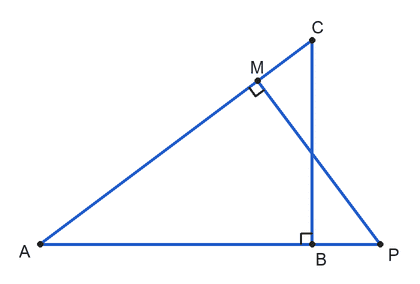
In the given figure, Δ ABC and Δ AMP are right angled at B and M respectively. Given AC = 10 cm, AP = 15 cm and PM = 12 cm.
(i) Prove that : Δ ABC ~ Δ AMP
(ii) Find : AB and BC.
Confirming your payment
Sign up now and get 250 free tokens.
Similarity · Question 36 of 120
In the given figure, Δ ABC and Δ AMP are right angled at B and M respectively. Given AC = 10 cm, AP = 15 cm and PM = 12 cm.
(i) Prove that : Δ ABC ~ Δ AMP
(ii) Find : AB and BC.
Solution:
Concept: AA rule: If two angles of one triangle are equal to two angles of another triangle, the third angles are equal too (the angles of a triangle add up to 180°), so the triangles are similar. Their corresponding sides are then in the same ratio.
Given: ∠ABC and ∠AMP are right angles; AC = 10 cm, AP = 15 cm, PM = 12 cm.
Step 1 — Part (i): find two pairs of equal angles.
ΔABC is right-angled at B and ΔAMP at M, so ∠ABC and ∠AMP are both 90°. M lies on AC and B on AP, so ∠A is common to both triangles. By AA, ΔABC ~ ΔAMP, with B matching M and C matching P.
Step 2 — Part (ii): find AM.
ΔAMP is right-angled at M, so by Pythagoras' theorem:
Step 3 — Part (ii): write the ratio.
Corresponding sides of ΔABC and ΔAMP are in the same ratio:
Step 4 — Part (ii): find AB and BC.
Each side of ΔABC is of its partner in ΔAMP:
Check: In ΔABC, 6² + 8² = 36 + 64, and 100 is 10², so AC = 10 cm as given. ✓
Watch out: AC (opposite the right angle in ΔABC) matches AP (opposite the right angle in ΔAMP), not AM.
Therefore, (i) ΔABC ~ ΔAMP; (ii) AB = 6 cm and BC = 8 cm.