
Question 373 marksMedium
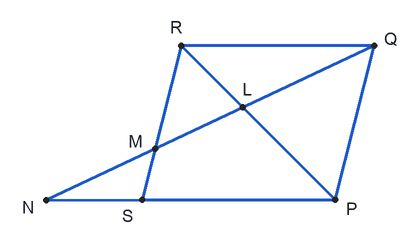
In the figure, PQRS is a parallelogram with PQ = 16 cm and QR = 10 cm. L is a point on PR such that RL : LP = 2 : 3. QL produced meets RS at M and PS produced at N. Find the lengths of PN and RM.
Confirming your payment
Sign up now and get 250 free tokens.
Similarity · Question 37 of 120
In the figure, PQRS is a parallelogram with PQ = 16 cm and QR = 10 cm. L is a point on PR such that RL : LP = 2 : 3. QL produced meets RS at M and PS produced at N. Find the lengths of PN and RM.
Solution:
Concept: When two straight lines cross at a point O and the segments joining their ends are parallel, the two triangles formed at O are similar (AA). The angles at O are vertically opposite, so they are equal, and the parallel lines make equal alternate angles with each crossing line.
Given: PQRS is a parallelogram, PQ = 16 cm, QR = 10 cm, RL : LP = 2 : 3.
Step 1 — Find RM: name the similar triangles.
RS ∥ PQ (opposite sides of the parallelogram). In ΔRLM and ΔPLQ, ∠RLM = ∠PLQ (vertically opposite) and ∠LRM = ∠LPQ (alternate angles, with PR crossing RS and PQ). So ΔRLM ~ ΔPLQ by AA.
Step 2 — Find RM: use the ratio RL : LP.
RM matches PQ, and RL matches PL:
Step 3 — Find PN: name the similar triangles.
PS ∥ QR, and N lies on PS produced, so PN ∥ QR. In ΔLRQ and ΔLPN, ∠RLQ = ∠PLN (vertically opposite) and ∠LRQ = ∠LPN (alternate angles). So ΔLRQ ~ ΔLPN by AA.
Step 4 — Find PN: use the ratio.
RQ matches PN, and RL matches PL:
Watch out: RL : LP = 2 : 3 is the ratio of the SMALL triangle to the big one, so RM is less than PQ but PN is more than QR.
Therefore, PN = 15 cm and RM = cm.