
Question 383 marksMedium
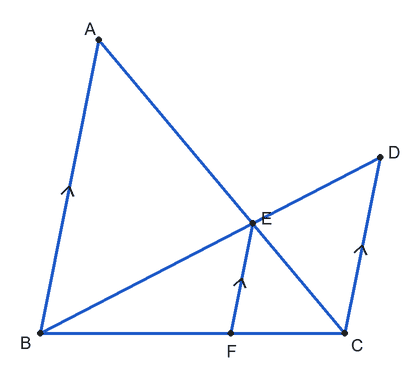
In the given figure, AB ∥ EF ∥ DC; AB = 67·5 cm, DC = 40·5 cm and AE = 52·5 cm.
(i) Name the three pairs of similar triangles.
(ii) Find the lengths of EC and EF.
Confirming your payment
Sign up now and get 250 free tokens.
Similarity · Question 38 of 120
In the given figure, AB ∥ EF ∥ DC; AB = 67·5 cm, DC = 40·5 cm and AE = 52·5 cm.
(i) Name the three pairs of similar triangles.
(ii) Find the lengths of EC and EF.
Solution:
Concept: Basic Proportionality Theorem (BPT): A line drawn parallel to one side of a triangle divides the other two sides in the same ratio. The small triangle it cuts off is similar to the whole triangle, because the parallel line makes equal corresponding angles.
Given: AB ∥ EF ∥ DC; AB = 67.5 cm, DC = 40.5 cm, AE = 52.5 cm.
Step 1 — Part (i): name the three pairs.
AB ∥ DC, so the triangles at E made by AC and BD are similar: ΔEAB ~ ΔECD. EF ∥ AB, so ΔCEF ~ ΔCAB (BPT in ΔCAB). EF ∥ DC, so ΔBEF ~ ΔBDC (BPT in ΔBDC).
Step 2 — Part (ii): find EC.
From ΔEAB ~ ΔECD, AE matches CE and AB matches CD:
So EC is of AE:
Step 3 — Part (ii): find EF.
From ΔCEF ~ ΔCAB, EF matches AB and CE matches CA. First, CA is the whole diagonal:
Rounded to two decimal places, EF ≈ 25.31 cm.
Check: From ΔBEF ~ ΔBDC, EF is of DC, and BE : ED is also 5 : 3, so EF is of 40.5, which is 25.3125. ✓
Watch out: In ΔCEF ~ ΔCAB compare CE with the WHOLE of CA (84 cm), not with EA.
Therefore, (i) ΔEAB ~ ΔECD, ΔCEF ~ ΔCAB, ΔBEF ~ ΔBDC; (ii) EC = 31.5 cm and EF = 25.3125 cm ≈ 25.31 cm.