
Question 11 markMCQEasy
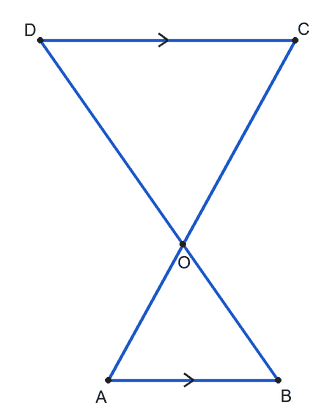
In the given diagram OC = 1·5 × OA, then OB is equal to :
Confirming your payment
Sign up now and get 250 free tokens.
Similarity · Question 1 of 120
In the given diagram OC = 1·5 × OA, then OB is equal to :
(A) 3 × OD
(B) 1·5 × OD
(C) × OD
(D) OD
Answer: (C) × OD
Concept: When two straight lines cross at a point O and the segments joining their ends are parallel, the two triangles formed at O are similar (AA). The angles at O are vertically opposite, so they are equal, and the parallel lines make equal alternate angles with each crossing line.
Step 1 — Name the similar triangles.
In the figure DC ∥ AB, and the lines AC and BD cross at O. In ΔOAB and ΔOCD, ∠AOB = ∠COD because they are vertically opposite, and ∠OAB = ∠OCD because they are alternate angles (AB ∥ DC, with AC as the crossing line). So ΔOAB ~ ΔOCD by AA, with A matching C and B matching D.
Step 2 — Write the ratio of corresponding sides.
Corresponding sides are in the same ratio, so OB is to OD as OA is to OC:
Step 3 — Put in OC = 1.5 × OA.
Since OC = 1.5 × OA, the ratio OA : OC does not depend on the actual lengths:
Therefore , which means OB = × OD.
Watch out: OC is the LONGER part (1.5 times OA), so OB, which matches OA, is the shorter part: OB is less than OD.
Why the other options are wrong:
Therefore, OB = × OD, option (C).