
Question 293 marksEasy
In a trapezium ABCD, side AB is parallel to side DC; and the diagonals AC and BD intersect each other at point P. Prove that :
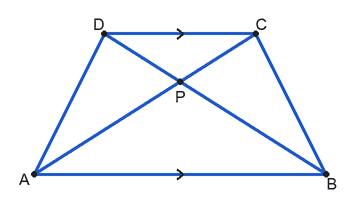
(i) Δ APB is similar to Δ CPD.
(ii) PA × PD = PB × PC.
Confirming your payment
Sign up now and get 250 free tokens.
Similarity · Question 29 of 120
In a trapezium ABCD, side AB is parallel to side DC; and the diagonals AC and BD intersect each other at point P. Prove that :
(i) Δ APB is similar to Δ CPD.
(ii) PA × PD = PB × PC.
Solution:
Concept: When two straight lines cross at a point O and the segments joining their ends are parallel, the two triangles formed at O are similar (AA). The angles at O are vertically opposite, so they are equal, and the parallel lines make equal alternate angles with each crossing line.
Given: ABCD is a trapezium with AB ∥ DC; the diagonals meet at P.
Step 1 — Part (i): find two pairs of equal angles.
The diagonals AC and BD cross at P, so ∠APB = ∠CPD (vertically opposite). AB ∥ DC and AC crosses them, so ∠PAB = ∠PCD (alternate angles).
Step 2 — Part (i): conclude.
By AA, ΔAPB ~ ΔCPD, with A matching C, P matching P and B matching D.
Step 3 — Part (ii): write the ratio of sides.
PA matches PC, and PB matches PD, so:
Step 4 — Part (ii): cross-multiply.
Multiplying both sides by PC × PD gives:
Watch out: PA and PC are the two parts of the SAME diagonal AC; they are matched with each other, not multiplied.
Therefore, (i) ΔAPB ~ ΔCPD and (ii) PA × PD = PB × PC. Hence proved.