Solution:
Concept: Two triangles with the same height (the same vertex and their bases on one straight line) have areas in the ratio of their bases, because area =21×base×height.
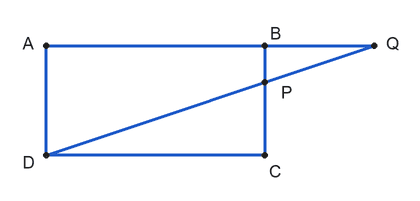
Given: ABCD is a parallelogram, BP : PC = 1 : 2, DP produced meets AB produced at Q, area of ΔCPQ = 20 cm².
Step 1 — Show ΔBPQ ~ ΔCPD.
Q lies on AB produced, so BQ ∥ DC. ∠BPQ = ∠CPD (vertically opposite) and ∠PBQ = ∠PCD (alternate angles). So ΔBPQ ~ ΔCPD, and PQ : PD equals BP : PC, which is 1 : 2.
Step 2 — Part (i): area of ΔCDP.
ΔCPQ and ΔCDP have the same vertex C, and their bases PQ and PD lie on the same line DQ. So their areas are in the ratio PQ : PD = 1 : 2, and ΔCDP has twice the area of ΔCPQ:
area of ΔCDP=2×20=40 cm2
Step 3 — Part (ii): area of ΔCDQ.
ΔCDQ is made of ΔCDP and ΔCPQ:
area of ΔCDQ=40+20=60 cm2
Step 4 — Part (ii): area of the parallelogram.
ΔCDQ has base DC, and its vertex Q is on line AB. So its height is the distance between AB and DC, the same as the height of the parallelogram on base DC. A triangle on the same base and between the same parallels has half the area of the parallelogram:
area of ABCD=2×60=120 cm2
Watch out: ΔCPQ and ΔCDP are not similar; they share a height, so their areas follow PQ : PD itself, not its square.
Therefore, (i) area of ΔCDP = 40 cm² and (ii) area of ABCD = 120 cm².