
Question 653 marksMedium
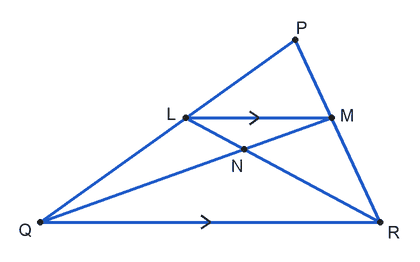
In the given triangle PQR, LM is parallel to QR and PM : MR = 3 : 4. Calculate the value of ratio :
(i) and then (ii) (iii)
Confirming your payment
Sign up now and get 250 free tokens.
Similarity · Question 65 of 120
In the given triangle PQR, LM is parallel to QR and PM : MR = 3 : 4. Calculate the value of ratio :
(i) and then (ii) (iii)
Solution:
Concept: Two triangles with the same height (the same vertex and their bases on one straight line) have areas in the ratio of their bases, because area .
Given: LM ∥ QR and PM : MR = 3 : 4; LR and MQ meet at N.
Step 1 — Part (i): PL : PQ and LM : QR.
LM ∥ QR, so by BPT L and M divide PQ and PR in the same ratio, and ΔPLM ~ ΔPQR. PM is 3 parts and MR is 4, so PR is 7 parts:
LM matches QR in the similar triangles, so as well.
Step 2 — Part (ii): show ΔLMN ~ ΔRQN.
LR and MQ cross at N. ∠LNM = ∠RNQ (vertically opposite) and ∠NLM = ∠NRQ (alternate angles, LM ∥ QR). So ΔLMN ~ ΔRQN, and LN : NR equals LM : QR, which is 3 : 7.
Step 3 — Part (ii): compare the areas.
ΔLMN and ΔMNR have the same vertex M, and their bases LN and NR lie on the same line LR, so they have the same height. Their areas are in the ratio of the bases:
So the ratio is 3 : 7.
Step 4 — Part (iii): split QM at N.
From the same similar triangles, QN : NM equals QR : LM, which is 7 : 3. So QN is 7 parts, NM is 3 parts and QM is 10 parts.
Step 5 — Part (iii): compare the areas.
ΔLQM and ΔLQN have the same vertex L, and their bases QM and QN lie on the same line, so their areas are in the ratio QM : QN:
Watch out: ΔLMN and ΔMNR are NOT similar; their areas come from equal heights, so use the plain ratio of the bases, not its square.
Therefore, (i) and ; (ii) 3 : 7; (iii) 10 : 7.