
Question 673 marksMedium
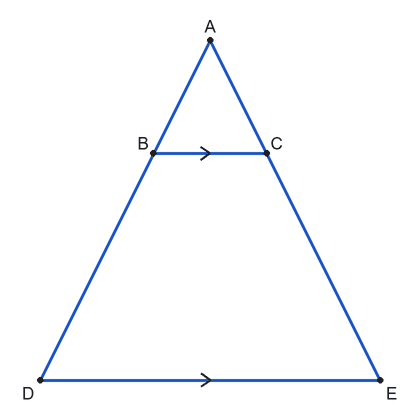
In the given figure, BC is parallel to DE. Area of triangle ABC = 25 cm², Area of trapezium BCED = 24 cm² and DE = 14 cm. Calculate the length of BC. Also, find the area of triangle BCD.
Confirming your payment
Sign up now and get 250 free tokens.
Similarity · Question 67 of 120
In the given figure, BC is parallel to DE. Area of triangle ABC = 25 cm², Area of trapezium BCED = 24 cm² and DE = 14 cm. Calculate the length of BC. Also, find the area of triangle BCD.
Solution:
Concept: The ratio of the areas of two similar triangles equals the square of the ratio of their corresponding sides: if the sides are in the ratio , the areas are in the ratio .
Given: BC ∥ DE, area of ΔABC = 25 cm², area of trapezium BCED = 24 cm², DE = 14 cm.
Step 1 — Find the area of ΔADE.
ΔADE is ΔABC together with the trapezium BCED:
Step 2 — Find BC.
BC ∥ DE, so ΔABC ~ ΔADE and the side ratio is the square root of the area ratio:
Step 3 — Find the gap between BC and DE.
The heights of the similar triangles from A are also in the ratio 5 : 7. The height of ΔABC comes from its area:
So the parallel lines BC and DE are 7 − 5 = 2 cm apart.
Step 4 — Find the area of ΔBCD.
ΔBCD has base BC = 10 cm, and its vertex D is on DE, so its height is the gap of 2 cm:
Watch out: ΔADE is the WHOLE big triangle (25 + 24 = 49 cm²); comparing 25 with 24 gives a wrong ratio.
Therefore, BC = 10 cm and the area of ΔBCD = 10 cm².