
Opening your dashboard
Class 10 Maths Chapter 15 Similarity: Previous Year Questions
25 questions on Chapter 15, each solved step by step. Class 10 Maths, ICSE 2026-27.
25 questions with solutions
1–4 marks · Mixed difficulty
- 14 marks
Question 1
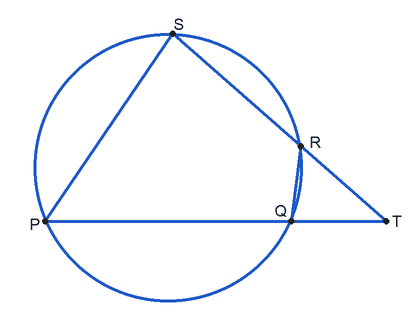
In the given figure PQRS is a cyclic quadrilateral PQ and SR produced meet at T.
(i) Prove .
(ii) Find SP if TP = 18cm, RQ = 4 cm and TR = 6cm.
(iii) Find area of quadrilateral PQRS if area of cm.
 Solve with AI
Written solution
Solution:
Concept: In a cyclic quadrilateral (all four vertices on a circle) an exterior angle equals the interior opposite angle, because opposite angles add up to 180°. AA rule: if two angles of one triangle equal two angles of another, the third angles are equal too (the angles of a triangle add up to 180°), so the triangles are similar. Similar triangles have their corresponding sides in the same ratio. Writing means A matches D, B matches E and C matches F. The ratio of the areas of two similar triangles equals the square of the ratio of their corresponding sides: sides in the ratio give areas in the ratio .
Given: PQ and SR produced meet at T; TP = 18 cm, RQ = 4 cm, TR = 6 cm, ar(ΔPTS) = 27 cm².
Step 1 — Part (i): find two pairs of equal angles.
In ΔTPS and ΔTRQ the angle at T is common. PQRS is cyclic, so the exterior angle ∠TRQ (at R, between RQ and the extension RT of SR) equals the interior opposite angle ∠QPS, which is ∠TPS. Two pairs of angles are equal, so ΔTPS ~ ΔTRQ by AA, with T matching T, P matching R and S matching Q.
Step 2 — Part (ii): write the ratios.
Corresponding sides are in the same ratio. TP matches TR, and SP matches QR:
Step 3 — Part (ii): find SP.
We put in TP = 18 cm, TR = 6 cm and RQ = 4 cm:
Step 4 — Part (iii): ratio of the areas.
The side ratio is , so the areas are in the ratio :
Step 5 — Part (iii): area of PQRS.
So ar(ΔTRQ) is one-ninth of 27 cm². The quadrilateral PQRS is ΔTPS with ΔTRQ cut away:
Watch out: P matches R (not Q), because the equal angles are at P and R. So SP is compared with RQ.
Therefore, (i) ΔTPS ~ ΔTRQ (AA); (ii) SP = 12 cm; (iii) area of PQRS = 24 cm².
- 23 marks
Question 2
A model of a ship is made to a scale 1 : 300
(i) The length of the model of the ship is 2 m. Calculate the length of the ship.
(ii) The area of the deck ship is 180, 000 m. Calculate the area of the deck of the model.
(iii) The volume of the model is 6.5 m. Calculate the volume of the ship.
Solve with AIWritten solution
Solution:
Concept: A scale compares a model (or map) with the real object: every real length is times the model length, every real area is times the model area, and every real volume is times the model volume.
Given: Scale 1 : 300; model length 2 m; real deck 1,80,000 m²; model volume 6.5 m³.
Step 1 — Part (i): length of the ship.
Every real length is 300 times the model length:
Step 2 — Part (ii): area of the model deck.
A model area is of the real area, and :
Step 3 — Part (iii): volume of the ship.
A real volume is times the model volume, and :
That is m³.
Watch out: Lengths scale by n, areas by and volumes by . Using n for an area or a volume is the usual slip.
Therefore, (i) 600 m; (ii) 2 m²; (iii) 17,55,00,000 m³ ( m³).
- 33 marks
Question 3
PQR is a triangle. S is a point on the side QR of such that .
Given QP = 8 cm, PR = 6 cm and SR = 3 cm
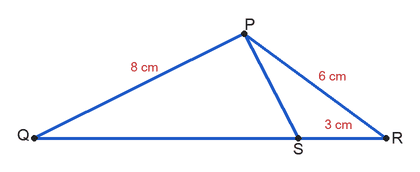
(i) Prove
(ii) Find the length of QR and PS
(iii)
Solve with AIWritten solution
Solution:
Concept: AA rule: if two angles of one triangle equal two angles of another, the third angles are equal too (the angles of a triangle add up to 180°), so the triangles are similar. Similar triangles have their corresponding sides in the same ratio. Writing means A matches D, B matches E and C matches F. The ratio of the areas of two similar triangles equals the square of the ratio of their corresponding sides: sides in the ratio give areas in the ratio .
Given: S on QR with ∠PSR = ∠QPR; QP = 8 cm, PR = 6 cm, SR = 3 cm.
Step 1 — Part (i): find two pairs of equal angles.
In ΔPQR and ΔSPR, ∠QPR = ∠PSR (given) and ∠R is common. So ΔPQR ~ ΔSPR by AA, with P matching S, Q matching P and R matching R.
Step 2 — Part (ii): write the ratios.
PR (in ΔPQR) matches SR (in ΔSPR), and both are known:
Step 3 — Part (ii): find QR and PS.
So QR is twice PR, and PQ is twice SP:
Step 4 — Part (iii): ratio of the areas.
The areas go as the square of the side ratio 2:
So the ratio is 4 : 1.
Watch out: Write the triangles in matching order: find which angle equals which first, then read corresponding sides from the same positions.
Therefore, (i) ΔPQR ~ ΔSPR (AA); (ii) QR = 12 cm and PS = 4 cm; (iii) 4 : 1.
- 43 marks
Question 4
On a map drawn to a scale of 1 : 50,000, a rectangular plot of land ABCD has the following dimensions. AB = 6 cm ; BC = 8 cm and all angles are right angles. Find :
(i) the actual length of the diagonal distance AC of the plot in km.
(ii) the actual area of the plot in square km.
Solve with AIWritten solution
Solution:
Concept: A scale compares a model (or map) with the real object: every real length is times the model length, every real area is times the model area, and every real volume is times the model volume.
Given: Scale 1 : 50,000; AB = 6 cm, BC = 8 cm on the map; all angles right angles.
Step 1 — Change the scale to kilometres.
On a 1 : 50,000 map, 1 cm stands for 50,000 cm. Since 1 km = 1,00,000 cm, 1 cm stands for 0.5 km:
Step 2 — Part (i): the diagonal on the map.
All angles of ABCD are right angles, so ΔABC is right-angled at B and Pythagoras gives AC:
Step 3 — Part (i): the real diagonal.
Each map centimetre is 0.5 km:
Step 4 — Part (ii): the real area.
The map area is 6 × 8 = 48 cm². Each 1 cm² on the map stands for 0.5 km × 0.5 km, that is 0.25 km²:
Watch out: Areas go as the SQUARE of the side ratio; do not use the side ratio itself for areas. Here 1 cm² stands for 0.25 km², not 0.5 km².
Therefore, (i) AC = 5 km; (ii) the area is 12 km².
- 53 marks
Question 5
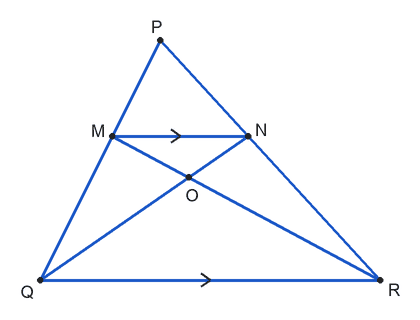
In , MN is parallel to QR and
(i) Find .
(ii) Prove that and are similar.
(iii) Find, Area of : Area of .
 Solve with AI
Written solution
Solution:
Concept: Basic Proportionality Theorem (BPT): a line parallel to one side of a triangle divides the other two sides in the same ratio, and the small triangle it cuts off is similar to the whole triangle (equal corresponding angles). When two lines cross at O and the segments joining their ends are parallel, the two triangles at O are similar (AA): the angles at O are vertically opposite, and the parallel lines make equal alternate angles with each crossing line. The ratio of the areas of two similar triangles equals the square of the ratio of their corresponding sides: sides in the ratio give areas in the ratio .
Given: MN ∥ QR and .
Step 1 — Part (i): use the parallel line.
MN ∥ QR, so ΔPMN ~ ΔPQR (∠P common, ∠PMN = ∠PQR as corresponding angles). Since PM : MQ is 2 : 3, PM is 2 parts of the 5 parts of PQ:
Step 2 — Part (ii): find two pairs of equal angles.
In ΔOMN and ΔORQ, ∠OMN = ∠ORQ because they are alternate angles (MN ∥ QR, with MR as the crossing line), and ∠MON = ∠ROQ because they are vertically opposite. So ΔOMN ~ ΔORQ by AA, with M matching R and N matching Q.
Step 3 — Part (iii): ratio of the areas.
MN matches RQ, and :
Watch out: MN is compared with the WHOLE side PQ: the ratio is PM : PQ; this gives 2 parts out of 5, not 2 out of 3.
Therefore, (i) ; (ii) ΔOMN ~ ΔORQ (AA); (iii) 4 : 25.
- 63 marks
Question 6
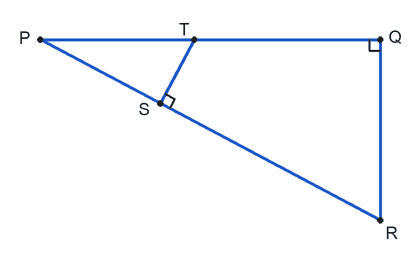
In the given figure, , PQ = 5 cm and PS = 2 cm.
(i) Prove that .
(ii) Find Area of : Area of quadrilateral SRQT.
 Solve with AI
Written solution
Solution:
Concept: AA rule: if two angles of one triangle equal two angles of another, the third angles are equal too (the angles of a triangle add up to 180°), so the triangles are similar. Similar triangles have their corresponding sides in the same ratio. Writing means A matches D, B matches E and C matches F. The ratio of the areas of two similar triangles equals the square of the ratio of their corresponding sides: sides in the ratio give areas in the ratio .
Given: ∠PQR and ∠PST are both 90°, PQ = 5 cm, PS = 2 cm.
Step 1 — Part (i): find two pairs of equal angles.
In ΔPQR and ΔPST, ∠PQR and ∠PST are both 90° (given), and ∠P is common. So ΔPQR ~ ΔPST by AA, with Q matching S and R matching T.
Step 2 — Part (ii): ratio of the areas of the triangles.
PQ matches PS, so the side ratio is and the areas go as its square:
Step 3 — Part (ii): area of the quadrilateral.
Let ar(ΔPQR) be 25 units, so ar(ΔPST) is 4 units. SRQT is ΔPQR with ΔPST cut away:
So ar(ΔPQR) : ar(SRQT) = 25 : 21.
Watch out: Q matches S (the right angles), so PQ is compared with PS; do not pair PQ with PT.
Therefore, (i) ΔPQR ~ ΔPST (AA); (ii) area of ΔPQR : area of SRQT = 25 : 21.
- 73 marks
Question 7
The model of a building is constructed with the scale factor 1 : 30.
(i) If the height of the model is 80 cm, find the actual height of the building in meters.
(ii) If the actual volume of a tank at the top of the building is 27 m³, find the volume of the tank on the top of the model.
Solve with AIWritten solution
Solution:
Concept: A scale compares a model (or map) with the real object: every real length is times the model length, every real area is times the model area, and every real volume is times the model volume.
Given: Scale 1 : 30; model height 80 cm; real tank 27 m³.
Step 1 — Part (i): actual height.
Every real length is 30 times the model length, and 100 cm = 1 m:
2400 cm is 24 m.
Step 2 — Part (ii): volume of the model tank.
A model volume is of the real volume, and :
Since 1 m³ = 10,00,000 cm³, this is 1000 cm³.
Watch out: Lengths scale by n, areas by and volumes by . Using n for an area or a volume is the usual slip.
Therefore, (i) the building is 24 m high; (ii) the model tank holds 0.001 m³ (1000 cm³).
- 83 marks
Question 8
A model of a high rise building is made to a scale of 1 : 50.
(i) If the height of the model is 0.8 m, find the height of the actual building.
(ii) If the floor area of a flat in the building is 20 m, find the floor area of that in the model.
Solve with AIWritten solution
Solution:
Concept: A scale compares a model (or map) with the real object: every real length is times the model length, every real area is times the model area, and every real volume is times the model volume.
Given: Scale 1 : 50; model height 0.8 m; real floor area 20 m².
Step 1 — Part (i): height of the building.
Every real length is 50 times the model length:
Step 2 — Part (ii): floor area in the model.
A model area is of the real area, and :
Since 1 m² = 10,000 cm², this is 80 cm².
Watch out: Lengths scale by n, areas by and volumes by . Using n for an area or a volume is the usual slip.
Therefore, (i) the building is 40 m high; (ii) the model floor area is 0.008 m² (80 cm²).
- 91 mark
Question 9
In the given figure cm, cm, cm, cm and .
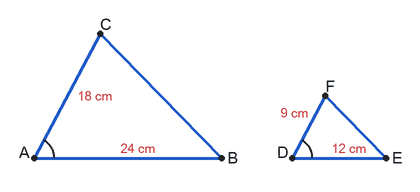
Then by the condition
Solve with AIAnswer
(A) AAA
- Correct
(B) SAS
(C) SSS
(D) AAS
Answer: (B) SAS
Concept: SAS rule for similarity: if one angle of a triangle equals one angle of another, and the sides forming these angles are in the same ratio, the triangles are similar.
Step 1 — Compare the sides around the equal angles.
∠BAC = ∠EDF. The sides forming ∠A are AB and AC; those forming ∠D are DE and DF:
Step 2 — Name the rule.
One pair of equal angles, with the sides forming them in the same ratio (2), is exactly the SAS similarity condition.
Watch out: SAS needs the equal angle to be the one BETWEEN the two proportional sides; here it is.
Why the other options are wrong:
- (A) AAA: AAA needs all the angles to be known equal, but only one pair of angles is given.
- (C) SSS: SSS needs all three pairs of sides; BC and EF are not given.
- (D) AAS: AAS is a congruence rule and needs two pairs of equal angles.
Therefore, ΔABC ~ ΔDEF by SAS, option (B).
- 101 mark
Question 10
In the given figure is parallel to , then by using condition of similarity
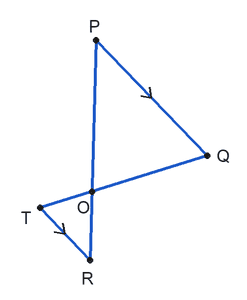 Solve with AI
Answer
(A)
- Correct
(B)
(C)
(D)
Answer: (B)
Concept: When two lines cross at O and the segments joining their ends are parallel, the two triangles at O are similar (AA): the angles at O are vertically opposite, and the parallel lines make equal alternate angles with each crossing line.
Step 1 — Find the equal angles.
PQ ∥ TR, and PR and QT cross at O. So ∠OPQ = ∠ORT (alternate angles) and ∠POQ = ∠ROT (vertically opposite). Hence ΔOPQ ~ ΔORT, with P matching R and Q matching T.
Step 2 — Write the ratios.
Corresponding sides are read from the same positions in the two names:
Watch out: Write the triangles in matching order: find which angle equals which first, then read corresponding sides from the same positions.
Why the other options are wrong:
- (A): it pairs OP with OT, but P matches R, not T.
- (C): it turns the second ratio upside down; OR is on top while RT is below.
- (D): it turns the third ratio upside down; OT is on top while RT is below.
Therefore, the correct statement is option (B).
- 111 mark
Question 11
In the given figure is a trapezium in which is parallel to .
cm and cm, cm, cm, cm and cm.
Using the given information answer the following questions.

(i) From the given figure name the pair of similar triangles
Solve with AIAnswer
(A)
- Correct
(B)
(C)
(D)
Answer: (B)
Concept: When two lines cross at O and the segments joining their ends are parallel, the two triangles at O are similar (AA): the angles at O are vertically opposite, and the parallel lines make equal alternate angles with each crossing line.
Step 1 — Find two pairs of equal angles.
DC ∥ AB and the diagonals AC and BD cross at O. ∠OCD = ∠OAB (alternate angles, AC as the crossing line) and ∠COD = ∠AOB (vertically opposite).
Step 2 — Name the similar pair.
Two pairs of equal angles make ΔCOD ~ ΔAOB by AA, with C matching A, O matching O and D matching B.
Watch out: The similar triangles are the two at O that touch the PARALLEL sides DC and AB.
Why the other options are wrong:
- (A) : ΔOAB and ΔOBC share only side OB; no angles are shown equal, so they are not similar in general.
- (C) : ΔADB and ΔACB stand on the same base AB but are not similar in general.
- (D) : ΔCOD and ΔCOB sit on either side of OC; nothing makes their angles equal.
Therefore, the similar pair is ΔCOD and ΔAOB, option (B).
- 121 mark
Question 12
In the given figure is a trapezium in which is parallel to .
cm and cm, cm, cm, cm and cm.
Using the given information answer the following questions.
(ii) The corresponding proportional sides with respect to the pair of similar triangles obtained in (i)
Solve with AIAnswer
- Correct
(A)
(B)
(C)
(D)
Answer: (A)
Concept: When two lines cross at O and the segments joining their ends are parallel, the two triangles at O are similar (AA): the angles at O are vertically opposite, and the parallel lines make equal alternate angles with each crossing line.
Step 1 — Use the similar pair found first.
ΔCOD ~ ΔAOB with C matching A, O matching O and D matching B.
Step 2 — Read off the corresponding sides.
So CD matches AB, OC matches OA and OD matches OB:
Watch out: Write the triangles in matching order: find which angle equals which first, then read corresponding sides from the same positions.
Why the other options are wrong:
- (B): AD and BC are the non-parallel sides of the trapezium, not sides of ΔCOD or ΔAOB.
- (C): AD, BC, BD and AC are not sides of the two similar triangles, and is the ratio upside down.
- (D): CB is not a side of ΔCOD or ΔAOB, so is not a ratio of corresponding sides.
Therefore, the proportional sides are CD : AB, OC : OA and OD : OB, option (A).
- 131 mark
Question 13
In the given figure is a trapezium in which is parallel to .
cm and cm, cm, cm, cm and cm.
Using the given information answer the following questions.
(iii) The ratio of the sides of the pair of similar triangles is
Solve with AIAnswer
(A) 1 : 3
- Correct
(B) 1 : 2
(C) 2 : 3
(D) 3 : 1
Answer: (B) 1 : 2
Concept: When two lines cross at O and the segments joining their ends are parallel, the two triangles at O are similar (AA): the angles at O are vertically opposite, and the parallel lines make equal alternate angles with each crossing line.
Step 1 — Choose a pair whose lengths are both known.
CD and AB are corresponding sides, and both are given:
Step 2 — State the ratio.
So the sides of ΔCOD and ΔAOB are in the ratio 1 : 2.
Watch out: Compare a pair of corresponding sides whose lengths are BOTH given (CD and AB), not OD with OA.
Why the other options are wrong:
- (A) 1 : 3: 1 : 3 does not match 8 : 16.
- (C) 2 : 3: 2 : 3 does not match 8 : 16.
- (D) 3 : 1: 3 : 1 is not the ratio of any pair of corresponding sides here.
Therefore, the ratio is 1 : 2, option (B).
- 141 mark
Question 14
In the given figure is a trapezium in which is parallel to .
cm and cm, cm, cm, cm and cm.
Using the given information answer the following questions.
(iv) Using the ratio of sides of the pair of similar triangles the values of and are respectively
Solve with AIAnswer
(A)
(B)
- Correct
(C)
(D)
Answer: (C)
Concept: When two lines cross at O and the segments joining their ends are parallel, the two triangles at O are similar (AA): the angles at O are vertically opposite, and the parallel lines make equal alternate angles with each crossing line.
Step 1 — Find x.
OC matches OA, and the ratio is :
Step 2 — Find y.
OD matches OB:
Watch out: OC is half of OA (not the other way round), because ΔCOD is the smaller triangle.
Why the other options are wrong:
- (A): x = 4.6 makes OC 3.6 cm, which is not half of 11 cm.
- (B): x = 7 makes OC 6 cm, not 5.5 cm.
- (D): y = 2 makes OB 5 cm, but OB must be twice OD, that is 10 cm.
Therefore, x = 6.5 and y = 7, option (C).
- 151 mark
Question 15
In the given figure , cm and cm, then is :
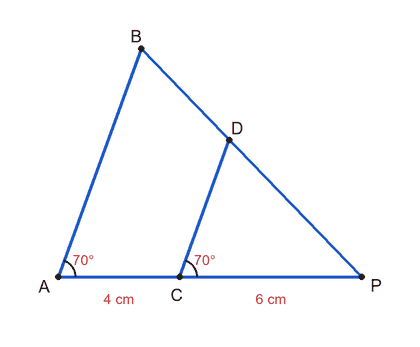 Solve with AI
Answer
(A)
(B)
- Correct
(C)
(D)
Answer: (C)
Concept: Basic Proportionality Theorem (BPT): a line parallel to one side of a triangle divides the other two sides in the same ratio, and the small triangle it cuts off is similar to the whole triangle (equal corresponding angles).
Step 1 — Show that CD ∥ AB.
∠BAP and ∠DCP are equal (both 70°), and they are corresponding angles on the line AP. So CD ∥ AB.
Step 2 — Apply BPT in ΔPAB.
CD ∥ AB cuts PA at C and PB at D, so it divides them in the same ratio:
Watch out: Compare part with part (PC with CA), not part with the whole side PA.
Why the other options are wrong:
- (A) : 5 : 3 compares the whole PA (10 cm) with PC (6 cm), not the two parts.
- (B) : 3 : 5 compares PC with the whole PA; that is PD : PB, not PD : DB.
- (D) : 2 : 3 is the ratio upside down; PD is the longer part because PC (6) is longer than CA (4).
Therefore, PD : DB = 3 : 2, option (C).
- 164 marks
Question 16
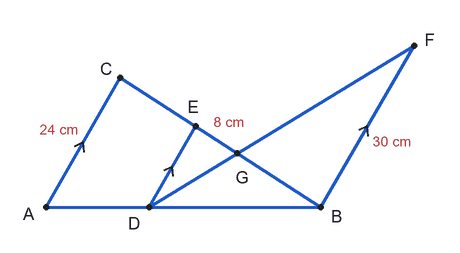
In the given figure, . If cm, cm, cm, cm.
(a) Prove
(b) Find DE
(c)
 Solve with AI
Written solution
Solution:
Concept: AA rule: if two angles of one triangle equal two angles of another, the third angles are equal too (the angles of a triangle add up to 180°), so the triangles are similar. Similar triangles have their corresponding sides in the same ratio. Writing means A matches D, B matches E and C matches F. When two lines cross at O and the segments joining their ends are parallel, the two triangles at O are similar (AA): the angles at O are vertically opposite, and the parallel lines make equal alternate angles with each crossing line.
Given: AC ∥ DE ∥ BF; AC = 24 cm, EG = 8 cm, GB = 16 cm, BF = 30 cm.
Step 1 — Part (a): find two pairs of equal angles.
In ΔGED and ΔGBF, ∠EGD = ∠BGF (vertically opposite) and ∠GED = ∠GBF (alternate angles, DE ∥ BF, with EB as the crossing line). So ΔGED ~ ΔGBF by AA, with E matching B and D matching F.
Step 2 — Part (b): find DE.
Corresponding sides are in the same ratio, so DE is to BF as EG is to GB:
Step 3 — Part (c): use ΔBDE and ΔBAC.
∠B is common, and ∠BDE = ∠BAC (corresponding angles, DE ∥ AC). So ΔBDE ~ ΔBAC by AA, and DB matches AB:
Watch out: Write the triangles in matching order: find which angle equals which first, then read corresponding sides from the same positions.
Therefore, (a) ΔGED ~ ΔGBF (AA); (b) DE = 15 cm; (c) DB : AB = 5 : 8.
- 171 mark
Question 17
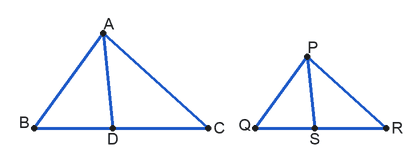
In the given diagram, . If AD and PS are bisectors of and respectively then:
 Solve with AI
Answer
(A)
- Correct
(B)
(C)
(D)
Answer: (B)
Concept: AA rule: if two angles of one triangle equal two angles of another, the third angles are equal too (the angles of a triangle add up to 180°), so the triangles are similar. Similar triangles have their corresponding sides in the same ratio. Writing means A matches D, B matches E and C matches F.
Step 1 — Use the similar triangles.
ΔABC ~ ΔPQR, so ∠B = ∠Q and ∠BAC = ∠QPR.
Step 2 — Use the bisectors.
AD bisects ∠BAC and PS bisects ∠QPR, so ∠BAD is half of ∠BAC and ∠QPS is half of ∠QPR. Halves of equal angles are equal, so ∠BAD = ∠QPS.
Step 3 — Apply AA.
In ΔABD and ΔPQS, ∠B = ∠Q and ∠BAD = ∠QPS. So ΔABD ~ ΔPQS, with A matching P, B matching Q and D matching S.
Watch out: Write the triangles in matching order: find which angle equals which first, then read corresponding sides from the same positions.
Why the other options are wrong:
- (A) : ΔPQS has an angle at P that is only half of ∠BAC, so its angles do not match those of ΔABC.
- (C) : B would have to match S, but ∠ABD equals ∠PQS, not ∠PSR.
- (D) : ΔPSR has an angle at P that is half of ∠QPR, so it cannot match the whole ΔABC.
Therefore, ΔABD ~ ΔPQS, option (B).
- 184 marks
Question 18
In the given diagram and are two right angled triangles with . If cm, cm, cm and cm
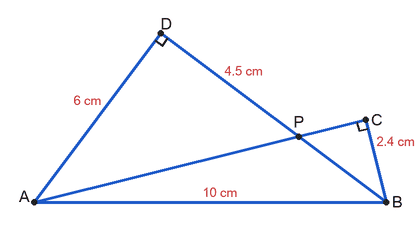
(a) Prove that .
(b) Find the length of BD and PB
(c) Hence, find the length of PA
(d) Find area : area
Solve with AIWritten solution
Solution:
Concept: AA rule: if two angles of one triangle equal two angles of another, the third angles are equal too (the angles of a triangle add up to 180°), so the triangles are similar. Similar triangles have their corresponding sides in the same ratio. Writing means A matches D, B matches E and C matches F. The ratio of the areas of two similar triangles equals the square of the ratio of their corresponding sides: sides in the ratio give areas in the ratio .
Given: ∠ADB and ∠BCA are right angles; AB = 10 cm, AD = 6 cm, BC = 2.4 cm, DP = 4.5 cm.
Step 1 — Part (a): find two pairs of equal angles.
In ΔAPD and ΔBPC, ∠ADP and ∠BCP are both 90° (given), and ∠APD = ∠BPC (vertically opposite). So ΔAPD ~ ΔBPC by AA, with A matching B, P matching P and D matching C.
Step 2 — Part (b): find BD.
ΔADB is right-angled at D, so Pythagoras gives BD:
Step 3 — Part (b): find PB.
P lies on BD, so PB is what is left of BD after DP:
Step 4 — Part (c): find PA by the similarity.
The word 'Hence' asks us to use part (a). AD matches BC and PA matches PB:
Step 5 — Part (d): ratio of the areas.
AD and BC are corresponding sides, so the areas go as the square of :
So the ratio is 25 : 4.
Watch out: D matches C (the right angles) and A matches B, so PA is compared with PB, not with PC.
Note: The printed lengths do not fit together exactly. Pythagoras in right ΔAPD would give a different PA:
With PA = 7.5 cm, BC would have to be 2.8 cm, not 2.4 cm. The question says 'Hence', so the expected answer uses the similarity of part (a) with the given BC, which gives 8.75 cm.
Therefore, (a) ΔAPD ~ ΔBPC (AA); (b) BD = 8 cm, PB = 3.5 cm; (c) PA = 8.75 cm; (d) 25 : 4.
- 191 mark
Question 19
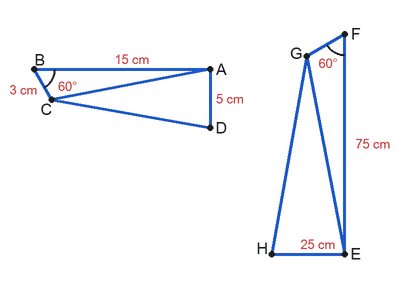
In the given diagram . If , then the length of the side FG is:
 Solve with AI
Answer
- Correct
(A) 15 cm
(B) 20 cm
(C) 25 cm
(D) 30 cm
Answer: (A) 15 cm
Concept: AA rule: if two angles of one triangle equal two angles of another, the third angles are equal too (the angles of a triangle add up to 180°), so the triangles are similar. Similar triangles have their corresponding sides in the same ratio. Writing means A matches D, B matches E and C matches F.
Step 1 — Match the sides.
ΔABC ~ ΔEFG, so A matches E, B matches F and C matches G. Then AB matches EF and BC matches FG.
Step 2 — Find the ratio and FG.
From the figure AB = 15 cm, BC = 3 cm and EF = 75 cm:
Watch out: The 5 cm (AD) and 25 cm (HE) belong to the other triangles in the figure; they are not used.
Why the other options are wrong:
- (B) 20 cm: 20 cm would make equal to about 6.7, not 5.
- (C) 25 cm: 25 cm is HE, a side of a different triangle; FG must be five times BC.
- (D) 30 cm: 30 cm is double the right value; it would need the ratio 10.
Therefore, FG = 15 cm, option (A).
- 204 marks
Question 20
In , , cm, cm, DE is perpendicular to AC such that and cm as shown in the given figure.
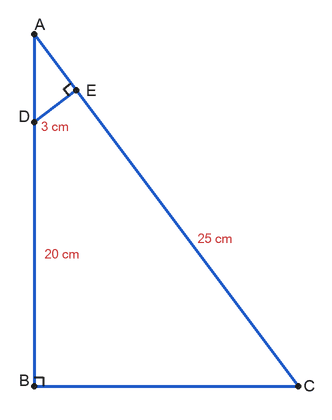
(a) Prove that .
(b) Find the lengths of BC, AD and AE.
(c) If BCED represents a plot of land on a map whose actual area on ground is 576 m, then find the scale factor of the map.
Solve with AIWritten solution
Solution:
Concept: AA rule: if two angles of one triangle equal two angles of another, the third angles are equal too (the angles of a triangle add up to 180°), so the triangles are similar. Similar triangles have their corresponding sides in the same ratio. Writing means A matches D, B matches E and C matches F. A scale compares a map with the real object: every real length is times the model length, every real area is times the model area, and every real volume is times the model volume.
Given: ∠ABC = 90°, AB = 20 cm, AC = 25 cm, DE ⊥ AC, DE = 3 cm; real area of BCED = 576 m².
Step 1 — Part (a): find two pairs of equal angles.
In ΔABC and ΔAED, ∠ABC and ∠AED are both 90°, and ∠A is common. So ΔABC ~ ΔAED by AA, with B matching E and C matching D.
Step 2 — Part (b): find BC.
ΔABC is right-angled at B, so Pythagoras gives BC:
Step 3 — Part (b): find AD and AE.
The ratios of corresponding sides are equal, and BC : ED is known:
Step 4 — Part (c): area of BCED on the map.
BCED is ΔABC with ΔAED cut away:
Step 5 — Part (c): find the scale.
Areas scale by . Here 144 cm² on the map stands for 576 m² on the ground, and 576 m² is 57,60,000 cm²:
Watch out: Change to one unit before comparing: 1 m = 100 cm, 1 km = 1,00,000 cm. Here the m² must become cm² before the square root is taken.
Therefore, (a) ΔABC ~ ΔAED (AA); (b) BC = 15 cm, AD = 5 cm, AE = 4 cm; (c) the scale is 1 : 200.
- 211 mark
Question 21
Assertion (A): In and , if and , then
Reason (R): by SSS axiom
Solve with AIAnswer
- Correct
(A) (A) is true, (R) is false.
(B) (A) is false, (R) is true.
(C) Both (A) and (R) are true, and (R) is the correct reason for (A).
(D) Both (A) and (R) are true, and (R) is the incorrect reason for (A).
Answer: (A) (A) is true, (R) is false.
Concept: AA rule: if two angles of one triangle equal two angles of another, the third angles are equal too (the angles of a triangle add up to 180°), so the triangles are similar. Similar triangles have their corresponding sides in the same ratio. Writing means A matches D, B matches E and C matches F. SSS similarity needs all three side ratios equal.
Step 1 — Judge the Assertion.
Two pairs of angles are equal, ∠BAC = ∠QPR and ∠ABC = ∠PQR. By the AA rule the triangles are similar, so the Assertion is true.
Step 2 — Judge the Reason.
SSS needs all three pairs of sides in the same ratio, but no sides are given at all. So SSS is not the rule used, and the Reason is false.
Watch out: Check WHICH rule the given facts fit: angles only means AA.
Why the other options are wrong:
- (B) (A) is false, (R) is true: it calls the Assertion false, but AA proves it.
- (C) Both (A) and (R) are true, and (R) is the correct reason for (A): it calls the Reason true, but SSS cannot apply when no sides are given.
- (D) Both (A) and (R) are true, and (R) is the incorrect reason for (A): it also calls the Reason true, which it is not.
Therefore, (A) is true and (R) is false, option (A).
- 221 mark
Question 22
If the areas of two similar triangles are in the ratio , then the ratio of their corresponding altitudes is:
Solve with AIAnswer
- Correct
(A)
(B)
(C)
(D)
Answer: (A)
Concept: The ratio of the areas of two similar triangles equals the square of the ratio of their corresponding sides: sides in the ratio give areas in the ratio . Corresponding altitudes are in the same ratio as the sides.
Step 1 — Relate the areas to the altitudes.
Corresponding altitudes are in the side ratio, and the areas go as its square:
Step 2 — Take the square root.
Both altitudes are positive, so we take the positive root:
Watch out: Take the square root of the area ratio; do not use it as it is.
Why the other options are wrong:
- (B) : 2 : 1 has no link to the given ratio.
- (C) : 9 : 64 forgets the square root.
- (D) : 8 : 3 is the ratio upside down.
Therefore, the altitudes are in the ratio 3 : 8, option (A).
- 234 marks
Question 23
In the given diagram, and .
(a) Prove that : and hence find .
(b) Prove :
(c) Given, area of square units, find the area of .
 Solve with AI
Written solution
Solution:
Concept: Basic Proportionality Theorem (BPT): a line parallel to one side of a triangle divides the other two sides in the same ratio, and the small triangle it cuts off is similar to the whole triangle (equal corresponding angles). When two lines cross at O and the segments joining their ends are parallel, the two triangles at O are similar (AA): the angles at O are vertically opposite, and the parallel lines make equal alternate angles with each crossing line. The ratio of the areas of two similar triangles equals the square of the ratio of their corresponding sides: sides in the ratio give areas in the ratio .
Given: DE ∥ BC, AD : DB = 2 : 3, ar(ΔDFE) = 16 square units.
Step 1 — Part (a): ΔADE ~ ΔABC.
∠A is common, and ∠ADE = ∠ABC (corresponding angles, DE ∥ BC). So ΔADE ~ ΔABC by AA. Since AD : DB = 2 : 3, AD is 2 of the 5 parts of AB:
So DE : BC = 2 : 5.
Step 2 — Part (b): ΔDFE ~ ΔCFB.
∠DFE = ∠CFB (vertically opposite) and ∠FDE = ∠FCB (alternate angles, DE ∥ BC, with DC as the crossing line). So ΔDFE ~ ΔCFB by AA, with D matching C and E matching B.
Step 3 — Part (c): area of ΔCFB.
DE matches CB, so the areas go as . Then:
Watch out: DE : BC is 2 : 5 (AD to the whole AB), not 2 : 3.
Therefore, (a) ΔADE ~ ΔABC, DE : BC = 2 : 5; (b) ΔDFE ~ ΔCFB (AA); (c) ar(ΔCFB) = 100 square units.
- 241 mark
Question 24
In the given diagram, and ar = ar quad BPQC. The value of is:
 Solve with AI
Answer
(A)
(B)
(C)
- Correct
(D)
Answer: (D)
Concept: The ratio of the areas of two similar triangles equals the square of the ratio of their corresponding sides: sides in the ratio give areas in the ratio .
Step 1 — Compare the areas.
The triangle APQ and the quadrilateral BPQC have equal areas, so ΔAPQ is half of ΔABC. PQ ∥ BC, so ΔAPQ ~ ΔABC and the area ratio is the square of AP : AB:
Step 2 — Find AP : AB.
Taking the square root:
So if AP is 1 part, AB is parts and PB is parts.
Step 3 — Find AP : PB.
We rationalise the denominator:
Watch out: The quadrilateral equals ΔAPQ, so ΔAPQ is HALF of the whole triangle (ratio 1 : 2), not 1 : 1.
Why the other options are wrong:
- (A) : 1 : 2 treats the area ratio as a length ratio.
- (B) : 2 : 1 also uses areas as lengths, and the wrong way round.
- (C) : 1 : √2 is AP : AB, not AP : PB.
Therefore, AP : PB = , option (D).
- 254 marks
Question 25
In the given diagram, lines AE and BD intersect each other at C such that .
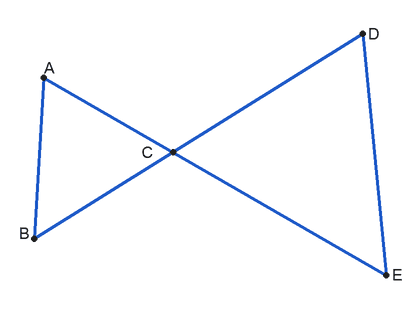
(a) Complete the equation with corresponding sides of and .
(b) is equal to which angle of ?
(c) If, , find the ratio of ar : ar .
Solve with AIWritten solution
Solution:
Concept: AA rule: if two angles of one triangle equal two angles of another, the third angles are equal too (the angles of a triangle add up to 180°), so the triangles are similar. Similar triangles have their corresponding sides in the same ratio. Writing means A matches D, B matches E and C matches F. The ratio of the areas of two similar triangles equals the square of the ratio of their corresponding sides: sides in the ratio give areas in the ratio .
Given: AE and BD meet at C; ΔABC ~ ΔDEC; AB : DE = 2 : 3.
Step 1 — Part (a): match the vertices.
ΔABC ~ ΔDEC means A matches D, B matches E and C matches C. So AC matches DC and BC matches EC:
Step 2 — Part (b): the equal angle.
B matches E, so ∠ABC equals ∠DEC.
Step 3 — Part (c): ratio of the areas.
The areas go as the square of AB : DE:
Watch out: Write the triangles in matching order: find which angle equals which first, then read corresponding sides from the same positions.
Therefore, (a) the missing sides are DC and BC, giving AB : DE, AC : DC and BC : EC equal; (b) ∠ABC = ∠DEC; (c) 4 : 9.