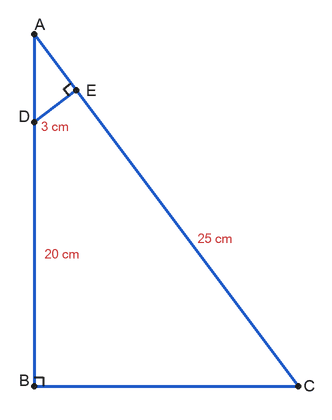
In ABC , ∠ ABC = 90^° , AB = 20 cm, AC = 25 cm, DE is perpendicular to AC such that ∠ DEA = 90^° and DE = 3 cm as…
Question 204 marksAsked 2025Medium
In △ABC, ∠ABC=90∘, AB=20 cm, AC=25 cm, DE is perpendicular to AC such that ∠DEA=90∘ and DE=3 cm as shown in the given figure.
(a) Prove that △ABC∼△AED.
(b) Find the lengths of BC, AD and AE.
(c) If BCED represents a plot of land on a map whose actual area on ground is 576 m2, then find the scale factor of the map.
Solution:
Concept:AA rule: if two angles of one triangle equal two angles of another, the third angles are equal too (the angles of a triangle add up to 180°), so the triangles are similar. Similar triangles have their corresponding sides in the same ratio. Writing ΔABC∼ΔDEF means A matches D, B matches E and C matches F. A scale1:n compares a map with the real object: every real length is n times the model length, every real area is n2 times the model area, and every real volume is n3 times the model volume.
Given: ∠ABC = 90°, AB = 20 cm, AC = 25 cm, DE ⊥ AC, DE = 3 cm; real area of BCED = 576 m².
Step 1 — Part (a): find two pairs of equal angles.
In ΔABC and ΔAED, ∠ABC and ∠AED are both 90°, and ∠A is common. So ΔABC ~ ΔAED by AA, with B matching E and C matching D.
Step 2 — Part (b): find BC.
ΔABC is right-angled at B, so Pythagoras gives BC:
BC=252−202=225=15 cm
Step 3 — Part (b): find AD and AE.
The ratios of corresponding sides are equal, and BC : ED is known: