
Question 184 marksAsked 2024Medium
In the given diagram and are two right angled triangles with . If cm, cm, cm and cm
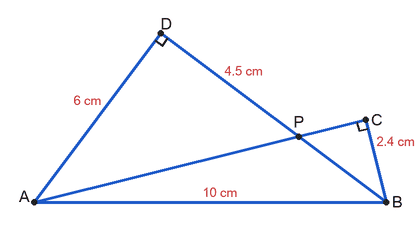
(a) Prove that .
(b) Find the length of BD and PB
(c) Hence, find the length of PA
(d) Find area : area
Confirming your payment
Sign up now and get 250 free tokens.
Previous Year Questions · Question 18 of 25
In the given diagram and are two right angled triangles with . If cm, cm, cm and cm
(a) Prove that .
(b) Find the length of BD and PB
(c) Hence, find the length of PA
(d) Find area : area
Solution:
Concept: AA rule: if two angles of one triangle equal two angles of another, the third angles are equal too (the angles of a triangle add up to 180°), so the triangles are similar. Similar triangles have their corresponding sides in the same ratio. Writing means A matches D, B matches E and C matches F. The ratio of the areas of two similar triangles equals the square of the ratio of their corresponding sides: sides in the ratio give areas in the ratio .
Given: ∠ADB and ∠BCA are right angles; AB = 10 cm, AD = 6 cm, BC = 2.4 cm, DP = 4.5 cm.
Step 1 — Part (a): find two pairs of equal angles.
In ΔAPD and ΔBPC, ∠ADP and ∠BCP are both 90° (given), and ∠APD = ∠BPC (vertically opposite). So ΔAPD ~ ΔBPC by AA, with A matching B, P matching P and D matching C.
Step 2 — Part (b): find BD.
ΔADB is right-angled at D, so Pythagoras gives BD:
Step 3 — Part (b): find PB.
P lies on BD, so PB is what is left of BD after DP:
Step 4 — Part (c): find PA by the similarity.
The word 'Hence' asks us to use part (a). AD matches BC and PA matches PB:
Step 5 — Part (d): ratio of the areas.
AD and BC are corresponding sides, so the areas go as the square of :
So the ratio is 25 : 4.
Watch out: D matches C (the right angles) and A matches B, so PA is compared with PB, not with PC.
Note: The printed lengths do not fit together exactly. Pythagoras in right ΔAPD would give a different PA:
With PA = 7.5 cm, BC would have to be 2.8 cm, not 2.4 cm. The question says 'Hence', so the expected answer uses the similarity of part (a) with the given BC, which gives 8.75 cm.
Therefore, (a) ΔAPD ~ ΔBPC (AA); (b) BD = 8 cm, PB = 3.5 cm; (c) PA = 8.75 cm; (d) 25 : 4.