
Question 33 marksAsked 2017Medium
PQR is a triangle. S is a point on the side QR of such that .
Given QP = 8 cm, PR = 6 cm and SR = 3 cm
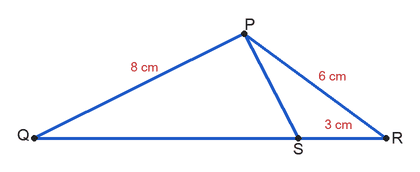
(i) Prove
(ii) Find the length of QR and PS
(iii)
Confirming your payment
Sign up now and get 250 free tokens.
Previous Year Questions · Question 3 of 25
PQR is a triangle. S is a point on the side QR of such that .
Given QP = 8 cm, PR = 6 cm and SR = 3 cm
(i) Prove
(ii) Find the length of QR and PS
(iii)
Solution:
Concept: AA rule: if two angles of one triangle equal two angles of another, the third angles are equal too (the angles of a triangle add up to 180°), so the triangles are similar. Similar triangles have their corresponding sides in the same ratio. Writing means A matches D, B matches E and C matches F. The ratio of the areas of two similar triangles equals the square of the ratio of their corresponding sides: sides in the ratio give areas in the ratio .
Given: S on QR with ∠PSR = ∠QPR; QP = 8 cm, PR = 6 cm, SR = 3 cm.
Step 1 — Part (i): find two pairs of equal angles.
In ΔPQR and ΔSPR, ∠QPR = ∠PSR (given) and ∠R is common. So ΔPQR ~ ΔSPR by AA, with P matching S, Q matching P and R matching R.
Step 2 — Part (ii): write the ratios.
PR (in ΔPQR) matches SR (in ΔSPR), and both are known:
Step 3 — Part (ii): find QR and PS.
So QR is twice PR, and PQ is twice SP:
Step 4 — Part (iii): ratio of the areas.
The areas go as the square of the side ratio 2:
So the ratio is 4 : 1.
Watch out: Write the triangles in matching order: find which angle equals which first, then read corresponding sides from the same positions.
Therefore, (i) ΔPQR ~ ΔSPR (AA); (ii) QR = 12 cm and PS = 4 cm; (iii) 4 : 1.