
Question 53 marksAsked 2018Medium
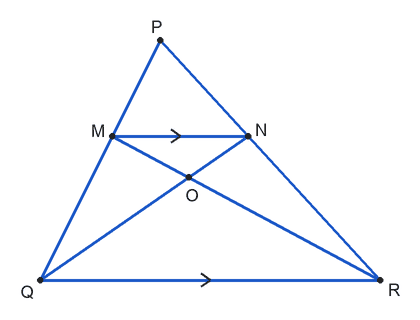
In , MN is parallel to QR and
(i) Find .
(ii) Prove that and are similar.
(iii) Find, Area of : Area of .
Confirming your payment
Sign up now and get 250 free tokens.
Previous Year Questions · Question 5 of 25
In , MN is parallel to QR and
(i) Find .
(ii) Prove that and are similar.
(iii) Find, Area of : Area of .
Solution:
Concept: Basic Proportionality Theorem (BPT): a line parallel to one side of a triangle divides the other two sides in the same ratio, and the small triangle it cuts off is similar to the whole triangle (equal corresponding angles). When two lines cross at O and the segments joining their ends are parallel, the two triangles at O are similar (AA): the angles at O are vertically opposite, and the parallel lines make equal alternate angles with each crossing line. The ratio of the areas of two similar triangles equals the square of the ratio of their corresponding sides: sides in the ratio give areas in the ratio .
Given: MN ∥ QR and .
Step 1 — Part (i): use the parallel line.
MN ∥ QR, so ΔPMN ~ ΔPQR (∠P common, ∠PMN = ∠PQR as corresponding angles). Since PM : MQ is 2 : 3, PM is 2 parts of the 5 parts of PQ:
Step 2 — Part (ii): find two pairs of equal angles.
In ΔOMN and ΔORQ, ∠OMN = ∠ORQ because they are alternate angles (MN ∥ QR, with MR as the crossing line), and ∠MON = ∠ROQ because they are vertically opposite. So ΔOMN ~ ΔORQ by AA, with M matching R and N matching Q.
Step 3 — Part (iii): ratio of the areas.
MN matches RQ, and :
Watch out: MN is compared with the WHOLE side PQ: the ratio is PM : PQ; this gives 2 parts out of 5, not 2 out of 3.
Therefore, (i) ; (ii) ΔOMN ~ ΔORQ (AA); (iii) 4 : 25.