
Question 601 markMCQMedium
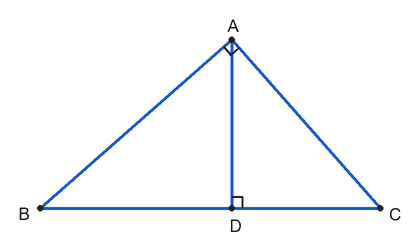
In the given figure, ∠BAC = 90°, AD is perpendicular to BC, BC = 13 cm and AC = 5 cm, then area of ΔADC : area of ΔDBA is :
Confirming your payment
Sign up now and get 250 free tokens.
Similarity · Question 60 of 120
In the given figure, ∠BAC = 90°, AD is perpendicular to BC, BC = 13 cm and AC = 5 cm, then area of ΔADC : area of ΔDBA is :
(A) 5 : 13
(B) 13 : 5
(C) 25 : 144
(D) 144 : 25
Answer: (C) 25 : 144
Concept: In a right-angled triangle, the perpendicular from the right angle to the hypotenuse splits it into two triangles. Each of them shares an acute angle with the whole triangle and has a right angle, so by AA all three triangles are similar.
Step 1 — Find AB.
∠BAC = 90°, so by Pythagoras' theorem:
Step 2 — Show ΔADC ~ ΔBDA.
The perpendicular AD from the right angle makes two triangles similar to each other. In ΔADC and ΔBDA the angles at D are both 90°, and ∠ACD = ∠BAD (each is 90° − ∠B). So ΔADC ~ ΔBDA, with A matching B, D matching D and C matching A. So AC (in ΔADC) matches BA (in ΔBDA).
Step 3 — Square the ratio for the areas.
The side ratio is AC : BA, which is 5 : 12:
Watch out: Areas go as the SQUARE of the side ratio. Do not use the side ratio itself for areas.
Why the other options are wrong:
Therefore, area ADC : area DBA = 25 : 144, option (C).