
Question 193 marksMedium
In ΔABC, ∠B = 90° and BD ⟂ AC.
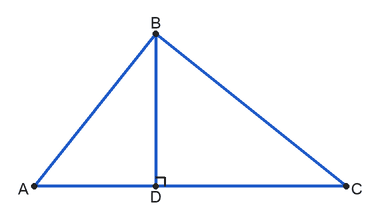
(i) If CD = 10 cm and BD = 8 cm; find AD.
(ii) If AC = 18 cm and AD = 6 cm; find BD.
(iii) If AC = 9 cm and AB = 7 cm; find AD.
Confirming your payment
Sign up now and get 250 free tokens.
Similarity · Question 19 of 120
In ΔABC, ∠B = 90° and BD ⟂ AC.
(i) If CD = 10 cm and BD = 8 cm; find AD.
(ii) If AC = 18 cm and AD = 6 cm; find BD.
(iii) If AC = 9 cm and AB = 7 cm; find AD.
Solution:
Concept: In a right-angled triangle, the perpendicular from the right angle to the hypotenuse splits it into two triangles. Each of them shares an acute angle with the whole triangle and has a right angle, so by AA all three triangles are similar.
Given: In ΔABC, ∠B = 90° and BD ⟂ AC.
Step 1 — Two useful results.
ΔADB and ΔBDC both have a right angle at D. Also ∠ABD and ∠C are both equal to 90° − ∠A, so ΔADB ~ ΔBDC by AA. Hence BD is to DC as AD is to BD:
Cross-multiplying gives:
In the same way ΔADB ~ ΔABC (right angles at D and B, and the common angle A). Hence AB is to AC as AD is to AB:
Cross-multiplying gives:
Step 2 — Part (i): find AD.
We use (1) with BD = 8 cm and DC = 10 cm, and divide by 10:
Step 3 — Part (ii): find DC, then BD.
D lies on AC, so DC is the rest of AC after AD:
Now (1) gives BD², and we take the square root:
As a decimal, 6√2 is about 8.49 cm.
Step 4 — Part (iii): find AD.
We use (2) with AB = 7 cm and AC = 9 cm, and divide by 9:
Watch out: In (2) AD is the part of AC NEXT TO A, the end of the side AB; using DC there instead of AD gives a wrong answer.
Therefore, (i) AD = 6.4 cm, (ii) BD = 6√2 cm ≈ 8.49 cm and (iii) AD = cm.