
Question 1123 marksMedium
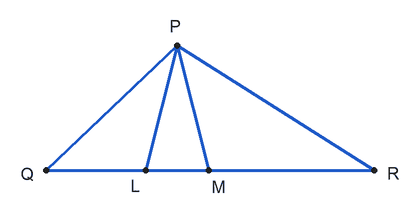
In a triangle PQR, L and M are two points on the base QR, such that ∠LPQ = ∠QRP and ∠RPM = ∠RQP. Prove that :
(i) Δ PQL ~ Δ RPM (ii) QL × RM = PL × PM (iii) PQ² = QR × QL
Confirming your payment
Sign up now and get 250 free tokens.
Similarity · Question 112 of 120
In a triangle PQR, L and M are two points on the base QR, such that ∠LPQ = ∠QRP and ∠RPM = ∠RQP. Prove that :
(i) Δ PQL ~ Δ RPM (ii) QL × RM = PL × PM (iii) PQ² = QR × QL
Solution:
Concept: AA rule: If two angles of one triangle are equal to two angles of another triangle, the third angles are equal too (the angles of a triangle add up to 180°), so the triangles are similar. Their corresponding sides are then in the same ratio.
Given: L and M are on QR with ∠LPQ = ∠QRP and ∠RPM = ∠RQP.
Step 1 — Part (i): find two pairs of equal angles.
In ΔPQL and ΔRPM, ∠LPQ = ∠MRP, because ∠MRP is the same angle as ∠QRP. Also ∠PQL = ∠RPM, because ∠PQL is the same angle as ∠RQP. So ΔPQL ~ ΔRPM by AA, with P matching R, Q matching P and L matching M.
Step 2 — Part (ii): write the ratio and cross-multiply.
QL matches PM, and PL matches RM:
Cross-multiplying gives:
Step 3 — Part (iii): show ΔPQL ~ ΔRQP.
In ΔPQL and ΔRQP, ∠Q is common and ∠QPL = ∠QRP (given). So ΔPQL ~ ΔRQP by AA, with P matching R and L matching P.
Step 4 — Part (iii): write the ratio and cross-multiply.
PQ matches RQ, and QL matches QP:
Cross-multiplying gives:
Watch out: Write the triangles in matching order. Find which angle equals which first, then read the corresponding sides from the same positions in the two names.
Therefore, (i) ΔPQL ~ ΔRPM, (ii) QL × RM = PL × PM and (iii) PQ² = QR × QL. Hence proved.