
Opening your dashboard
Class 10 Maths Chapter 15 Similarity: Practice Questions
43 questions on Chapter 15, each worked through on its own page with the AI tutor. Class 10 Maths, ICSE 2026-27.
43 questions
1–5 marks · Mixed difficulty
- 11 mark
Question 1
Bloom's level: Remember
Two figures are said to be similar when they have :
- 21 mark
Question 2
Bloom's level: Remember
Which of the following is not a condition for the similarity of two triangles?
- 31 mark
Question 3
Bloom's level: Remember
The ratio of the areas of two similar triangles is equal to the ratio of :
- 41 mark
Question 4
Bloom's level: Understand
If PQR XYZ, which of the following is necessarily true?
- 51 mark
Question 5
Bloom's level: Apply
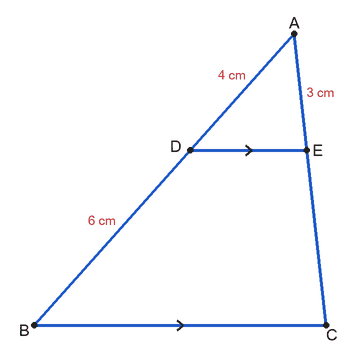
In ABC, D and E are points on AB and AC respectively such that DE BC. If AD = 4 cm, DB = 6 cm and AE = 3 cm, then EC is :
- 61 mark
Question 6
Bloom's level: Apply
Two similar triangles have a pair of corresponding sides of length 6 cm and 9 cm. If the area of the smaller triangle is 48 cm², the area of the larger triangle is :
- 71 mark
Question 7
Bloom's level: Apply
On a map drawn to a scale of 1 : 50000, the distance between two villages is 3·6 cm. The actual distance between them is :
- 81 mark
Question 8
Bloom's level: Apply
A triangle of area 20 cm² is enlarged by a scale factor of 1·5. The area of the image is :
- 91 mark
Question 9
Bloom's level: Analyse
In ABC, and . In PQR, and .
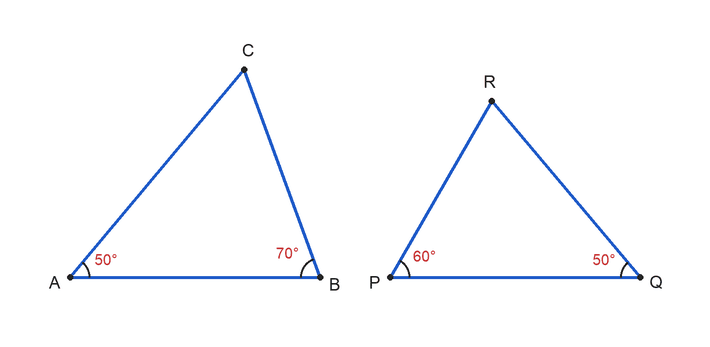
Which statement is correct?
- 101 mark
Question 10
Bloom's level: Understand
Assertion (A) : All equilateral triangles are similar to one another.
Reason (R) : Each angle of every equilateral triangle is 60°.
- 111 mark
Question 11
Bloom's level: Evaluate
In PQR, S is a point on PQ and T is a point on PR such that PS = 3 cm, SQ = 4 cm, PT = 4 cm and TR = 5 cm.
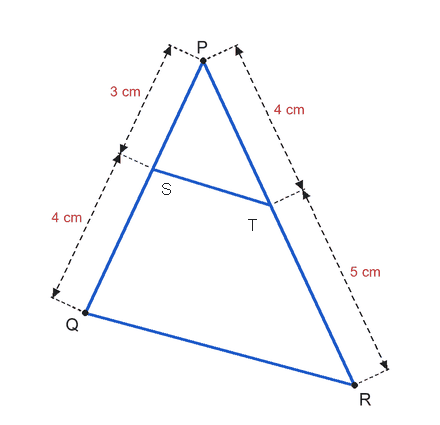
Assertion (A) : ST is parallel to QR.
Reason (R) : If a line divides two sides of a triangle in the same ratio, it is parallel to the third side.
- 121 mark
Question 12
Bloom's level: Analyse
Assertion (A) : If the areas of two similar triangles are 36 cm² and 81 cm², their corresponding sides are in the ratio 2 : 3.
Reason (R) : The ratio of the areas of two similar triangles is equal to the ratio of their corresponding sides.
- 131 mark
Question 13
Bloom's level: Remember
State the two conditions that must both hold for two polygons with the same number of sides to be similar.
- 142 marks
Question 14
Bloom's level: Understand
Using one example of each, explain why any two congruent figures are similar, but two similar figures need not be congruent.
- 152 marks
Question 15
Bloom's level: Apply
In ABC, DE BC, where D lies on AB and E lies on AC. If AD cm, DB cm, AE cm and EC cm, find the value of .

- 162 marks
Question 16
Bloom's level: Apply
ABC DEF with AB = 4 cm, BC = 6 cm, CA = 5 cm and DE = 6 cm.
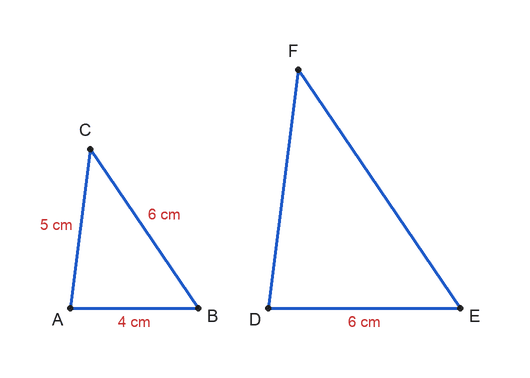
Find EF and FD, and the ratio of the perimeters of the two triangles.
- 172 marks
Question 17
Bloom's level: Apply
A rectangle measuring 8 cm by 5 cm is enlarged so that the area of its image is 160 cm². Find the scale factor and the dimensions of the image.
- 182 marks
Question 18
Bloom's level: Understand
Explain why it is enough to show that two pairs of angles are equal to prove that two triangles are similar.
- 192 marks
Question 19
Bloom's level: Analyse
D is a point on the side BC of ABC such that BD : DC = 2 : 3. Find, with a reason, the ratio of the areas of
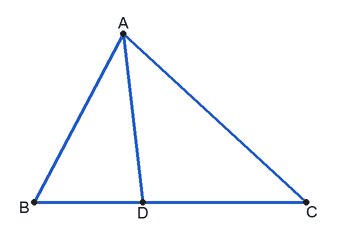
(i) ABD and ADC, (ii) ABD and ABC.
- 201 mark
Question 20
Bloom's level: Understand
A map is drawn to a scale of 1 : 25000. Explain what this scale means, giving the actual distance in metres represented by 1 cm on the map.
- 212 marks
Question 21
Bloom's level: Evaluate
In ABC, AB = 3 cm, AC = 4 cm and . In PQR, PQ = 6 cm, QR = 8 cm and . Rohan says the triangles are similar by the SAS condition. Is he right? Justify your answer.
- 222 marks
Question 22
Bloom's level: Apply
A model of a car is made to a scale of 1 : 40. The area of the windscreen on the model is 15 cm². Find the area of the actual windscreen in m².
- 233 marks
Question 23
Bloom's level: Understand
It is given that LMN XYZ.

(a) Write down the three pairs of equal angles and the equal ratios of corresponding sides.
(b) Is it also correct to write LMN YXZ? Explain.
(c) If LM = 6 cm, XY = 9 cm and YZ = 12 cm, find MN.
- 243 marks
Question 24
Bloom's level: Understand
(a) State the Basic Proportionality Theorem and its converse.
(b) D and E are the mid-points of sides AB and AC of ABC. Use the converse to explain why DE BC.
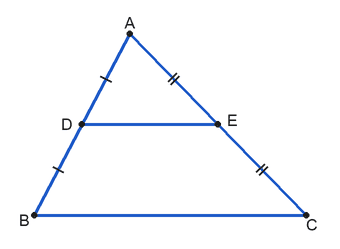
(c) Hence use similar triangles to explain why DE BC.
- 254 marks
Question 25
Bloom's level: Create
Design a method that uses similar triangles to find the width of a river without crossing it.
Describe the points you would mark and the measurements you would take, prove that the triangles you use are similar, and then work out the width for a set of measurements of your own choice.
- 264 marks
Question 26
Bloom's level: Analyse
ABCD is a trapezium with AB DC and AB = 3 DC. The diagonals AC and BD meet at O.
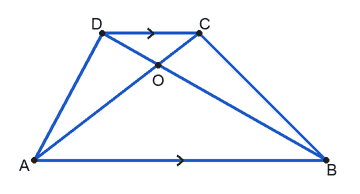
(i) Prove that AOB COD and find the ratio of their areas.
(ii) Find the ratio of the areas of AOD and COD.
(iii) If the area of COD is 5 cm², find the area of the trapezium ABCD.
- 275 marks
Question 27
Bloom's level: Apply
Case study: An engineer builds a model of a water tank to a scale of 1 : 50 to show the town council.
(a) The height of the model is 30 cm. Find the actual height of the tank in metres.
(b) The floor of the model has an area of 200 cm². Find the actual floor area of the tank in m².
(c) The model holds 4 litres of water. Find the capacity of the actual tank, in litres and in m³.
- 285 marks
Question 28
Bloom's level: Analyse
Case study: A street lamp is fixed at the top of a vertical pole 4·5 m high. A girl 1·5 m tall walks on level ground directly away from the foot of the pole.
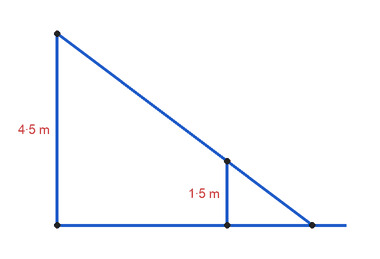
(a) When the girl stands at some point, explain why the triangle formed by the girl and her shadow is similar to the triangle formed by the pole and the far end of her shadow.
(b) Find the length of her shadow when she is 4 m from the foot of the pole.
(c) How far from the foot of the pole must she stand for her shadow to be 3 m long? What do you notice about her distance from the pole compared with the length of her shadow?
- 294 marks
Question 29
Bloom's level: Evaluate
A triangle has sides 3 cm, 4 cm and 5 cm, and an area of 6 cm². Three students make claims about it.
(i) Asha: "If it is enlarged by a scale factor of 3, its perimeter becomes 36 cm."
(ii) Bilal: "If it is enlarged by a scale factor of 3, its area becomes 18 cm²."
(iii) Chitra: "Using a scale factor of 1·2 will make a smaller copy of the triangle."
Judge each claim. Correct any claim that is wrong.
- 304 marks
Question 30
Bloom's level: Create
Your classroom is a cuboid 9 m long, 6 m wide and 4 m high. You want to make a model of it whose floor fits on a board 50 cm by 40 cm.
(a) Choose a suitable scale of the form (with a whole number) and justify your choice.
(b) Find the dimensions of your model.
(c) Find the ratio of the floor areas and the ratio of the volumes of the model and the room, and check your answers using the actual measurements.
- 313 marks
Question 31
In the given figure, , AB = 6 cm and AD = 3 cm.
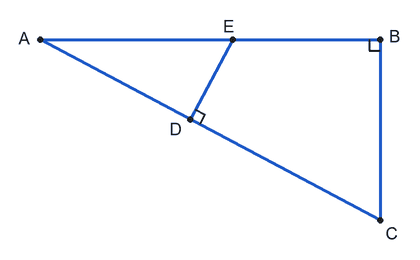
(i) Prove that .
(ii) Find Area of : Area of quadrilateral DCBE.
- 323 marks
Question 32
In the given figure, , PQ = 4 cm and PS = 3 cm.
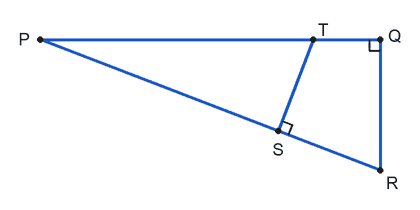
(i) Prove that .
(ii) Find Area of : Area of quadrilateral SRQT.
- 331 mark
Question 33
The model of a building is constructed with the scale factor 1 : 30. If the height of the model is 50 cm, find the actual height of the building in metres.
- 341 mark
Question 34
In the triangles and , and . Which one of the following is a correct statement of similarity ?
- 351 mark
Question 35
The areas of two similar triangles are and . A side of the smaller triangle is 15 cm long. The length of the corresponding side of the larger triangle is :
- 361 mark
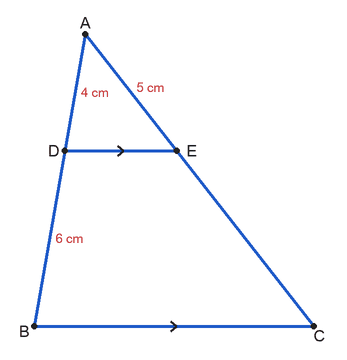
Question 36
In a triangle , the point lies on and the point lies on , with . If cm, cm and cm, then is :
- 372 marks
Question 37
, with cm, cm, cm and cm.
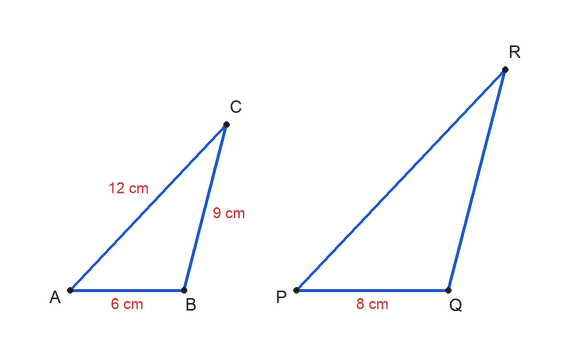
Find the lengths of and .
- 383 marks
Question 38
In the figure, is a point on and is a point on of the triangle , and . It is given that cm, cm, cm and cm.

(i) Prove that .
(ii) Find the length of and the length of .
- 393 marks
Question 39
In the triangle , lies on and lies on , and . If cm, cm, cm and cm, find the value of and the lengths of and .

- 403 marks
Question 40
. The area of is and the area of is .
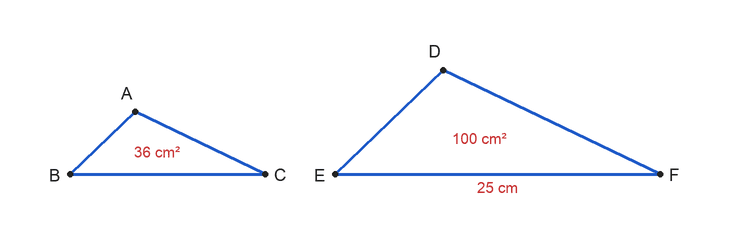
(i) Find the ratio .
(ii) If cm, find .
- 414 marks
Question 41
A triangle has sides cm, cm and cm, and its area is . It is enlarged to a similar triangle with scale factor .
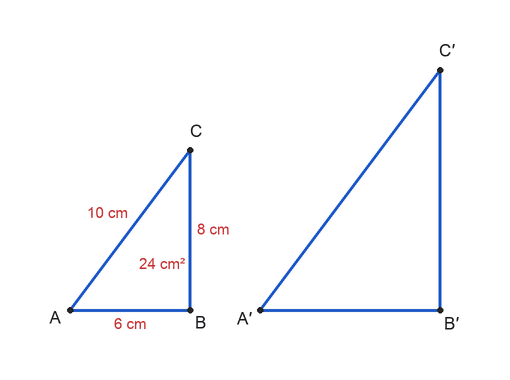
(i) Find the lengths of the sides of .
(ii) Find the ratio of the area of to the area of .
(iii) Find the area of .
- 424 marks
Question 42
On a map, the scale is .
(i) Two villages are cm apart on the map. Find the actual distance between them.
(ii) A road is actually km long. How long is it on the map ?
(iii) A lake covers an area of on the map. Find its actual area in .
- 434 marks
Question 43
is a trapezium in which . Its diagonals and intersect at . It is given that cm and cm.
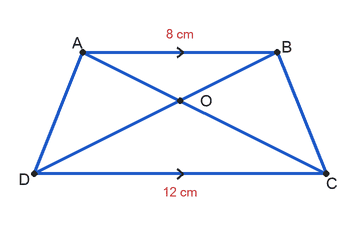
(i) Prove that .
(ii) Find the ratio and the ratio of the areas of and .
(iii) If cm, find the length of .